
Anchoring bias does its damage before the debate looks serious. The first number lands, the room treats it as a reference point, and every later figure is judged by its distance from a starting position nobody earned. The fix is not awareness. It is forcing the anchor into the open as an assumption.
German judges and prosecutors once rolled dice before deciding a shoplifting sentence. The dice were rigged so they could land only on 1 or 9. The people throwing them had, on average, more than 15 years of legal experience. Those who saw 9 gave sentences close to eight months. Those who saw 1 gave about five. The number was irrelevant. It still bent the sentence. That is anchoring bias.
The damage happens before the debate looks serious. Once the opening number feels official, the room starts defending distance from it instead of asking whether it belongs there at all. The Universal Decision-Making Method catches it by forcing that early number into the open as an assumption before the room can mistake influence for judgement.
Anchoring bias is the pull exerted by the first number or reference point, even when it has not earned authority.
Anchoring bias starts before the argument
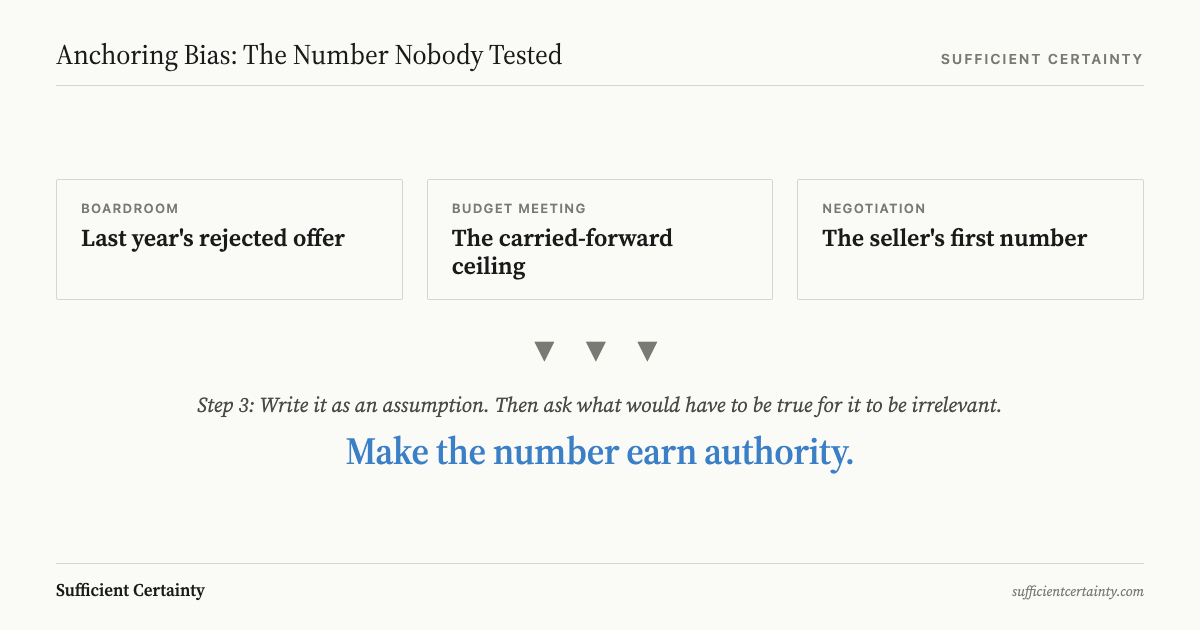
In my experience, I do not need dice to see the mechanism. In an acquisition discussion, someone puts last year's rejected offer on the first slide, as if stale numbers improve with age. In a capital budget meeting, the carried-forward figure becomes the ceiling because the spreadsheet arrived before the thinking did. Nobody says, "I am now anchoring the room." The number appears, and the conversation starts circling it.
Roger Estall and I have seen this for years. I have watched directors inherit a "working range" for an acquisition before anyone had settled whether they were buying market access or merely paying to stop a nuisance competitor. Once that range is on the table, every move is judged as a departure from it. The original number escapes scrutiny because all the scrutiny is aimed at the poor soul who wants to leave the fence.
That is why I treat cognitive biases in decision making as process failures, not character flaws. If nobody names the first number as an assumption, it wins by default.
Why experts still get anchored
The comfortable defence is expertise, and it fails. Northcraft and Neale gave estate agents and students the same property information, then changed the listing price. The agents had, on average, more than 9 years in the field. Their valuations moved with the listing price much like the students' did. Experience did not remove anchoring bias; it made it easier to deny.
The students could at least admit the listing price had tugged at them. The agents were more certain that it had not. That is the expert's trap. Experience gives you a fuller vocabulary for defending the contaminated answer. The explanation sounds more professional, which people often mistake for more true.
That matters in board papers and briefing notes. A recommended range on page 2 is not neutral because a diligent analyst typed it carefully. I have seen directors argue fiercely inside a range nobody had authorised. They thought they were doing due diligence. The real decision had already happened when the paper made the range look official. A range is two anchors wearing a suit. Status is the cheapest anchor in the building. When status wears a name instead of a number, it becomes halo effect bias, and the admired reputation carries the claim while the room calls it evidence.
Reset the number driving your decision and test whether it is evidence or just an anchor. Start the Walk →
Anchoring bias turns influence into evidence
In negotiation, the effect is often deliberate. Galinsky and Mussweiler found that first offers anchored final agreements across several negotiation experiments. The party who made the first offer often shaped the settlement range before the other side had built its own reference point.
Most negotiation manuals treat that as a tactic. I treat it as a warning. The first offer smuggles a guess into the other side's arithmetic. If they accept the range implied by that guess, the negotiation is already half decided while both sides still congratulate themselves on bargaining hard. The defence is your own number, built before the offer lands and tested against the assumptions a settlement figure rests on.
Awareness-only advice is excellent for the people selling awareness-only advice. Bias catalogues and workshop vendors can teach the label and still leave the number in charge, which is a neat business if your income depends on the label rather than the decision. I am all for naming the problem, and the larger job of overcoming cognitive biases does require that. It does not follow that spotting the bias fixes it. The number still has to be dragged into the open as an assumption.
How I test the first number
I test an anchor by asking where it came from and what would have to be true for it to be irrelevant. The second question does the real work. People can usually explain the number's history. They are far less happy imagining the decision without it.
In the Universal Decision-Making Method, this is Step 3: Recognise assumptions. If the room is arguing over an acquisition price before it has settled whether the target is worth owning at all, the anchor already owns the room. I stop the conversation and go back to Frame the decision and Develop options.
Then I ask the Deciders to write the number as an assumption. We are assuming the old budget is still the right ceiling. We are assuming the seller's reserve price has something to do with value. Once it is written that plainly, the number loses some borrowed authority. It can be examined like every other assumption.
I am not against labels. Pages on types of cognitive bias have their place. I simply refuse to pretend the naming was the cure. On difficult decisions I want the assumption written in plain English where everyone can see it. The room changes when the sentence is visible. A director can challenge it without accusing anyone of bias. The argument moves from personal confidence to the thing that must be true for the decision to work.
Sometimes the number survives. That is fine. The problem is unearned deference, not chronology. If the number survives testing, it has become evidence. Before that, it is only influence wearing a borrowed badge.
Anchors are dangerous because they look harmless. One carry-forward cell in a spreadsheet or one opening bid across a table, and the decision starts bending around them. Later everyone explains the bend as judgement. Good decision process is rude to first numbers. It asks what they assume. It asks whether a different starting point would have produced a different answer. If the answer is yes, the number has been steering the decision while pretending merely to inform it.
You could open the meeting with a number and spend the meeting defending it.
Work through your decisionNo sign-up. Just pick your decision and start.
Grant Purdy is the co-author, with Roger Estall, of Deciding (2020), and the architect of the Universal Decision-Making Method.