
Behavioral decision science earns its keep after the syllabus. Naming biases in a workshop changes nothing. Changing who can challenge the call in the room where pressure, status, and fear are doing the real work is where behavioural insight starts producing better decisions.
I once watched a hospital handover where the night registrar had five pages of notes, the day consultant had the scans open, and nobody wanted to be the first person to say the patient was in real trouble. The facts were in the room. So were status pressure and fear. That is behavioral decision science in the only form that interests me.
Hierarchy, not missing information, kept the room quiet. Nobody wanted to be the junior person who made the senior person look slow. When organizations call that a communication issue, they usually mean nobody senior wants the real diagnosis written down. A great deal of organizational machinery is built to protect that instinct, which is splendid if you sell reports and miserable if you own the outcome.
Behavioral decision science is the study of how people actually make choices under uncertainty, and how predictable human tendencies shape judgment long before a formal decision is announced.
The rational model cracked first
I do not need a Nobel syllabus to tell me people do not decide like calculators, but Herbert Simon and the Nobel committee's account of Daniel Kahneman's work made the break official. They pulled the field away from the fantasy that real organizations choose by cool optimization. People choose with limited attention and with a frame already wrapped around the options.
That part matters, but it is only the beginning. In my experience, boards rarely fail because they lacked one more spreadsheet. They fail because nobody wanted to own the ugly part of the call. So they buy another model or another assurance memo. That looks rigorous to the consultant who sold it and to the executive who wants cover. It does very little for the decision.
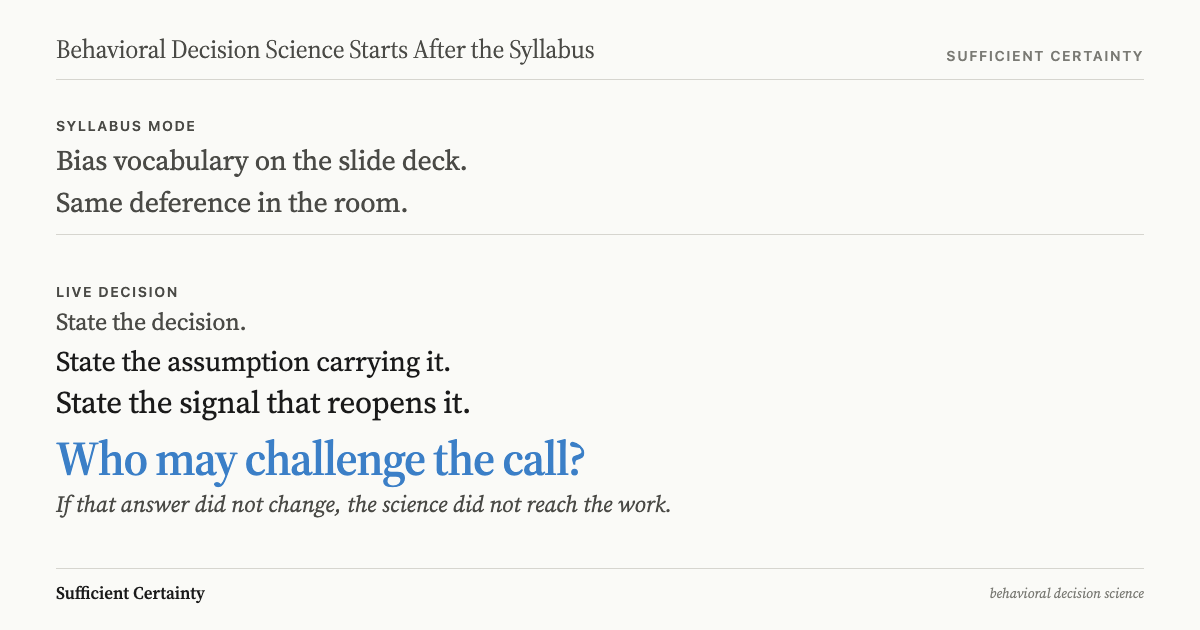
Behavioral decision science matters only when the briefing changes
The useful lesson from the FAA history of Crew Resource Management is simple. Aviation stopped treating deference as professionalism and started treating challenge as part of the job. That is what makes the field worth more than a lecture theatre. Most firms copy the language and skip the permission structure. They want the badge of candor without the inconvenience of being contradicted.
I keep returning to cockpits and operating rooms because both learned the same hard truth. Seniority becomes dangerous when nobody can interrupt it. Roger Estall and I built the Universal Decision-Making Method around that fact. If the room cannot state the decision and the Purpose it serves, it cannot test the call properly.
CRM worked because it changed the briefing and made challenge part of competent work. That sounds obvious until you remember who loses comfort when a junior person can stop the room. Plenty of corporate process is designed to avoid that moment, because embarrassment feels expensive and bad decisions often arrive with enough polish to pass for governance. I have watched committees spend ninety minutes on a call that two people could have settled in ten, and everyone left believing the length proved rigor.
That is where the science of decision making stops being classroom furniture and starts earning its keep. If nobody in the room can challenge the assumption carrying the call, the science has not reached the work.
Bring a live handover decision through the five steps and expose where hierarchy is replacing challenge with a bias label. Start the Walk →
Behavioral decision science does not end with a bias label
Many organizations turn an awkward finding about judgment into training furniture. They teach the vocabulary and call the problem handled. A 2019 systematic review of 61 healthcare Crew Resource Management interventions found that 48 percent did not define their own terms clearly enough for another team to reproduce them. The label spread faster than the behavior. That should worry anyone who thinks sending staff to a workshop counts as changing how decisions are made.
I have seen the same trick with risk registers and decision workshops. The artifact arrives, the behavior does not. Trainers have a course to sell and managers get cover, while the operator facing the real decision is left with the same social pressure as before. Bureaucracies adore that kind of reform because it looks like progress and threatens nobody senior. If behavioral decision science ends there, it has been turned into office decor.
The trap catalog matters less than the structural question. Most writing on cognitive biases in decision making stops at naming the fault. The stronger reviews, including this 2021 overview, keep one distinction clear. Describing how people decide is one job. Changing the process is another.
Once the field gets tamed, the awkward finding dies. Someone leaves with new terminology, nobody leaves with better challenge rights for Tuesday's meeting, and the meeting itself stays exactly as it was. Four cases, from Zillow Offers to the Post Office Horizon scandal, show what that gap costs in decision science examples. I do not call that progress. I call it the academic cousin of a risk register, impressive at a glance and flimsy when the decision bites back.
What I want the field to do in practice
I want four checks handled before commitment. What is the decision? Who owns it?
Then I want the room to say which assumption is carrying the call. I want it to say what signal would reopen the call, and who is allowed to force that conversation before rank hardens into certainty. Those two questions terrify organizations that confuse consensus with quality, because the answers expose who was deferring and who was actually deciding. Anything less and the room is still being run by status.
That is the heart of applied decision science. Roger Estall and I wrote Deciding after watching rooms confuse longer discussion with better deciding. If the reopening signal is missing, uncertainty has not been handled. It has merely been covered with elapsed time.
The decision science overview covers the wider territory. My point here is narrower. I care about behavioral decision science when a nurse interrupts a consultant, or when a board chair asks which assumption is carrying the paper. A glossary and a certificate are easier to invoice, which is precisely why so many organizations stop there.
You could stay quiet in the next handover and let hierarchy decide for you.
Work through your decisionNo sign-up. Just pick your decision and start.
Grant Purdy is the co-author, with Roger Estall, of Deciding (2020), and the architect of the Universal Decision-Making Method.