
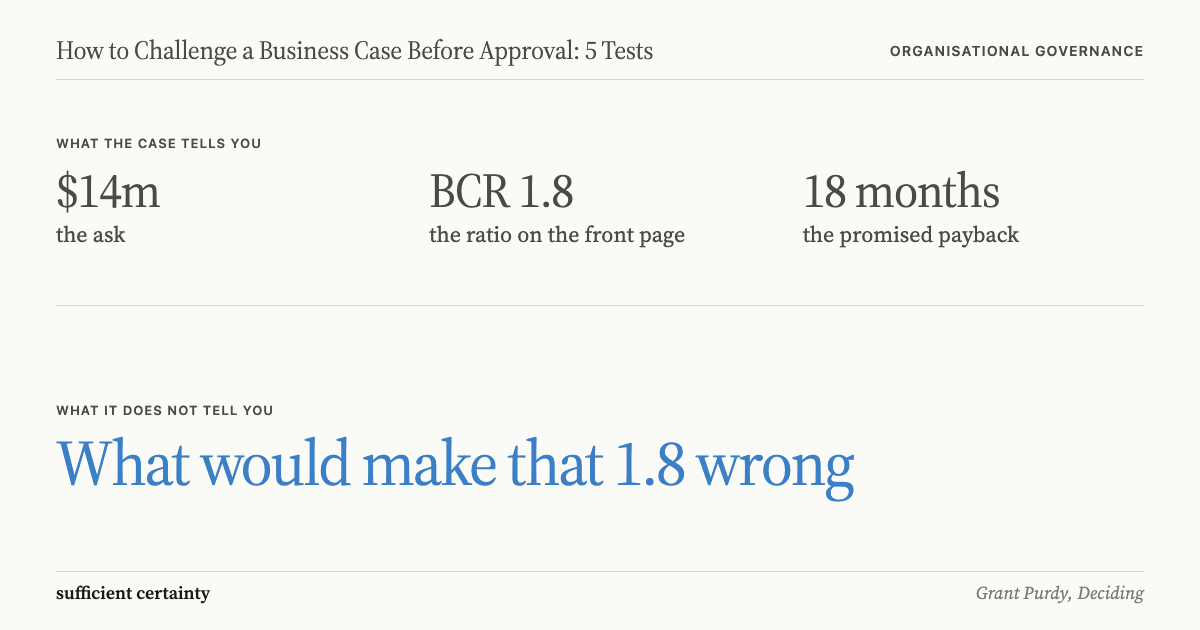
I once had four days to decide whether to approve $14 million. The case ran to 26 pages and promised payback inside eighteen months, with an appendix putting the benefit-cost ratio at 1.8. Nothing in it said what would make that ratio fall apart. That gap is where knowing how to challenge a business case before approval earns its keep, not three quarters later when the money is gone and everyone swears the warning signs were unknowable.
When I walk into a meeting like that, I start with one unfashionable assumption: the paper is trying to sell me something. That is not a criticism. It is the nature of the document. The people asking for the spend want the spend. My job is not to admire the pack. My job is to decide whether the organisation should take the bet.
Challenging a business case before approval is testing whether a proposed spend rests on assumptions you can defend and obligations you can monitor.
What are you actually being asked to approve?
Approval commits the organisation to a spend that will later be judged against results. That is why the HM Treasury approvals process treats approval as a spending-authority decision, and why the guidance on the senior responsible owner keeps accountability with a named person. The paper does not own the spend, a person does.
I have watched boards spend more time checking whether an approval paper ticked every box in the governance framework than asking whether the spend could survive contact with reality. A neat pack and a complete template can create the impression that the hard work has been done. Often the hard work has been avoided. The pack is immaculate, the assumptions are threadbare, and everyone behaves as if stationery has done the thinking.
The cost-benefit ratio matters, but only if the paper is honest about what has to hold for that ratio to stay standing. The Green Book expects options, prior evidence, and explicit optimism-bias adjustments before final approval. I do not care how polished the recommendation sounds if the paper will not tell me which uptake rate, saving assumption, or delivery date is carrying the whole case. A ratio that survives only in good weather is not much use to an approver.
Committees make this worse because they spread the discomfort so widely that nobody feels it properly. The minute then becomes a splendid hiding place. Six sensible people can approve the spend together and each leave the room feeling a little less answerable than they were when they entered.
How to challenge the numbers in a business case
I start with the outside view. Homes England published a worked example on optimism bias and contingency showing that a 10% contingency gave only 35% certainty of delivering on budget. Their P50 uplift was 25%, and they also tested a P80 uplift of 51% to see whether the case still stood. That is the sort of challenge I want in the room. Thin contingency keeps the sponsor comfortable, not the budget safe.
When a sponsor tells me the project is too special to compare with earlier work, I take that as a warning, not an answer. Most disappointing approvals come wrapped in the claim that this one is different. Of course it is different in detail. What is usually not different is human optimism, especially when the room wants the answer to be yes. If you want to know how to challenge a business case before approval without turning the meeting into a quarrel about prose, ask what comparable work says about the numbers before you argue about the spreadsheet cells.
The next test is plainer. I want the point at which the case dies. Show me how far cost can rise, or adoption can fall, before the proposal is no longer worth doing. If nobody can tell me that, the paper is offering one tidy path and concealing the cliff edge. The Universal Decision-Making Method is useful here because it does not ask for perfect certainty. It asks for enough certainty to justify the call, and honesty about what would break it.
Take the case in next week's papers and find the one number its whole benefit rests on. Start the Walk →
Who owns the claimed benefits?
A benefits section full of verbs does not help me unless those verbs belong to someone. The National Audit Office said in 2024 that government had improved at making the investment case and managing cost and timetable, yet was less good at securing intended purpose and long-term value. I have seen the same pattern in private organisations. The paper can be excellent at winning the money and hopeless at naming who will explain the missing value a year later.
In one approval meeting, a service redesign promised a 20% reduction in customer calls inside twelve months. The number looked respectable. What nobody could tell me was who owned that reduction once the program team disbanded. Operations thought the contact-centre manager owned it. The contact-centre manager thought digital owned it. Digital assumed the savings would appear naturally once the new portal launched. That benefit had three admirers and no owner. A week later I asked for the paper to come back with one named person and one date for reporting. Until then, the number was decoration.
I ask two questions and I keep asking them until I get real answers: who owns the claimed benefit, and when do they report back? If the answer is "the business" or "the program", the case is still hiding. If the people chasing the spend are also marking their own approval homework, the challenge is not independent enough to be trusted. That is where a sound governance structure matters, because the approver needs somebody in the room who is still free to say the case is weak.
What approval commits you to after the meeting
A decent approval leaves a live obligation behind it. The guidance on post-implementation reviews gets this right. Before I approve a case, I want to know what will be watched and what result would make us reopen the decision, and I want the timing stated plainly. If the paper cannot answer that, it is asking me for faith, not judgement.
The handover matters. Roger Estall and I wrote in Deciding that accountability does not move into a document just because people have signed it. In this setting, that means the live assumptions and the recheck trigger should travel into the decision record, so the organisation can see later what it actually relied on when it said yes.
When should you send the case back?
I send it back when the paper asks me to rely on confidence instead of a testable claim. That usually shows up when the owner of the benefit is vague and the estimate arrives without an outside view behind it. The other giveaway is that nobody can say what outcome would make us revisit the approval. The follow-up after a business case turns that concern into benefits checks and conditions for continuing the investment. Most of how to challenge a business case before approval comes down to those three tells. I do not need perfect prose. I need a case that can survive an honest question.
If you want the wider frame for where this challenge sits, it belongs inside organisational governance, not in some side ritual performed after the spending mood has settled over the room. The approval meeting is where the organisation either keeps its head or loses it.
I have been told more than once that this sort of challenge slows things down, and sometimes it does. What slows an organisation far more is a bad yes. It ties up money for years, protects nobody from blame, and gives the next approval paper one more shabby precedent to hide behind. I would rather hold up Tuesday's meeting than approve a fantasy on Tuesday and spend the next two years paying for it.
You could approve the spend on Thursday and own the assumption nobody tested.
Work through your decisionNo sign-up. Just pick your decision and start.
Grant Purdy is the co-author, with Roger Estall, of Deciding (2020), and the architect of the Universal Decision-Making Method.