
A governance structure tells you who sits on which committee. It does not tell you who can still stop the decision. The chart earns its place when it shows who owns the call and what evidence would force that call back into the room before the commitment hardens.
When someone hands me a governance structure, I ask one rude question before I study the chart: who can still stop this? I asked it while staring at two pages of committees and assurance lines on a troubled project. Nobody answered. That silence told me more than the diagram did.
Most people still treat structure as architecture. They think a diagram and reporting lines are enough to count as governance. Roger Estall and I spent years on Deciding precisely because the useful question is always the same: who can commit the organisation, and what challenge can send that call back for another look before the loss hardens?
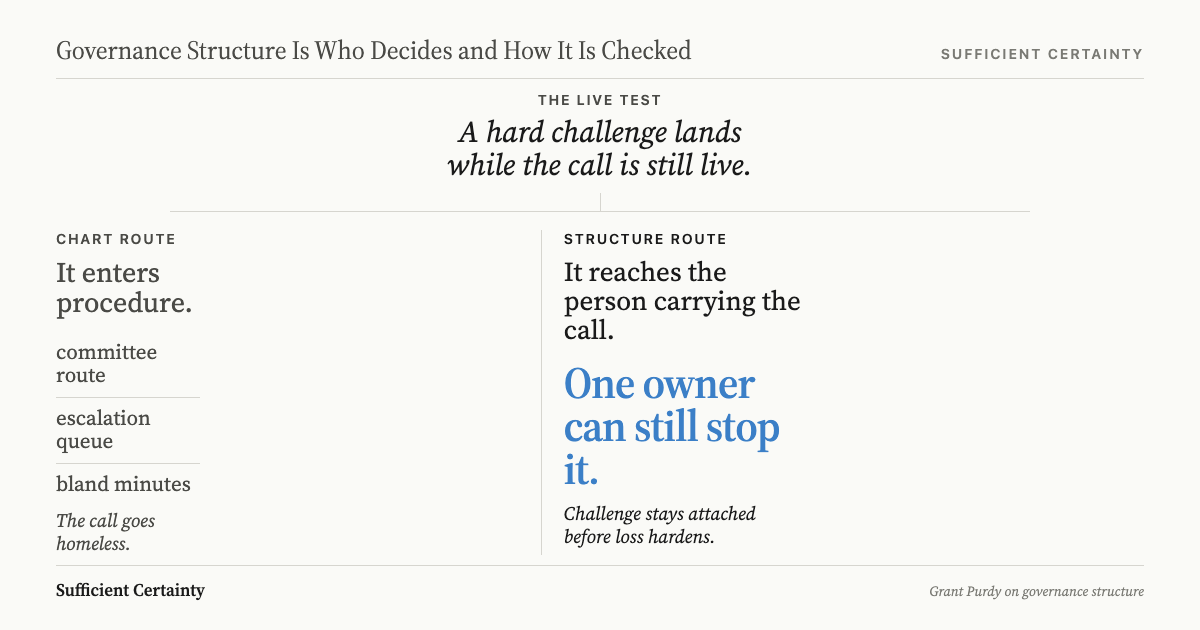
Governance structure is the arrangement that makes one decision owner clear and keeps challenge attached to that owner while the call is still live.
Governance structure on paper still leaves decisions homeless
The structure fails when it creates rooms full of approvers without one person carrying the decision. The Stewart review of HS2 found layers of approval and assurance but no single controlling mind. That arrangement suited secretariats, and the people who preferred escalation to ownership, because delay can always be dressed up as care. It shows up most plainly at the moment of signing, where somebody has to challenge the business case before approval or the structure has decided nothing.
This is how trouble starts before it becomes a public catalogue of governance failures. The machinery looks serious because it produces minutes and another trip upstairs. I have never been impressed by that. Once challenge has to crawl through procedure before it reaches the person with authority, the structure is no longer controlling the organisation. It is protecting the people who built the maze.
When I ask who can stop the decision, I am not asking for the escalation path. I am asking for the person who can say no without booking another meeting. A governance structure that cannot answer that question is built for procedural safety, not organisational control. They suit people who want to stand near the decision without carrying it.
A governance structure starts with one accountable Decider
If nobody can name the person carrying the balance-sheet bet, the structure is already decorative. The Federal Reserve's review of Silicon Valley Bank says the board did not receive adequate information about the bank's risks. Then depositors pulled more than $40 billion in a day. That setup suited management and directors who could hide inside reporting while nobody owned the rate call.
The defect was missing ownership. The live question should have landed on one Decider: are we still sufficiently certain to keep this position on? Instead the challenge dissolved into papers and polite deferrals, the corporate version of everybody nodding while the floor gives way. In my experience, committees are very good at comment and very poor at carrying a bet.
I am unimpressed by a board pack that can describe interest-rate exposure beautifully while nobody has to answer for the position itself. Structure is the route bad news takes to the person who can act, while action is still possible.
Boards sometimes tell themselves the risk committee has this covered. No, it has it described. That is different. A committee can challenge and demand better evidence. It cannot absorb accountability. When the committee becomes the place where ownership goes to die, the structure is only a waiting room for trouble. That is the ordinary shape of a steering committee that will not make the decision.
Mark one board decision on the chart and see whether your governance structure names a decider or only attendees. Start the Walk →
Challenge belongs inside the governance structure
Credit Suisse shows what happens when challenge exists formally but never bites. In its report on the crisis, FINMA recorded 113 high-risk or critical items and still said responsibilities were often inadequately defined. That arrangement suited executives who could treat challenge as correspondence, and advisers who could always recommend another layer because the existing layers paid their rent.
People often muddle this with governance vs management. The structural point here is narrower. Challenge has to land on the person carrying the call. A committee note or a regulator letter changes nothing if the supposed owner can file it and carry on. I have watched organisations confuse challenge with distribution. It is a popular habit when nobody wants the burden of the answer.
I have seen the same dodge in smaller organisations. A memo gets written and tabled, and everyone leaves believing the matter has been handled. It has not. Broken governance structures survive because they let people borrow authority when things are pleasant and return it the moment the decision starts to smell expensive.
Board minutes reveal who actually governs
Board minutes that cannot show challenge exist to flatter the meeting, not to govern the organisation. The joint RBNZ and FMA review found that many minutes did not say enough about how decisions were reached, and that 70 per cent of entities had not undertaken an independent board performance evaluation. That arrangement suited directors who preferred ceremonial oversight, and executives who were happy for hard questions to disappear into a bland record.
Minutes matter because they expose whether challenge had any teeth. A bland minute is not neutral. It protects the meeting from memory. Six months later, when the decision has soured, everyone can point to the tidy record and nobody has to admit that the hard question was never asked aloud.
I do not want more monitoring theatre. I want a structure that ties monitoring to the original call, so the decision can be reopened before the loss is permanent. The Universal Decision-Making Method forces that discipline because it asks who owns the decision and what would force it back onto the table. That is what a board should be able to see in its papers, not a polished record of how civil everyone sounded. The same test applies further down, where making decisions transparent at work means writing the call while it is still open to challenge.
The wider frame sits under organisational governance, and the same structural test applies to change management, but the question here is brutally simple. If the chart cannot show where the stop-handle is, it is not a governance structure. A real structure makes that stop-handle easy to reach, even when pulling it is awkward and expensive. Otherwise you are just building a corridor so challenge gets lost before it reaches the valve.
You could redraw the chart again and still leave the real decision owner missing.
Work through your decisionNo sign-up. Just pick your decision and start.
Grant Purdy is the co-author, with Roger Estall, of Deciding (2020), and the architect of the Universal Decision-Making Method.