
Change management frameworks each assume a different root cause. Kotter assumes the organisation lacks urgency. ADKAR assumes individuals lack readiness. Lewin assumes the status quo needs destabilising. Diagnosing which problem your rollout actually faces comes before picking a framework, not after.
Change management frameworks share one structural gap. They tell you how to manage the transition after the decision has been taken. None tests whether the decision was sound, whether the assumptions behind it still hold, or what would require a course change. A framework that starts after the commitment is a delivery tool, not a decision tool.
Last year I sat with a program director at a mid-size manufacturer. Her ERP rollout was running across fourteen sites, three months in, and two regional teams had stopped entering data into the new system. They were filing orders on spreadsheets, quietly, as if nothing had changed. Her general manager had asked the question that always arrives at this stage: "What methodology are we using?"
She had spent six weeks comparing change management frameworks. Kotter’s eight steps on one slide. ADKAR’s five elements on another. Lewin’s three phases on a third. She wanted me to tell her which one to pick.
I told her she was asking the wrong question.
The question was not which framework to adopt. The question was why those two teams had reverted to spreadsheets, and what that told her about what they believed they were about to lose. Until she answered that, no model would help. After she answered it, the right model was obvious.
I have been asked this question, or a version of it, in nearly every sector I have worked in over fifty years. The answer has never been a model name. When somebody asks which change management framework to use, the honest answer is almost always a second question: what is failing right now, and why?
This is the pattern I see repeatedly in change management work. Organisations treat model selection as the first decision. It is not. It is the second. The first decision is a diagnosis.
A change management framework is a structured sequence of interventions designed to move an organisation from its current state to a chosen target so that the change is adopted rather than merely announced.
The 70% myth and why it poisons model selection
Most conversations about how to choose between Kotter, ADKAR, and Lewin begin with the same statistic: 70% of change initiatives fail. That number has been repeated so often it feels like settled science. It is not.
Mark Hughes reviewed the five most-cited sources for the 70% claim and found that none of them provided valid, traceable evidence. One source was a magazine article. Another was a book that cited the magazine article. McKinsey’s own 2008 global survey, often invoked in support, reported an outright failure rate closer to six per cent.
This matters for model selection because the fabricated statistic creates false urgency. If seven out of ten rollouts fail, choosing the “right” model feels existential. Consultants position their preferred framework as the difference between the 30% and the 70%. But if the actual failure rate is far lower, the decision is not about survival. It is about fit.
Rune Todnem By’s critical review of organisational change theory, cited more than 1,375 times, concluded that the major theories are “often contradictory, mostly lacking empirical evidence.” That finding has not changed in two decades. The models we are comparing were never validated the way their popularity suggests.
What each framework assumes about your rollout
Kotter assumes your problem is organisational momentum. His eight steps begin with “create a sense of urgency,” which works when people are complacent. But Teczke and colleagues showed in a 2022 study that urgency-creation backfires when resistance is identity-based. If your regional teams are not complacent but frightened, telling them the building is on fire makes them run faster in the wrong direction.
ADKAR assumes your problem is individual readiness. It sequences a person through five adoption elements: awareness, desire, knowledge, ability, and reinforcement. Prosci’s own comparison positions ADKAR at the individual level and Kotter at the organisational level. That distinction is useful, but neither framework handles the case where resistance is collective and rooted in group identity. A team that sees itself as “the people who do it properly” will not be moved by individual awareness campaigns or organisational urgency.
Lewin assumes stable start and end states. You unfreeze the current behaviour, introduce the change, then refreeze into a new equilibrium. Hussain and colleagues’ critical review of Lewin’s model identified the core weakness: “refreeze” is unrealistic in turbulent environments. If your organisation is managing three overlapping transformations, there is no stable state to freeze into. Lewin gives you a clean diagram and an impossible instruction.
Each framework presupposes a specific type of problem. Pick the wrong one and you are solving someone else’s rollout, not yours.
Name the assumption your chosen framework makes about why people will adopt the change, and test it against what the front line actually said. Start the Walk →
Diagnosis before selection: what the resistance pattern tells you
Stouten, Rousseau, and De Cremer’s review in the Academy of Management Annals found that most prescriptive change models lack empirical validation and skip diagnosis entirely. They overpromise because they begin with a solution architecture and retrofit the problem to fit it. I have watched this happen dozens of times: a consultancy arrives with a methodology already chosen, then interprets every symptom as evidence that their methodology is the right one.
The alternative is to start with what is actually happening. Three diagnostic questions sort the resistance pattern before any change management framework enters the conversation.
What do people believe they are about to lose? William Bridges’ Transition Model distinguishes change (the external event) from transition (the internal psychological process). Resistance is often a grief response to loss, something I see regularly in transition management work. If your teams are mourning expertise that the new system makes irrelevant, that is a different problem from ignorance about what the new system does.
Is the resistance individual or collective? If individuals are struggling with new processes, ADKAR’s sequence makes sense. If an entire team is resisting as a unit, protecting its identity, you are dealing with something that individual-level interventions cannot reach.
Is your environment stable enough for a phased model? If you are mid-rollout and the scope is still shifting, both Lewin’s three phases and Kotter’s eight steps assume a linearity you do not have. You need something that accommodates iteration, not a model that demands sequential completion.
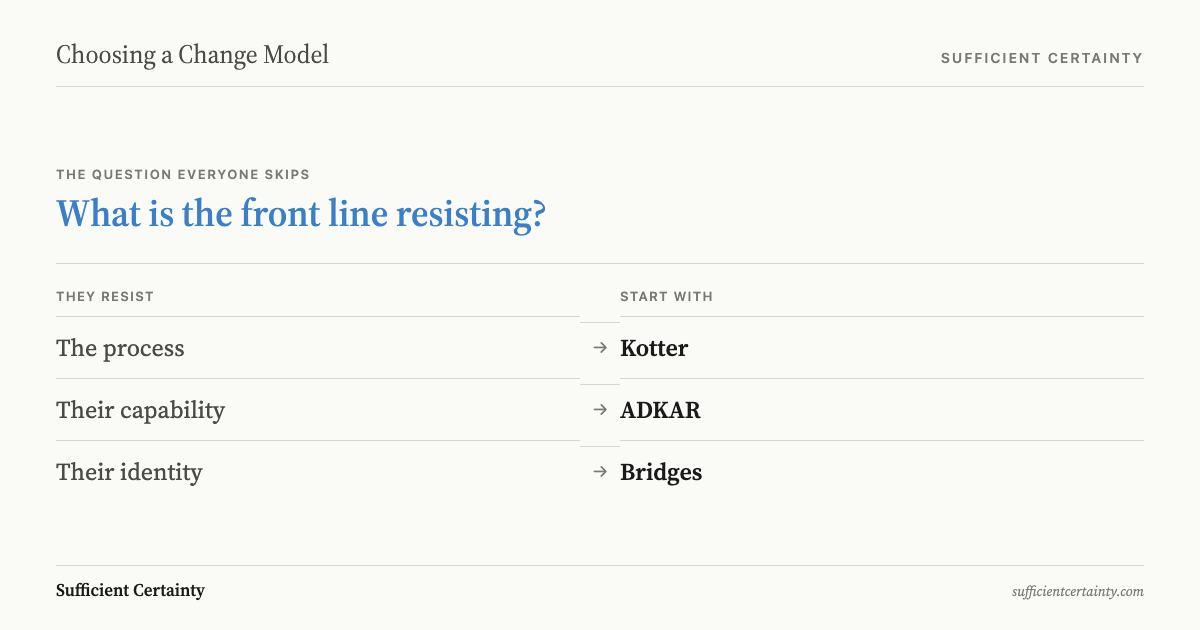
Notice that none of these questions mentions a model name. The diagnosis is framework-agnostic. Once you have the answers, the match follows: individual skill gaps point to ADKAR, organisational momentum problems point to Kotter, and identity-based resistance needs direct conversation, not a framework.
The program director I mentioned had a collective identity problem. Her regional teams were not confused about the ERP system. They were skilled operators who believed the new system would expose them to errors they previously caught by hand. Their resistance was rational. Once she saw that, she stopped comparing frameworks and started having conversations about what “doing it properly” would look like in the new system. The model she eventually chose was secondary to the diagnosis that made it possible.
What every change management framework skips
SI Labs warns against what they call “framework fetishism” and recommends running a Force Field Analysis before selecting any model. That advice is sound. But it still treats model selection as the destination, with diagnosis as a preliminary step. I would go further.
The comparison itself is the wrong unit of work. When a senior leader asks “what methodology are we using?” they want a label for a slide. The label gives the appearance of rigour. It signals that someone has thought this through. But adopting the visible architecture of a framework is not the same as changing how decisions get made. Roger and I wrote about this in Deciding: organisations adopt the trappings of a structured approach without changing the underlying behaviour. They talk the walk but do not walk the walk.
What matters is whether the people running the rollout have identified the assumptions they are making about why people will adopt the change, and whether those assumptions have been tested. That is what a change management plan should force before it schedules a single workshop. That is not a Kotter question or an ADKAR question. It is a question about the quality of the decision to proceed.
The Universal Decision-Making Method starts here: with the assumptions beneath the decision, made visible and examined before resources are committed. Assumptions are far more likely to be properly understood if they are articulated, rather than left as background beliefs nobody examines. The method we use to structure decisions surfaces those gaps before they become resistance. No change model I have encountered includes that step.
What to tell the steering committee
If you are the person who has to defend a methodology choice to your senior leader next week, here is what I would do.
Stop comparing models. Write down, in plain language, what you believe is causing the resistance you are seeing. Not what a framework says should be causing it. What you are actually observing. Then ask three people closest to the front line whether your description matches their experience.
If the resistance is individual skill gaps, ADKAR gives you a useful sequence. If the resistance is organisational inertia at the leadership level, Kotter’s coalition-building steps are practical. If the resistance is identity-based, neither model addresses it directly, and you need conversations that no framework will script for you.
Present the diagnosis, not a brand. A defensible rationale for the committee is not “Kotter is best practice.” A defensible rationale is: “We spoke to the front line. The resistance is identity-based. Here is the evidence. Bridges addresses that pattern. Kotter would make it worse.” The committee will accept it because it rests on what their own people said, not on what a textbook recommended.
Then tell your senior leader the truth: the change management framework matters less than the diagnosis. The rollout is not fragile because you picked the wrong framework. It is fragile because something in the organisation was not understood before the change began. Fix the understanding and the model question answers itself. A structured decision method makes that understanding its starting point.
Monitoring matters here as well. Whichever framework you select, it has no value unless someone competent is watching whether the assumptions behind it hold, and is authorised to change course when they do not. Most rollouts I have seen do not fail because the wrong framework was chosen. They fail because nobody was watching the assumptions that made the framework selection seem reasonable in the first place.
You could compare every framework on the slide and still miss what the front line is actually resisting.
Work through your decisionNo sign-up. Just pick your decision and start.
Grant Purdy is the co-author, with Roger Estall, of Deciding (2020), and the architect of the Universal Decision-Making Method.