
Force field analysis maps the forces pushing for and against a change. The useful question is not which column is longer but whether the strongest restraining force reveals an assumption the sponsor has not examined. When it does, the honest next step is to pause the change, not to add more arrows.
Force field analysis maps driving and restraining forces around a change. That map is useful when it shows which restraint could block the commitment and which driver the decision depends on. It is not useful when the team populates both columns, tallies a score, and treats a net positive as permission to proceed without testing the assumptions underneath.
I sat through a two-hour workshop with a sponsor, two line managers and a consultant while a whiteboard filled with arrows. By the end we had fourteen sticky notes on driving forces, nine on restraining forces, and a photograph on somebody’s phone that would later be filed as evidence of serious work. Nobody had answered the question that brought us into the room: should the change still go ahead? Most force field analysis example pages stop at that photograph.
They show you how to score the arrows, tidy the diagram, and push the change through with a straighter face. In my experience, the map is only worth the ink if it can tell you to pause or stop, because when the strongest restraint sits in governance, authority or operating reality, pushing harder does not fix it; it just disguises a weak decision as a change program.
Force field analysis is a way of mapping the forces pushing for and against a proposed change so a team can judge whether the change is workable.
Most force field analysis examples stop at the whiteboard
That incompleteness is built into the way most people use the tool. Swanson and Creed revisited Lewin and pointed out that the field morphs as the change unfolds; a force that looked helpful on Monday can become an impediment once the work lands in ordinary operating life. The neat two-column sheet makes the meeting feel controlled, which is useful if your real objective is to survive the steering committee, but it still does not answer whether the strongest restraint is survivable.
The 2021 health-systems study matters because it shows how easily “resistance” gets mislabelled. Experts said the main restraint was weak organisational support; managers said the block sat outside their authority. I have sat with sponsors who called a missing data cleanse or a missing decision-rights fix “resistance” because that wording kept the embarrassment off the program board. That is not insight; it is a relabelling exercise. Resistance carries diagnostic data about the decision, not the people asked to live with it.
Rewrite each major force as an assumption. Ask what must stay true for the change to work, and who can act when it stops being true. If nobody in the room can answer the second question, the map has not settled anything, and the readiness test needs to get stricter before the work is blessed. That is also why I pull the exercise back into the Universal Decision-Making Method, because Sufficient Certainty is harder to fake than a page of arrows.
A completed workshop sheet creates false comfort. The sponsor gets a picture of diligence, the consultant gets an artefact, and the operators get the cut-over, which is a splendid distribution if you judge success by who escapes the meeting with status intact. In my experience, the map earns its keep only when it changes the decision or the design before the organisation sends other people to wear the cost.
Name the strongest restraining force on your whiteboard and write whether it sits inside or outside the authority of anyone in the room. Start the Walk →
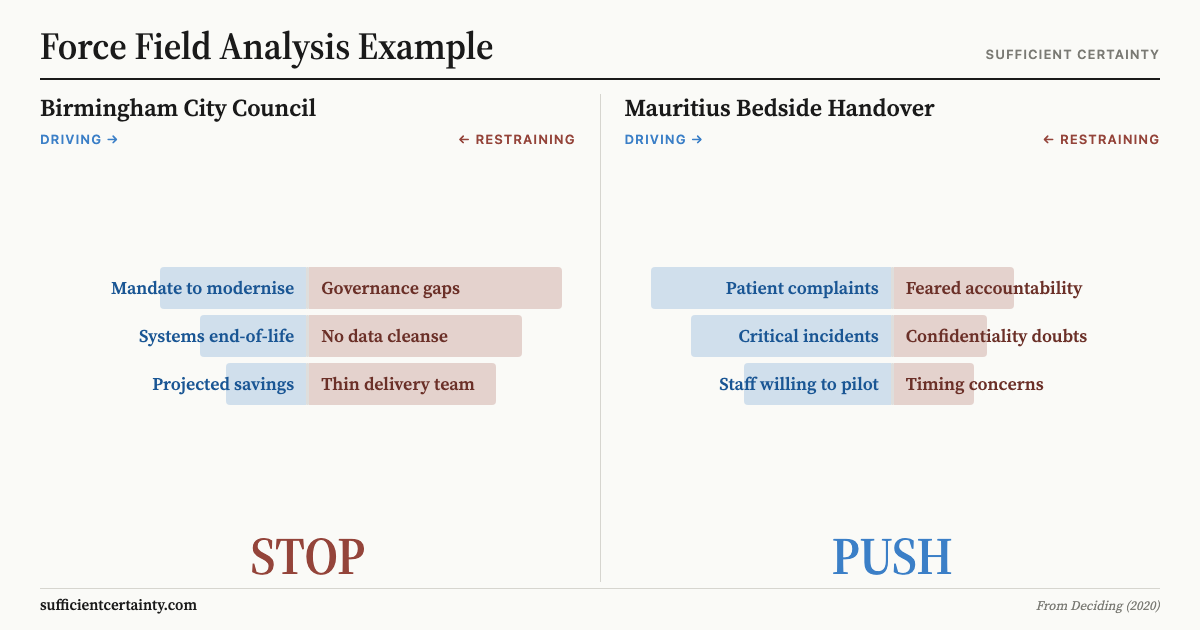
A force field analysis example from Birmingham said stop
Birmingham City Council’s Oracle program is the force field analysis example I would put in front of any team that thinks resistance is mostly emotional. According to CIO’s summary of the Grant Thornton audit, a phase-one budget that began at GBP19 million had grown to more than GBP90 million once reimplementation costs were counted. Those were not awkward feelings on the shop floor. The restraining forces were sitting in governance, data quality and delivery capacity before anybody could honestly say the program was fit to push.
| Driving → | ← Restraining |
|---|---|
| Mandate to modernise | Governance gaps |
| Systems end-of-life | No data cleanse |
| Projected savings | Thin delivery team |
STOP
Computer Weekly reported on 2 February 2026 that the wider forecast through 2027/28 had reached GBP144 million, that the planned July 2026 go-live could slip to September 2026, and that auditors still saw a low but real abandonment risk. I have chaired reviews where people wanted to repair that kind of picture with extra briefings and a brighter comms plan, which is fantasy when a change depends on clean data and competent oversight because those are conditions of feasibility, not attitude problems.
Once you state the forces plainly, the verdict sharpens. A thin integration team can sometimes be reinforced; an absent data cleanse cannot be wished into existence by urgency, and a project team cannot manufacture authority it does not have. That is the line force field analysis is supposed to draw: the difference between a restraint you can reduce and one that sends the decision back to its owner.
This is the point the broader change management guide has to keep making. Once the map shows the block sits in governance or data integrity, the workshop is over and the decision goes back upstairs; organizational change management can support a sound decision, but it cannot launder a bad one into a good one.
A force field analysis example from Mauritius said push
The bedside handover case from Mauritius points the other way, which is exactly why it matters. In a 28-bed gynaecological ward with 21 nurses, the old office-style handover had contributed to complaints and critical incidents, and the team used force field analysis to shift to bedside handover. The restraining forces were explicit: staff feared accountability, doubted confidentiality, and worried the timing would not work on real shifts, which made them real objections but still local ones.
| Driving → | ← Restraining |
|---|---|
| Patient complaints | Feared accountability |
| Critical incidents | Confidentiality doubts |
| Staff willing to pilot | Timing concerns |
PUSH
The ward did not answer those objections with pep talks. It changed the protocol, piloted the new handover, and supported the nurses while the test ran; five of the six handover criteria were later met every time, the sixth 90 per cent of the time, and interviews with 40 patients produced 96 per cent overall satisfaction. That is why this force field analysis example deserves a push verdict and Birmingham does not: the strongest restraints were inside the team’s control and yielded when the design changed.
In plain English, if the block is confusion, clarify the work, and if the block is missing capability, build it or stop; that is what a change management plan is for when it is any good, because the plan should answer the real objection instead of reciting activities at it.
The only useful question is whether the strongest restraint is survivable
When I use force field analysis, I drag it through the five steps rather than leaving it on the wall. First, Frame the decision so the room is clear what is actually being proposed. Then Develop options and Recognise assumptions until the heaviest restraint is stated as a condition that must hold. Only then can we judge Sufficient certainty, because a force that cannot be reduced in time is not an implementation detail; it is a reason not to proceed.
Appendix D in Deciding gives Roger Estall and me the practical move I want here. We rewrite the important uncertainties as assumptions about context, then test their significance, how quickly they could change, and whether the warning signs would show up in time to matter. A force field analysis example becomes decision-useful only when one row on the page is allowed to reopen the whole change.
The fifth step, Design monitoring, is where most workshop versions collapse. Swanson and Creed were right that forces morph; a sponsor can become a blocker once early concessions pile up, and a sceptic can become useful once design faults are admitted. In my experience, if the map does not say what you will watch, who will notice drift, and who can reopen the decision, it is not a decision tool at all, which is why monitoring belongs in the original design rather than in the post-launch autopsy.
Use the diagram if you like, but if the strongest restraint sits outside your authority or will not yield before the change lands, stop there and send the decision back to its owner, because the price of pretending otherwise gets paid by the people who have to run the thing.
You could map every force on the whiteboard and still leave no one able to say whether the strongest restraint is survivable.
Work through your decisionNo sign-up. Just pick your decision and start.
Grant Purdy is the co-author, with Roger Estall, of Deciding (2020), and the architect of the Universal Decision-Making Method.