
ADKAR describes five stages a person moves through during change. It does not test whether the change was a sound decision in the first place. If the decision to change rested on an assumption nobody examined, the five stages will execute a rollout that should never have started.
ADKAR names five conditions a person must meet before a change takes hold: awareness, desire, knowledge, ability, reinforcement. That sequence is useful for diagnosing where an individual is stuck. It is not useful for deciding whether the change itself was the right commitment. Most ADKAR implementations track adoption without ever testing the assumption the change depends on.
ADKAR was never going to save TSB's 2018 migration. The bank had spent more than four years preparing and ran nine dress rehearsals before moving five million customers onto a new platform. About 80,000 customers still switched out. TSB also recorded about 204,000 complaints. Its post-migration costs reached GBP330.2 million in 2018.
That is the first thing I would say to anyone told to use the model as if the acronym itself can rescue a bad call. It helps once a change has been chosen. It does nothing to answer whether the change, in this form and at this time, deserved commitment.
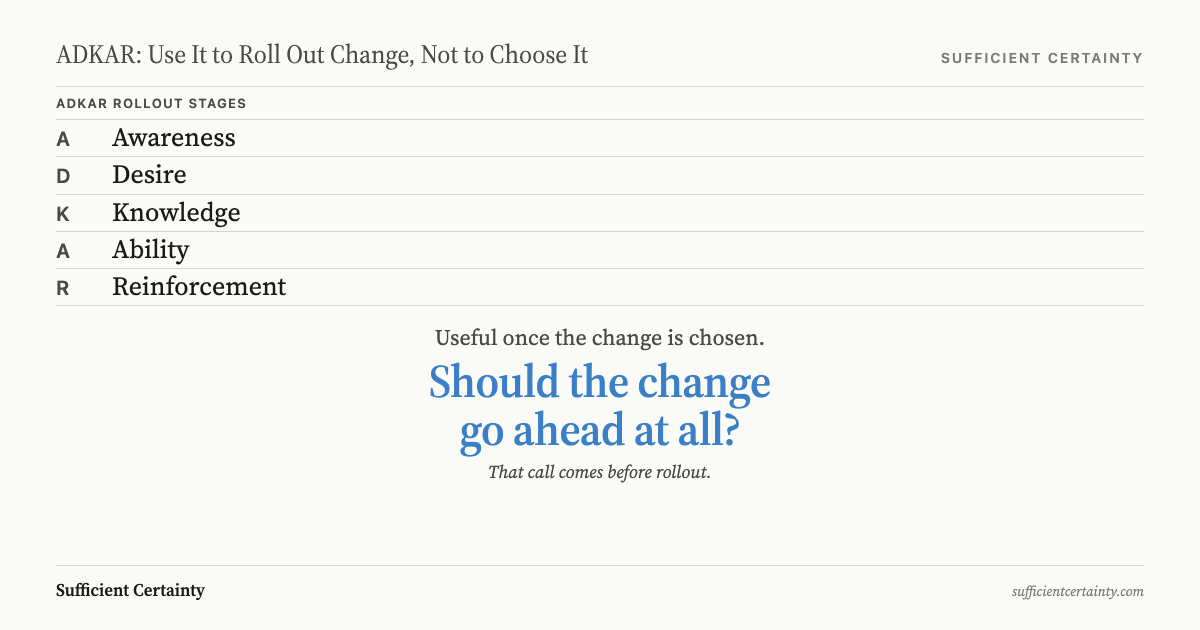
The five stages are Awareness, Desire, Knowledge, Ability, and Reinforcement. Each one targets a different reason people stall during a transition. What none of them targets is whether the transition deserved commitment in the first place.
ADKAR is a five-stage change model for helping people adopt a chosen change after the decision has already been made.
What ADKAR does well
The model does one job well. It helps you find where adoption is stalling once the organisation has already chosen its course. People may understand the announcement and still not want the change. They may want it and still fail under live conditions. That is useful for the manager who has to turn a program into daily work.
Prosci sells adoption, so of course it defines the model as an adoption tool and stops there in its 20 August 2025 note on the distinction between a model and a methodology. That is not a scholarly boundary. It is the edge of the product. Even so, the practical point is sound enough. If your staff have the will but not the know-how, ADKAR can help. If your managers nod in meetings and then refuse to back the rollout, it can help there as well.
This is why I do not throw it in with empty stakeholder buy in language. Used honestly, the model can force someone to say where the blockage really is instead of calling every objection resistance.
Where the model breaks down
It breaks down when the real trouble sits upstream of adoption. If the business problem was badly framed, or the preferred solution rested on fantasy, no amount of awareness work will rescue it. You are no longer dealing with a people-transition problem. You are dealing with a weak decision being carried forward by a polished rollout plan.
The point in the UK National Audit Office report on digital change, published on 21 July 2021, is simpler than the report's wording: if nobody understood the business problem, the rollout was dead before anyone wrote the first briefing. The report makes clear that underperformance often begins before delivery because key technology choices were not thought through properly. The model does not repair that.
This is also why sponsors misuse the model so often. It gives them a respectable place to stand while they avoid reopening the main decision. Once the program has a name, a sponsor deck, and a training plan, doubt can be relabelled as poor buy in. That is convenient for the people who approved the change. It is dangerous for everyone else, because the cost of a weak decision is pushed downstream onto people who never chose it.
TSB is the cleaner case because the bank did many of the things change programs like to wave about. The independent review published on 19 November 2019 said stronger supplier oversight and harder questions about testing could have changed the outcome. Those are not failures of staff attitude. They are failures of assumption testing and go-live judgement.
The National Audit Office review of the NHS program, published on 15 May 2020, points to the same pattern. The earlier National Programme for IT consumed an estimated GBP9.8 billion and still failed to deliver key benefits. Weak clinician support mattered, but the larger problem was a top-down technology push that never reckoned properly with the work itself. People blame adoption because it is tidier than admitting the original call was weak.
Take the change you are rolling out through five steps and test whether ADKAR is carrying a bad decision forward. Start the Walk →
ADKAR cannot tell you whether the change was worth making
By the time you get to awareness, the main decision has already been smuggled through. The live question is no longer whether the change deserves carrying. The live question is how to make people carry it. That confusion runs through the wider change management argument, and it is sharper in organizational change management because support work can start protecting the very decision it should be testing. Activity looks like progress. Reopening the underlying bet looks like trouble.
J.C. Penney gives the non-technology version. In its 27 February 2013 results filing, the company reported that full-year sales fell 24.8 per cent, comparable sales fell 25.2 per cent, and the net loss was USD985 million. A company can drive adoption hard and still march its people into a bad bet.
What follows is the usual protection racket: sponsors, project staff, and consultants counting sentiment scores so nobody has to reopen the original bet. They can wave training completion and pulse surveys all day. The real question sits untouched: what had to be true for this change to work, and how sure were we?
How I would use it without letting it run the show
Before anyone builds a rollout plan, I want the decision framed in plain English. Why does this change exist? What outcome is it meant to secure? How long must that answer hold before the context makes it foolish? Those are operational demands. If the room cannot answer them, it has no business discussing reinforcement plans.
Roger Estall and I built the Universal Decision-Making Method to sit before rollout machinery starts breeding paperwork. The sequence is exact: Frame the decision, Develop options, Recognise assumptions, Sufficient certainty, Design monitoring. The model belongs after that sequence. First test the change. Test the assumptions carrying it. Decide how much certainty this setting actually needs. Then use ADKAR for the practical work of helping people live with a decision that has already survived scrutiny.
I would rather have an ugly argument early than a beautiful rollout plan late. The first may bruise egos. The second burns money. If a warehouse lead, branch manager, or clinician can show me that the new process collapses under real conditions, I want that before the program is wrapped in adoption language. Once the language hardens, bad decisions become harder to stop because too many careers are tied to pretending the premise was settled.
I also do not treat pushback as a morality play. Sometimes resistance is fresh evidence from the work itself. A plant supervisor saying the new process will fail on night shift may be giving you the most valuable information in the building. I wrote more about that in managing disagreement in teams.
That is also why I tie every rollout back to monitoring. If the assumptions were wrong, I want to see it early, while the damage is still containable.
So use ADKAR for rollout. Do not ask it to certify the decision it inherits. If the room wants an adoption acronym before it wants a judgement, the organisation is already halfway to explaining a failure it has not had yet.
I insist on that order because once adoption work starts before judgement work is finished, the tool stops helping and starts excusing. That is how respectable projects drift into failure while everyone stays busy and defensive.
You could use ADKAR for rollout and still never test the decision it inherits.
Work through your decisionNo sign-up. Just pick your decision and start.
Grant Purdy is the co-author, with Roger Estall, of Deciding (2020), and the architect of the Universal Decision-Making Method.