
Collaborative decision making examples that teach anything useful share one feature. A named person owned the call. The group tested the assumptions beneath it, not the mood. When examples skip ownership, they describe pleasant workshops that produced agreement nobody monitored and nobody was held to afterwards.
Collaborative decision making examples that teach something useful share one feature: a named decider drew on the group's knowledge without surrendering authority to the group's comfort. The cases people remember are not about consensus. They are about a structure that surfaced the right expertise at the right moment and let one person commit.
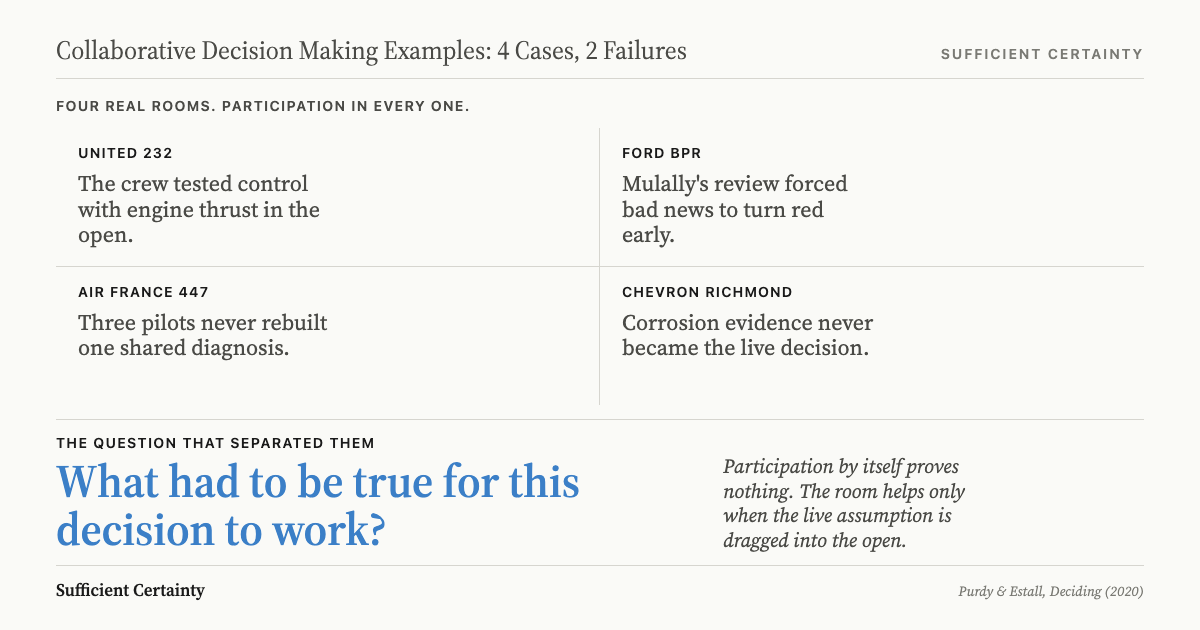
On 19 July 1989, United 232 lost all three hydraulic systems with 296 people aboard. Captain Al Haynes had help in the cockpit, including an off-duty training captain. They tried the absurd idea of steering a crippled DC-10 with engine thrust and got 185 people out alive. On 1 June 2009, Air France 447 had three pilots, plenty of training, and 228 people died after the crew lost any shared picture of what the instruments meant. Those are collaborative decision making examples I take seriously, because the outcome tells me whether the group sharpened the judgement or merely made the room feel useful.
Most advice pieces dodge cases like that because toy scenarios are safer than wreckage and an outcome nobody can massage after the fact.
Collaborative decision making examples are real cases that show how a group contributed to a choice and whether that contribution improved the outcome.
Examples without outcomes teach you nothing
Examples without outcomes are decorative. If all you can tell me is that everyone spoke and the meeting ended on time, you have described a meeting, not a decision. A case without consequences tells me nothing about the quality of the judgement. I trust a case only when I can see what the room assumed and what happened when the world pushed back. I do not care whether the flip chart was full if the live assumption stayed untouched.
I am severe on process diagrams for the same reason. A neat collaborative decision making model can still hide a bad call if nobody owns it and nobody tests the live assumption underneath it. Once the test becomes "did everyone participate?", the decision can fail and the meeting still gets marked as a success. That is how useless machinery stays in service for years. That softer standard suits facilitators and governance staff. It also suits the in-house 'risk' people, because the workshop survives and the owner blurs out of view, which is very convenient if your department lives on workshops.
Collaborative decision making examples that worked under pressure
United 232 worked because collaboration sharpened one person's judgement instead of dissolving it. In the NTSB's accident report, the board explicitly credited cockpit resource management and the off-duty pilot's assistance as central survival factors.
The off-duty pilot was Dennis Fitch, a training check airman who happened to be in first class. He came forward, knelt between the seats, and took over the throttles because the control surfaces were gone and differential thrust was the only steering input left. For thirty-four minutes that crew tested an idea no simulator had ever rehearsed and no manual described. Haynes kept the call and kept asking for ideas. Nobody stopped to protect feelings or wait for a completed options paper. They ran a rough idea against the aircraft and kept learning from the response.
Ford under Alan Mulally is the business version. In his interview with McKinsey, Mulally described a weekly Business Plan Review where leaders came in with the same facts and had to show red when something was off. The first executive to show red was Mark Fields, who flagged the Edge launch as delayed because of a technical problem. The room went quiet. Mulally thanked him.
That single response told the organisation that surfacing bad news was safer than hiding it. Ford then reported full-year 2009 net income of $2.7 billion, a $17.5 billion improvement on 2008. Large companies do not usually die from a shortage of meetings. They get hurt because bad news arrives after the forecast has hardened and the people in charge have started defending it. I care about one rule in Mulally's room: red had to appear early, while it was still cheap.
Run your own team decision against these cases and see where shared input helps the call or hides it. Start the Walk →
Examples that failed in plain sight
Air France 447 failed because the cockpit never rebuilt the problem in plain language. The BEA's final investigation said the crew never made the link between lost airspeed data and the required procedure, and surprise weakened the way they shared the work.
The first officer pulled his side-stick fully back for nearly the entire descent without announcing it. The captain returned from a rest break with less than ninety seconds of flight remaining and never received a plain statement of what the aircraft was doing. Three pilots were present, yet the aircraft never got one shared diagnosis. Headcount helped nobody because nobody forced the conversation back to the actual aircraft. In my experience, this is how groupthink usually arrives: several capable people carrying different private stories and nobody forcing the decision back into one frame.
Chevron Richmond failed for the same reason in overalls rather than uniforms. The Chemical Safety Board report found that multiple internal groups had evidence of severe corrosion, but the refinery treated continued operation as normal, so the false assumption that the pipe could wait survived right up to rupture.
The pipe was a carbon steel line installed in 1976. Inspections years earlier had measured wall thickness well below the minimum safe level, yet the unit kept running without replacement because no single group owned the decision to shut it down. Six workers were engulfed in a vapour cloud before ignition and about 15,000 nearby residents sought medical treatment after the fire. The plant had process and technical staff. What it lacked was a decision that treated the corrosion evidence as live. In big organisations, normality is a dangerous defence. Leave a problem untouched for long enough and someone will start calling that discipline.
What these cases actually prove
These cases make one thing plain: good groups drag the live assumption into daylight while it is still cheap to change course; bad groups let procedure keep it hidden until reality sends the invoice. Roger Estall and I wrote Deciding because of cases like these. The Universal Decision-Making Method forces a room to state the call plainly and recognise assumptions before process turns into cover. Collaborative decision making works only when that happens.
Before I trust any room that calls itself collaborative, I ask two rude questions. Who can still say yes or no when the meeting ends? What had to be true for this decision to work, and who is watching that after Tuesday? Most rooms hate the first question because it exposes whether the owner is real or decorative. If the first answer is a committee label, the room is already lying to itself.
That is the standard behind any serious team decision making process. Cases like these are useful only when they show the live assumption and the person who owned the call. Registers are fine as records. They are useless as substitutes for a visible owner. If those vanish into a register or a steering committee, the group has built a padded room for future blame and called it collaboration.
You could call the next meeting collaborative and still leave the assumption untested.
Work through your decisionNo sign-up. Just pick your decision and start.
Grant Purdy is the co-author, with Roger Estall, of Deciding (2020), and the architect of the Universal Decision-Making Method.