
Conflict resolution fails when it treats the argument as the problem. The real problem is usually a decision nobody named. Two people quarrel about method because nobody stated what was being decided, who carries the consequences, and which assumption must hold. Name the decision and most friction disappears.
Conflict resolution fails when it treats the argument as the problem. The real problem is usually a decision nobody in the room has named. Two people quarrel about method because nobody stated what was being decided, who carries the consequences, and which assumption must hold. Name the decision and most of the friction disappears.
I was pulled into a project meeting after ninety minutes of circular misery. The project manager had a scope document covered in red ink. Finance was staring at a cost line already 11 per cent over plan. The sponsor was still defending the client date because he had promised it, and promises have a funny way of outranking evidence in some rooms. Most conflict resolution advice would tell you to lower the temperature. I would write the decision on the wall and ask who is willing to own it.
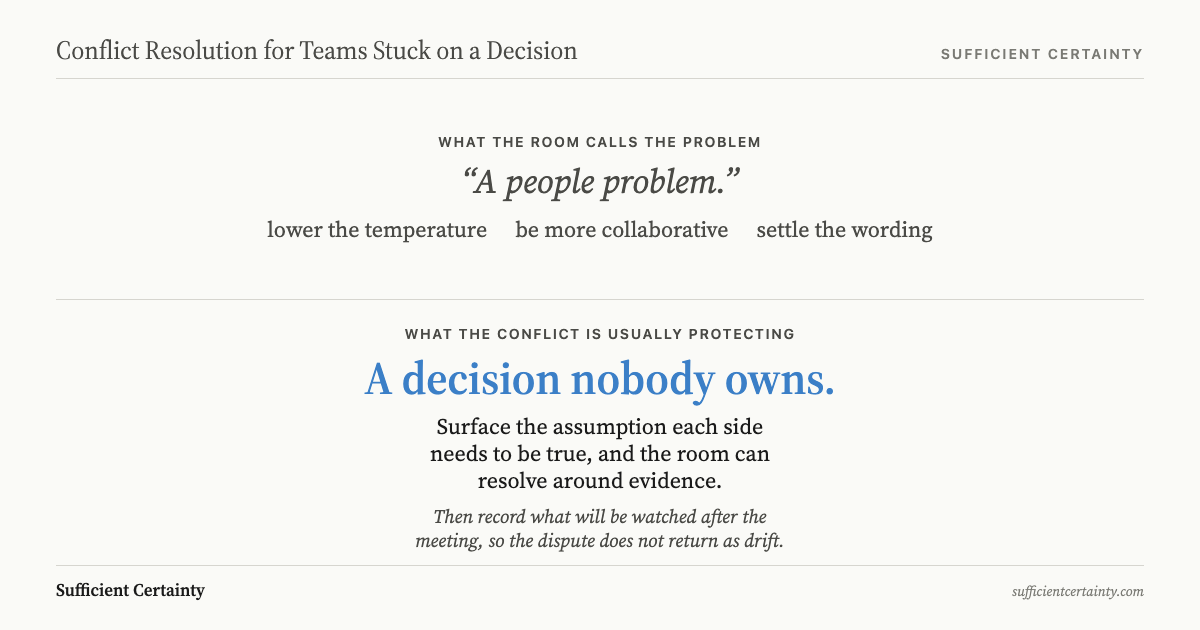
That is the mistake I see most often. The room says it has a people problem. What it usually has is an unstated call, protected by blur, with two different beliefs being defended as if both came down from the mountain on stone tablets. If you have been asked to sort it out before the next meeting, nicer phrasing will not save you. You need the argument in a form that can be tested.
At work, conflict resolution means turning a dispute into a clear decision, with named authority and something to watch after the meeting.
Most conflict resolution starts on the wrong question
Most workplace conflict drags on because nobody has written the actual decision in one sentence. One side thinks the question is whether the launch date can move. The other thinks the question is whether the product is safe enough to release. Those are different questions. Until somebody picks the one that matters, the room can argue for an hour and still miss each other cleanly.
The cost is not trivial. The CPP Global Human Capital Report found that 85 per cent of employees deal with workplace conflict to some degree and that the average employee spends 2.1 hours each week on it. More useful than the headline, at least to me, is the damage pattern. In the same study, 18 per cent had seen conflict push people out of the organisation and 9 per cent had seen it end in project failure. That is delivery damage. Nobody needs a wellness poster to diagnose it.
This is why I keep coming back to framing the call before the room starts performing concern. A blurred decision is useful to the sponsor who wants the date left untouched. It is also useful to the chair who wants the meeting over before anyone names the trade-off. If you want the broader version of that problem, the stakeholder alignment problem at organisational scale makes the same point. When the call stays foggy, "alignment" is usually just a nicer label for drift.
Put the conflict on the table as a decision, then use the five steps to identify the owner and monitoring point. Start the Walk →
The dispute usually sits inside one untested assumption
Most conflict resolution writing starts with style. Ralph Kilmann's overview of the Thomas-Kilmann Conflict Mode Instrument sorts behaviour into five modes and asks which one fits. I understand why managers like that material. It lets them talk about temperament instead of the call they failed to make. Style talk is safe because it keeps the failed decision offstage.
In my experience, the useful question is much plainer: what does each side think is true? One stakeholder may believe the client will walk if the date moves. Another may believe the defect rate will spike if the date holds. Those are not moods. They are claims about the world. If nobody writes them down, task disagreement mutates into personal friction because each side hears challenge as disrespect.
The research backs that up. A 2012 meta-analysis by de Wit, Greer, and Jehn reviewed 116 studies covering 8,880 groups and found that relationship conflict and process conflict were reliably harmful. Task conflict could be useful when it stayed away from personal hostility. That line matters. Teams do not usually fall apart because they disagreed about the work. They fall apart because nobody separated fact from assumption while there was still time.
So I do not start by asking people to be more collaborative. I ask each side to finish one sentence: "My position only works if..." Then I ask what evidence would prove that sentence wrong. The room usually settles because we have moved from personality to proof. That move sits inside the Universal Decision-Making Method, especially Frame the decision and Recognise assumptions. It forces the room to deal with claims, not moods. If your problem is still ordinary team friction, rather than a formal dispute, my piece on managing disagreement in teams covers the lighter version. Collaboration language is popular because it lets the weakest claim stay hidden.
Conflict resolution at scale exposes the same old dodge
I use public cases here because they make the mechanics obvious. When OpenAI's board removed Sam Altman on 17 November 2023, it said it no longer had confidence in his candour. By 20 November, more than 700 employees had signed a letter saying they might leave unless the board resigned. On 22 November, Altman was back as chief executive. A board tried to act on a candour claim without carrying the organisation with it, and the move collapsed almost immediately.
The pattern is older than Silicon Valley. A board paper says a site is unsafe to keep running or too expensive to modernise. Management moves first, assuming paper authority will do the rest. The people closer to the work reject the premise or the evidence. I have watched a chair bring in a change management consultant rather than reopen the cost assumption that operations disputed. Management got administrative closure. The workforce got the cost of living under that closure. Underneath the soft-skills label sits a live fight about authority and proof, with operating consequences attached.
Roger Estall and I describe this dodge in Deciding after watching it for years in boards and operating teams. Recasting a hard dispute as temperament suits HR and sponsors. Chairs like it as well, especially when reopening the call would expose how little was actually settled. The machinery is broken in a very flattering way. It allows senior people to look constructive while leaving the dangerous assumption untouched.
Conflict resolution needs one owner and a monitoring point
Practical conflict resolution needs one person to own the call. It also needs a check after the meeting, so the losing side is not being asked to trust the winner's intuition forever. Without those two things, the dispute is not resolved. It is merely parked, usually under a polite heading in the minutes.
If I were running the next meeting, I would keep it brutally plain. Write the decision in one sentence where nobody can pretend not to see it. Ask each side what has to be true for its preferred option to work. Ask what evidence would change its mind. Then ask who the Decider is. If that person is not in the room, you are not resolving anything, you are rehearsing. If the Decider is in the room, make them say what will be watched over the next week or month and who will look at it. That is the part most meetings skip, because monitoring sounds tedious right up until the skipped detail turns into rework or an ugly board surprise.
I keep coming back to the Universal Decision-Making Method because it makes the room do the unfashionable work. People must Frame the decision before debate starts, then Recognise assumptions while they are still only claims. The room still has to do Design monitoring before anyone calls the matter settled. Nice process language cannot substitute for that. It mostly gives cover to people who want peace in the room without paying for clarity.
Some disputes do need formal mediation, especially when trust is already shot or employment consequences are in play. Even then, somebody still has to record the disputed claim and who has the authority to act on it. Somebody also has to say what evidence would justify changing course. If the room keeps chasing agreement for its own sake, read my piece on alignment versus consensus. Consensus is a lovely hiding place for ownership.
Leave the call blurred and you do not get peace. You get two private versions of the same decision carried into delivery, until the cost shows up in late work or a board paper nobody believes.
You could mediate the next blowup and still leave the stalled decision untouched.
Work through your decisionNo sign-up. Just pick your decision and start.
Grant Purdy is the co-author, with Roger Estall, of Deciding (2020), and the architect of the Universal Decision-Making Method.