
Workplace mediation can settle an interpersonal dispute, but it cannot fix the missing decision that caused it. When two managers stop speaking, the root cause is rarely personality. It is usually a gap in authority or accountability that nobody wrote down, and mediation without that diagnosis treats the bruise while leaving the fracture.
A people director rang me about two managers in a shared services team who had stopped speaking to each other. Nine months of silence. A grievance drafted but never lodged, and a team of eleven who had learned to route every request around both of them. She had a mediator booked for the Tuesday and an employment lawyer telling her to get it done before the grievance was filed.
I asked her what the two of them disagreed about that could actually be checked. She said she had assumed it was a personality problem. It was not. One manager believed the other had been given authority to approve overtime for her team, and nobody had ever written down whether that was true. That is the question I want answered before anyone commissions workplace mediation, and it is almost never asked.
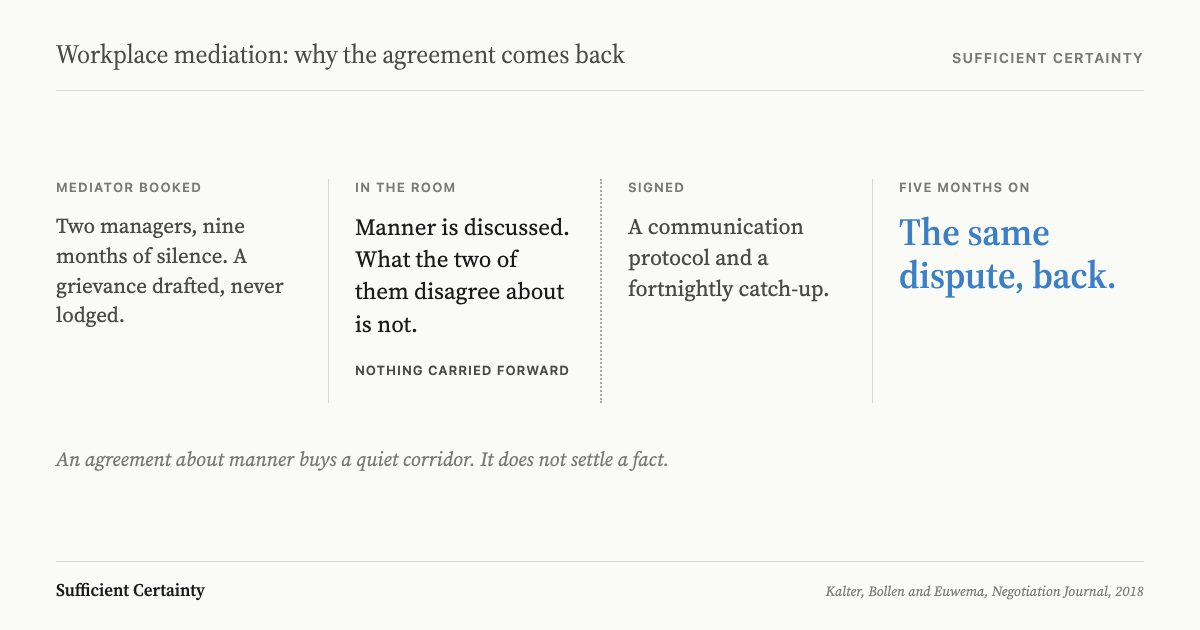
The session would have gone ahead perfectly well without the answer. Both women were reasonable, which is the point rather than a courtesy: reasonable people are exactly who mediation succeeds on. They would have agreed a communication protocol and a fortnightly catch-up, and everyone would have left the room lighter. Then in about five months the overtime approvals would have come round again and the same dispute would have restarted wearing different clothes.
Workplace mediation is a confidential process in which an impartial third party helps two people in a dispute at work reach their own agreement instead of having one imposed.
What workplace mediation is good at, and what it leaves alone
Mediation is very good at restoring civility and very poor at settling facts. The mediator is impartial, which means establishing whose account of the overtime policy is correct is neither their job nor within their gift.
Nobody else in the room has reason to mind. HR gets a file it can close and the lawyer gets the grievance forestalled rather than answered, which is what he was engaged to achieve. The provider gets another agreement to put in next year's renewal paper. So the process works on what it can reach, which is tone and manner.
Acas and the National Centre for Social Research surveyed 4,558 working-age people in Great Britain in the autumn of 2025 and found that 44 per cent had experienced conflict at work in the previous year, with 57 per cent of those reporting stress, anxiety or depression as a result. Acas puts the annual cost to British organisations at £28.5 billion. Only about half said the matter was largely or fully resolved. Workplace mediation is sold into that gap.
That last figure is the one HR should be reading, because it is the only one that describes an outcome rather than an incident. Everything else on the subject is measured at the point of signature: a session was held, an agreement was reached, the file was closed.
I have sat in enough post-incident reviews to know what a closure metric is worth when nobody has defined what would count as the matter being over. This is the same failure that runs through alignment once a decision has to travel: visible agreement is cheap to produce and easy to minute, and it tells you almost nothing about what people now understand.
The dispute is nearly always a claim about something that happened
Ask each party to finish the sentence "what I believe is true here is", and the relationship framing usually collapses within a minute. One says the reorganisation gave her the approvals. The other says a promise was made in a corridor in March. Each of those is an assertion about events, authority or entitlement, and each could in principle be tested against a document or a third person's account.
The CIPD's Good Work Index 2024 asked 5,496 UK workers about this, of whom 1,365 had experienced conflict in the previous year. Thirty-six per cent said the conflict was fully resolved, thirty per cent partly, and thirty-four per cent not at all. Those in conflict were roughly twice as likely to expect to leave within a year, at 33 per cent against 16 per cent.
"Partly resolved" is the interesting category. It is what you get when the manner has been fixed and the claim has not.
The most useful evidence I know of on misclassification comes from the United States Postal Service. Lisa Blomgren Bingham's review of the twelve-year REDRESS research program, drawing on more than 270,000 exit surveys, describes an organisation with over 900,000 employees receiving more than 24,000 informal discrimination complaints a year in 1994. Roughly half went to formal hearings, and the Postal Service prevailed in more than 95 per cent of them.
Bingham's explanation is the part that matters: a great many of those complaints were other workplace disputes filed under the only heading available to the person filing them. The label was wrong before anyone started work on it. If you want the general version of that argument, my piece on conflict resolution and the decision nobody named sets it out at length.
Take the dispute into the five steps and pin down the factual claim both sides will need to watch afterwards. Start the Walk →
A 95 per cent agreement rate is not a resolution rate
East Lancashire Hospitals NHS Trust rebuilt its internal mediation service and paired it with an Early Resolution Policy. Between September 2016 and May 2021 the Trust ran 142 individual mediations, of which 135 reached an initial agreement. All nine group mediations reached agreement too. Between January 2019 and July 2022, 223 cases entered the Early Resolution Policy and only 22 per cent went on to formal procedures.
Read further into the same report and you find what the headline rate hides. Some managers said they had felt compelled to attend and doubted the agreements would hold. Staff involved in the service warned that workplace mediation was becoming the default response to ordinary management problems. That is the diagnosis, and it is why I distrust a high agreement rate as a measure of anything.
A manager who has never been told plainly that a direct report's performance is unacceptable, and a direct report who has never been told what standard applies, do not have a relationship problem that a third party can mediate.
They have a management decision that nobody has been willing to make and record, which is where alignment inside an organisation actually breaks. Mediation is a very civil way of not making that decision, and the invoice reads the same either way.
Workplace mediation holds when both sides know what to watch
The strongest evidence that agreements decay comes from the Netherlands. Kalter, Bollen and Euwema followed real hierarchical mediations between supervisors and subordinates and went back to both parties a year after the session. Short-term and long-term outcomes were related. Supervisors, though, perceived greater compliance with the agreement than their subordinates did. A year on, the two sides did not agree about whether the thing they had agreed was being honoured.
That is what you would expect from an agreement written in the language of intention. "We will communicate more openly" cannot be observed, so each party scores it privately against their own expectations and each concludes the other is failing. Nothing in the wording tells either of them what evidence would settle the question.
Roger Estall and I spent a long time in Deciding on this problem in the context of boards and operating decisions, and the mechanism is the same: an assumption that stays implicit will be interpreted differently by everyone who has to act on it.
There are two moves I would insist on before the mediator writes anything down. First, name the contested claim in plain words and record what each party believes about it, whether or not they can be brought to agree. Second, specify what each of them will observe over the next few weeks and who they tell when they see it.
The first two steps of the Universal Decision-Making Method do the first job, Frame the decision and Recognise assumptions, and the fifth step, Design monitoring, does the second.
In the overtime case that is the difference between "we will communicate more openly about scheduling" and "neither of us approves overtime for the other's team until the people director confirms in writing who holds that authority, and we each say so when a request arrives anyway."
The second can be checked on a Tuesday morning without either of them being asked how they feel about it. Without that fifth step, workplace mediation cannot tell the difference between an agreement that is working and an agreement both parties have quietly abandoned.
Before you commission a workplace mediation
If that case had reached me on the Monday with a mediator booked for the Tuesday, I would have spent an hour on the questions the mediator cannot answer. What does each person claim happened, in their own words. Then whether the answer, once you have it, belongs to a manager rather than a mediator, because a question about authority or performance standards is a decision somebody is paid to make and the lawyer's advice will never say so.
Often the hour is enough on its own. The overtime case ended without a mediator, because once the approvals question was written down, the head of shared services could see it had never been resolved in the reorganisation and said so in an email to both managers.
That was an answer rather than a reconciliation, and the civility followed it instead of substituting for it. Where the disagreement is still informal and the parties are talking, managing disagreement inside the team is usually the better route, and cheaper.
Workplace mediation is the right tool for one particular job. When two capable people have genuinely lost the ability to talk to each other and the facts between them are settled, an impartial third party earns their fee. When the facts are not settled, what you have bought is an agreement and, some months later, the same dispute back. The five steps are how you work out which conversation you are supposed to be having.
You could sign the mediation agreement, quiet the corridor, and meet the same dispute months later.
Work through your decisionNo sign-up. Just pick your decision and start.
Grant Purdy is the co-author, with Roger Estall, of Deciding (2020), and the architect of the Universal Decision-Making Method.