
Managing disagreement in teams gets treated as a people problem when it is almost always a process failure. The room argues about method or priority because nobody stated the assumption the choice depends on. Test the assumption and the disagreement either resolves or sharpens into a genuine difference worth having.
Managing disagreement in teams gets treated as a people problem when it is almost always a process failure. The room argues about method or priority because nobody has stated the assumption the choice depends on. Test the assumption and the disagreement either resolves or sharpens into a genuine difference worth having.
At Pike River in New Zealand, 29 men died after months of methane alarms and small ignitions. Most advice on managing disagreement in teams would diagnose a communication failure, perhaps a trust deficit, and prescribe better listening. What actually broke was simpler: an assumption about methane management was wrong, the people nearest the evidence said so, and management filed their objection under noise.
I have watched versions of this for years. The room gets pushed toward calm while the assumption stays hidden. The organisation congratulates itself on alignment and walks straight past the evidence.
Managing disagreement in teams is the work of locating the disputed assumption and deciding how that assumption will be tested before action is taken.
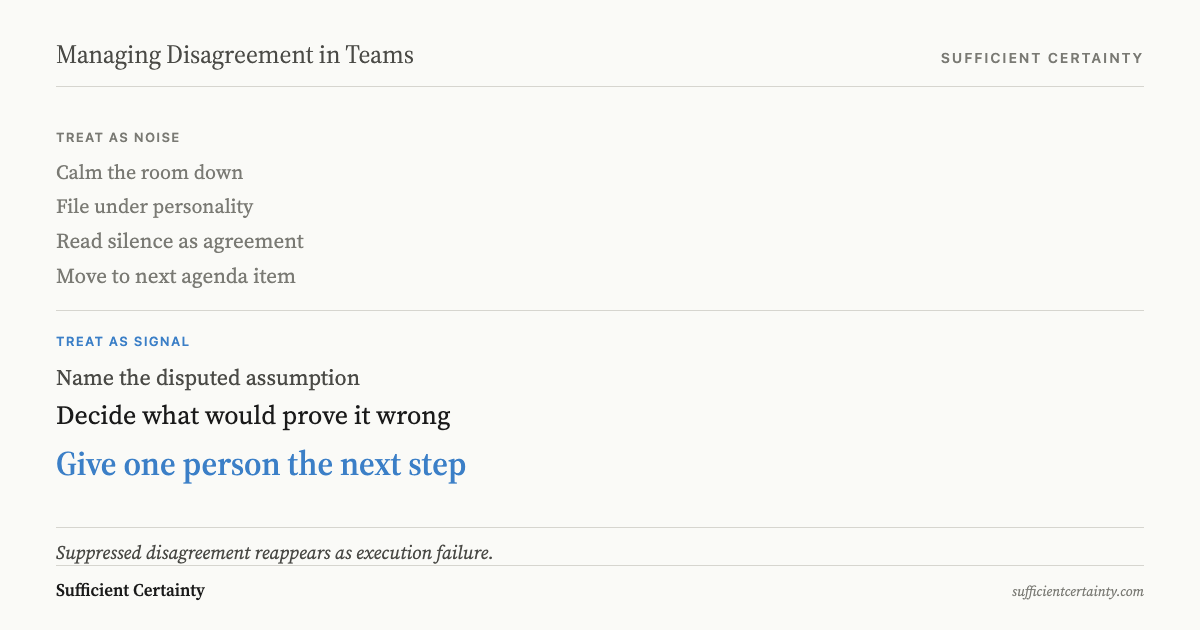
Why advice on managing disagreement in teams stops at empathy
Search for advice on this topic and you will find page after page about active listening, psychological safety, and mediation techniques. That work has its place, but it leaves the decision untouched. The question that matters, which assumption is in dispute, disappears the moment disagreement is reclassified as interpersonal friction. This is why so much stakeholder alignment work produces visible agreement and terrible execution. The distinction between alignment and consensus dies at the same point: untested assumptions dressed as agreement.
I do not start by asking who is difficult. I start by asking what the room is taking as fact, and what would happen if that turned out to be wrong. That is the starting point of the Universal Decision-Making Method. If the plan only works because nobody is asking awkward questions, the room is not aligned; it is just quiet.
The real work of managing disagreement in teams is deciding what would prove the objection right. If nobody can answer that, the room has shelved the argument, not resolved it.
Work the team dispute through the five steps and name the assumption everyone argues around but nobody agrees to test. Start the Walk →
When the room treats doubt as disloyalty
Theranos is the cleanest example because the organisation was full of technical people who knew the core claim was shaky. John Carreyrou's 2015 reporting in The Wall Street Journal showed that the Edison device was not doing the job the company claimed. The SEC's 2018 case and the 2022 fraud conviction told the rest. Laboratory staff were disagreeing about a factual assumption: that the device worked on patient samples. The organisation answered them with NDAs and legal threats. Founders, board members, and investors all needed the $9 billion story to hold. The assumption was never tested because testing it would have ended the company.
Pike River was worse because the evidence kept arriving in physical form. The Royal Commission described repeated methane alarms alongside a production-before-safety culture. Workers who kept disagreeing left. Production managers and executives needed the mine running to schedule, and the objectors were the obstacle to their timetable. Once the people carrying the objection walked out, management read the silence as agreement and lost the signal that could have prevented the explosion.
Volkswagen ran the same pattern over a decade. John Armour's Oxford analysis and the EPA enforcement record show engineers raising concerns while the company chased a diesel market story its technology could not honestly support. Senior leaders needed the US market share target and the program timeline. Engineers who knew the emissions assumption was false were overruled because answering them would have killed the program. More than 11 million vehicles carried the result, and the costs ran past €30 billion. When disagreement gets reclassified as disloyalty at the organisational level, the failure is structural.
Managing disagreement in teams starts with the disputed assumption
When I am in a decision room, I want the disputed assumption written in words plain enough that the dissenter can point at a sentence and say, "that is the bit I do not accept." Assumptions left unstated travel under the table and reappear as surprise during implementation. Most of the disputes I am asked to help with could have been settled in ten minutes if someone had written the contested point on a whiteboard before the room started debating solutions.
I have little patience for consensus that lets nobody own the call. The dissent does not vanish when the room moves on. It reappears weeks later as quiet non-compliance, missed handoffs, and execution gaps that nobody can trace to a specific choice because no specific choice was recorded. Roger Estall and I made this point in Deciding: the room that reaches agreement without naming its assumptions has not decided. It has postponed. Do it often enough and you have a standing committee that defers the same call session after session.
The discipline of managing disagreement in teams is to separate what is known from what is assumed, then give the objection one owner who must decide whether the assumption needs more work. Sometimes that means a short follow-up meeting that forces the objection into a concrete option and attaches one person, a next check, and a date. That is real collaborative decision-making: contribution that changes the reasoning, not attendance that widens the room.
Managing disagreement in teams does not end at the meeting
If the decision record does not name what to watch and who can reopen the call when drift appears, the disagreement has only been postponed. This is where most change management, including ADKAR work, fails: the initiative rolls forward while the disputed assumption sits unmonitored. The response to a dissenter should be to record the condition that would reopen the decision, not to quiet the room and move on.
I have seen boards receive reports so polished that the only thing they proved was that someone had written a report. Chairs, sponsors, compliance staff, and their consultants all benefit from a tidy paper trail because it lets them point at process when the outcome goes wrong. Real monitoring asks what would show that the crucial assumption has failed, and puts that question in the hands of someone competent enough to act on the answer. That means a named condition, not a vague instruction to keep watching. If sales drop below a number, if a sensor reads outside a range, if the regulator changes a rule, the decision reopens and the person responsible knows it before the damage compounds.
If people disagree, I assume the decision is telling us something. My job is to make that something visible before the organisation commits to a story it cannot defend.
You could calm the room down and still leave the disputed assumption untested.
Work through your decisionNo sign-up. Just pick your decision and start.
Grant Purdy is the co-author, with Roger Estall, of Deciding (2020), and the architect of the Universal Decision-Making Method.