
Most crisis management examples begin after the visible disaster and praise the speed of the response. That analysis stops too early. In each case the real failure is upstream, in a decision where the critical assumption was never stated explicitly and never assigned a threshold at which someone was required to act.
More than forty years of examining decisions that went wrong, both in formal investigations and in the advisory work that followed, has taught me to look for a pattern in the after-action reports. They begin at the moment the crisis became visible and end with a verdict on whether the response was fast enough.
What I have almost never seen among these accounts is an examination of the decision that manufactured the conditions for the disaster and the assumption that decision rested on. That upstream failure is what connects these cases to the discipline of leadership under pressure: defending the quality of the call, not only the speed of the reaction.
The three cases that follow changed how I approach every decision review. They span three industries and three decades; each has been written about extensively, and each has been written about incompletely.
A crisis management example is a documented case where an organisation's handling of a disruptive event is examined to identify the decisions and assumptions that preceded the visible crisis.
Johnson and Johnson: The Crisis Management Example Everyone Misreads
In September 1982, seven people in the Chicago area died after ingesting Extra-Strength Tylenol capsules laced with potassium cyanide. Johnson and Johnson recalled 31 million bottles, and within two months had reintroduced Tylenol with triple-safety tamper-evident packaging. I used to present this case as a model. The lesson always drawn is the speed of the response: the company pulled every bottle from every retail shelf and restored its market position within a year. For the response, that reputation is earned. What is not examined is what Johnson and Johnson knew before seven people died.
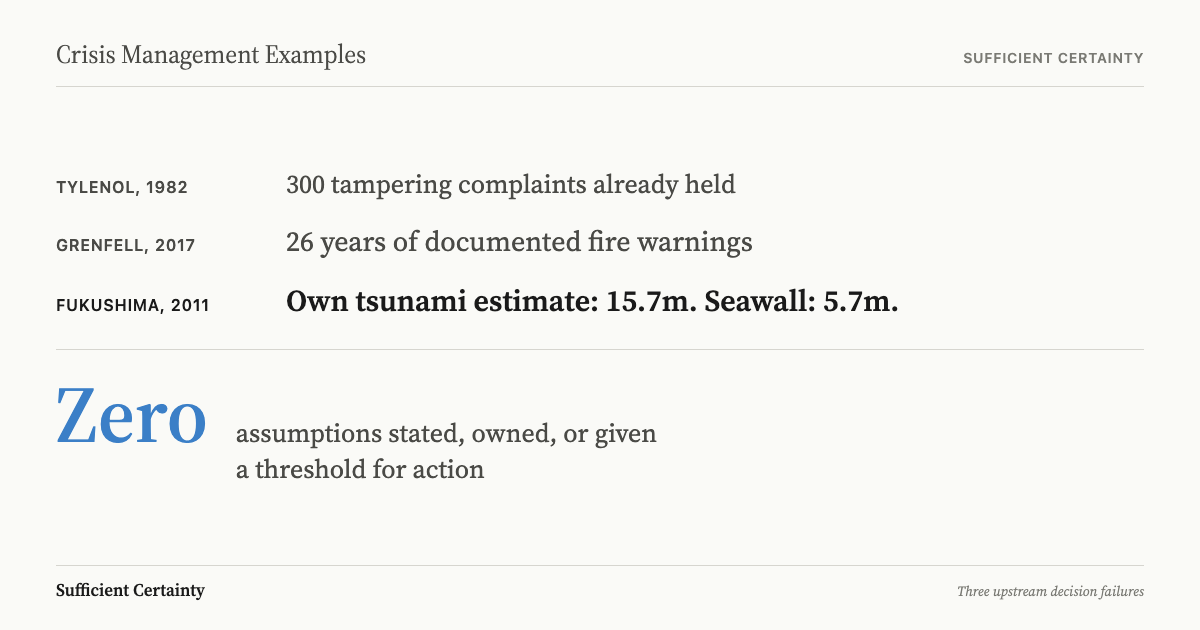
Civil litigation discovery revealed approximately 300 consumer complaints about tampering or contamination received before the cyanide deaths. J&J already sold tamper-evident packaging to hospitals in 1982; the technology existed and was deployed in a parallel distribution channel. No federal regulation required tamper-evident packaging for over-the-counter medicines at that time, and the FDA mandated tamper-evident packaging for all OTC medicines only after the seven deaths. The full evidentiary record of what J&J knew was sealed after a confidential settlement in 1991, on the eve of trial.
I have spent enough time with sealed settlements to know what that timing usually signals: a record the defendant preferred not to test in open court. The company fixed the problem within two months, which tells you the engineering capability was never the constraint. The missing piece was a decision process that connected existing evidence to an existing solution.
The unstated assumption behind the retail packaging was that consumer tampering was not a credible threat. In 1982, that assumption was defensible in the abstract, but it had never been tested against the complaint data the company already held. Three hundred complaints do not prove a specific cyanide attack is imminent, but they are evidence that the assumption deserved an owner and a review threshold.
A decision record stating "retail tampering probability is negligible" with a trigger (if tampering complaints exceed a defined number per quarter, reassess the packaging standard) would have forced the conversation before someone died. The step that was absent is the one that asks whether you have sufficient certainty to proceed and what evidence would change your mind. That is a decision failure, not a manufacturing failure.
Grenfell Tower: Twenty-Six Years of Documented Warnings
On 14 June 2017, a fire in a fourth-floor flat at Grenfell Tower in west London spread via combustible aluminium composite cladding on the building's exterior and killed 72 people. The Phase 2 inquiry report, published in September 2024 and running to 1,700 pages, found that between the Knowsley Heights fire in 1991 and Grenfell in 2017 there were "many opportunities" for the government to identify the risks of combustible cladding on high-rise residential buildings.
By 2016, the responsible department was "well aware" of those risks and did not act. The system produced warnings; it did not produce decisions.
The refurbishment had used Arconic's Reynobond PE panels (the cheaper, combustible version) instead of the fire-resistant Reynobond FR alternative; the saving was approximately GBP 293,368 across the entire project. I have seen this pattern in procurement decisions across other industries: the cost saving is documented and the safety assumption is not, so the cost saving wins by default. That is how 72 deaths trace back to a number on a procurement spreadsheet and an assumption that existed nowhere in writing.
The inquiry found "systematic dishonesty" from manufacturers Arconic, Celotex, and Kingspan: they manipulated fire-testing processes and misrepresented the results. Arconic ordered staff not to share documents comparing the combustible and fire-resistant versions with clients. A single civil servant carried the entire regulatory responsibility for fire safety in high-rise buildings, which meant the system had no redundancy at the one point where it most needed it.
The assumption that ACM panels were safe for high-rise residential use was never stated as a sentence anyone was required to own. No threshold existed for when the accumulating evidence from fires at Knowsley Heights and Lakanal House (2009) would compel a regulatory decision.
The monitoring mechanism (BRE fire testing) was captured by the very manufacturers it was supposed to hold accountable, and nobody was responsible for verifying whether the monitoring itself remained independent. That is a pattern I have observed across industries: the monitoring arrangement exists on paper, but the question of whether it still functions belongs to no one.
What distinguishes this crisis management example is the duration of the failure: a system with the information and no decision structure connecting that information to action produced 26 years of documented evidence and 72 deaths.
Name the three assumptions your current crisis plan depends on and ask who owns the signal that one of them has changed. Start the Walk →
Fukushima Daiichi: The Estimate Executives Asked to Lower
On 11 March 2011, a magnitude 9.0 earthquake generated a tsunami that reached approximately 13 to 14 metres at the Fukushima Daiichi nuclear power plant. The plant's seawall had been designed for 5.7 metres. The tsunami overtopped the wall, flooded the basements containing the emergency diesel generators, and caused three reactor meltdowns; over 150,000 people were evacuated.
Radioactive contamination from the meltdowns made large areas of Fukushima Prefecture uninhabitable, and the cost, both human and financial, is still being calculated more than fifteen years later. The National Diet of Japan's independent investigation concluded that the accident was "not a natural disaster" but "apparently a man-made disaster," and that the direct causes were "all foreseeable." I would go further: they were foreseen.
Three years before the tsunami, in March 2008, TEPSCO (a TEPCO subsidiary) had briefed headquarters on an internal study estimating that tsunamis up to 15.7 metres could reach the plant. The estimate drew on the Headquarters for Earthquake Research Promotion's analysis of the 869 Jogan earthquake, which had sent a tsunami at least four kilometres inland across the Sendai plain; the 2011 event matched that historical pattern closely.
TEPCO headquarters responded by asking whether the calculated height could be reduced by changing the methodology. I have sat across the table from people asked to make an inconvenient number smaller; it is never framed as suppression, always as methodological rigour. When told the figure could not be lowered, the board commissioned the Japan Society of Civil Engineers to study the matter further rather than raise the seawall or relocate the generators.
That is an organisation choosing to question its own evidence rather than act on it. TEPCO continued using 5.7 metres as its design basis for three more years, from the internal estimate in 2008 to the disaster in March 2011.
Three former TEPCO executives were tried for professional negligence resulting in 44 deaths and 13 injuries; they were acquitted in September 2019, with the Tokyo District Court finding it "not realistic" for executives to predict all tsunami scenarios. I find that acquittal instructive.
The legal question was whether the executives could have predicted the specific event, but the decision question is different: were they required to act on their own organisation's internal estimate? The assumption embedded in the plant's design (that a tsunami exceeding 5.7 metres would not reach this site) was visible in the engineering specifications. When the 2008 study produced a figure nearly three times the design basis, the institutional response was to challenge the number rather than re-examine the assumption.
A decision record that named the assumption with an assigned owner and a clear threshold for protective action would have made continued inaction a documented, reviewable choice rather than an institutional default.
What These Crisis Management Examples Actually Prove
The three cases span different industries and different decades, but each organisation held evidence that contradicted its own operating assumption and each found a way to receive that evidence without acting on it. J&J sealed the complaint record before trial. The UK government left one civil servant as the sole regulatory backstop for an entire class of building. TEPCO asked its own engineers whether the inconvenient number could be made smaller. The method of eventual discovery differed: litigation for J&J, a public inquiry for Grenfell, and a parliamentary investigation for Fukushima.
The upstream mechanism was identical.
I have read those accounts for decades; They are what taught me to stop examining the response and start examining the decision that created the vulnerability the crisis exposed. That is the practical consequence of studying crisis management examples the way they are usually presented: an organisation can absorb every lesson about speed and transparency and still have no method for examining the assumptions its own current decisions rest on.
The question most crisis management examples never ask is the one that matters to someone making decisions under pressure right now: how to structure the original decision so the failure is less likely. Roger Estall and I wrote Deciding because we kept encountering this gap. The Universal Decision-Making Method asks the Decider to make assumptions explicit and test whether sufficient certainty exists to proceed, with monitoring designed at the time the decision is made.
None of the three organisations above lacked information. Each lacked a method that would have made its own inaction visible before the consequences arrived.
Each of these cases eventually produced its own record of what went wrong: a sealed settlement, a 1,700-page inquiry, a parliamentary investigation concluding "man-made disaster." Those records exist because the retrospective examination happened after the deaths, not before.
An organisation that does not examine the assumptions behind its current decisions will eventually have those assumptions examined for it, in proceedings it did not choose. If your organisation reviews crisis management plans without examining the decisions those plans depend on, it is studying the response to a failure it has not tried to prevent.
You could build the crisis playbook and never examine the decisions that will create the next one.
Work through your decisionNo sign-up. Just pick your decision and start.
Grant Purdy is the co-author, with Roger Estall, of Deciding (2020), and the architect of the Universal Decision-Making Method.