
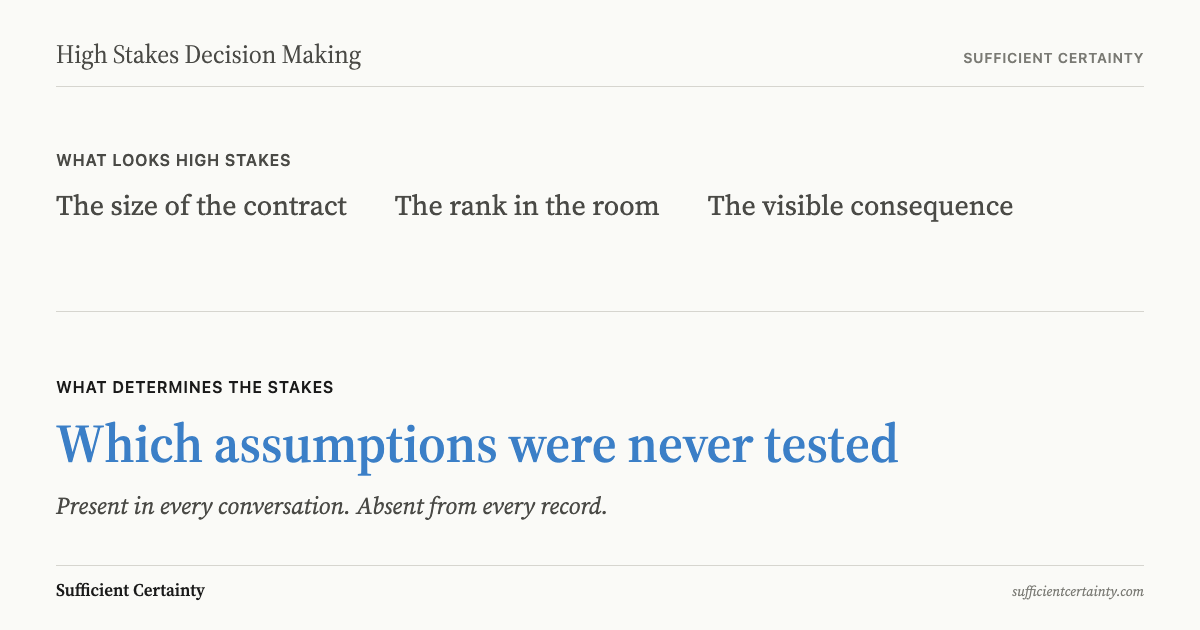
High stakes decision making is governed by the assumptions behind the call, not by the size of the contract or the rank of the people in the room. The decisions that carry genuine risk are the ones whose critical assumptions have never been tested. In my experience, that test is almost always skipped.
I once sat with a restaurant owner who needed to hire an assistant chef. There was nothing dramatic about the conversation. The owner had a salary range, two applicants, and a head chef who would train whichever one arrived. The decision looked like a routine staffing choice; it was not. The entire case turned on a single assumption: that the head chef had enough spare capacity to supervise the new hire closely enough to catch mistakes before they reached a plate. If that assumption was wrong, the hire was not a staffing problem but a food-safety incident waiting for a customer.
In 1985, the board of Trans Union Corporation approved a $55-per-share merger after a two-hour meeting; the CEO had presented his case orally, and the board had obtained no independent valuation and no fairness opinion. The price was a premium over the market, but the Delaware Supreme Court, in Smith v. Van Gorkom, found the board grossly negligent: the directors could not show they had informed themselves of the material information before acting. A good outcome did not prove a good decision.
The restaurant hire and the corporate merger sit at opposite ends of every conventional scale of consequence. The same failure connected them: the assumption the outcome depended on had not been tested.
High stakes decision making is the practice of identifying and testing the assumptions a decision depends on when the consequences of getting those assumptions wrong would be severe.
Name the Assumption Before the Room Commits
I have run this exercise in boardrooms, project teams, and operational reviews: before the commitment, I ask the room to name the assumptions that would change the outcome if they turned out to be wrong. Gary Klein published a version of this as the premortem technique in the Harvard Business Review in 2007, and the research behind it confirms that reframing the task as explanation rather than criticism makes the room roughly 30 per cent better at identifying genuine failure points.
But the premortem names failure modes; it does not automatically test the assumptions underneath them. That additional step is where most organisations stop, because testing an assumption means admitting the decision is not yet settled, and nobody in the room wants to be the person who delays the commitment.
The Universal Decision-Making Method calls this step "recognise assumptions," and it is the step that organisations skip most consistently because it is the one with the least impressive output. A risk register produces a document. A matrix produces a colour-coded grid. Naming the assumptions the decision actually rests on produces a short list that looks too simple to justify the consulting fee.
Before the room commits, name the assumption that would change the outcome and design the monitoring that catches its failure. Start the Walk →
What High Stakes Decision Making Actually Tests
Testing the restaurant assumption was a single question: does the head chef actually have enough spare time during service to supervise a new hire closely? Not a risk assessment. Not a staffing matrix. One question directed at the person who would know the answer. If the capacity existed, the hire was routine. If it did not, the owner was not making a staffing decision at all; he was loading a food-safety assumption onto a kitchen that could not carry it.
The Trans Union board could have run the same kind of test. A valuation study would have surfaced whether the $55 figure rested on defensible revenue projections; a fairness opinion would have surfaced whether the alternatives had been considered. Neither was obtained, and the Delaware Supreme Court held the board accountable for the gap.
I have seen this pattern repeat in every sector I have worked in. The specific failure is always the same: a string of individually defensible-looking calls that share unexamined assumptions about governance, capacity, or context. No single call looks dangerous.
The assumptions behind them were never tested as a set, and the accumulation becomes visible only when a reviewer arrives and asks what was known at the time. That is what high stakes decision making looks like when nobody checks: not one dramatic failure but a chain of calls that each felt manageable until, collectively, they were not.
In leadership under pressure, the temptation is to treat the visible scale of a decision as the measure of its stakes. The pattern shows the opposite: the stakes were set by the shared assumptions connecting the calls, present in every conversation and absent from every record. The crisis management strategies deployed after a collapse inherit that gap; what was never articulated cannot be managed after the fact.
Why High Stakes Decision Making Needs a Record
Name the assumptions, test them, record the result. None of these steps is exotic; they are what competent people already do when they decide well. The difference between a defensible decision and an indefensible one is almost always whether any of it was recorded; in my experience, that is the gap more often than any shortage of data or expertise.
The record that matters in high stakes decision making is not a full account of the process. It is the short list of assumptions the decision actually rested on, a judgement that those assumptions provided sufficient certainty for action, and monitoring designed to catch variance before the consequences arrive.
A reviewer does not look for whether the decision was right. They look for whether the person who made the call could show which assumptions were load-bearing and what was set for watching them. That is the standard the Delaware court applied in Smith v. Van Gorkom. It is decision making under pressure reduced to its essentials: not the ability to stay calm, but the discipline to record what the decision rested on before the outcome arrived.
The restaurant owner who records that the hire depends on the head chef having forty minutes a day to supervise is protected when the assumption fails, because the record shows the assumption was identified and the monitoring was designed before the new hire started. The board that votes without a valuation has no equivalent protection, regardless of how the share price moves. That is the method in practice: a record of the assumptions that would change the outcome if they proved wrong, produced before the commitment, not after the wreckage.
Why the Outcome Tells You Nothing About the Stakes
I have sat in enough board reviews to see how this works. When a product launch succeeds, nobody audits the decision process; when it fails, the same process that was acceptable last quarter becomes evidence of recklessness. The board reconstructs the stakes from the outcome, not from the assumptions that were live at the time the call was made.
A 2023 pre-registered replication by Aiyer and colleagues confirmed what this pattern suggests: people rate identical decisions as higher quality when told the outcome was good, even when they explicitly agree that outcomes should not affect the rating. This is outcome bias, and the effect sizes in the replication (d = 0.77 to 1.1) were larger than the original 1988 study.
The practical consequence is that organisations invest their sharpest scrutiny after the damage is done. Consultants arrive to reconstruct what went wrong (for a fee that would have paid for the assumption-testing ten times over), boards commission retrospective reviews, and everybody studies the wreckage with an intensity that would have been useful beforehand. The industry that services post-incident reviews has no incentive to point this out. When the facts change fast, the organisation that classifies its stakes by outcome is always looking at the wrong moment.
McKinsey's research on board decisions sorts calls into categories ranging from HR and succession through strategy and governance. That is useful, but the category does not tell you the stakes. A succession decision with one candidate and no fragile assumptions may carry less genuine risk than a routine procurement where the entire supply chain depends on a single untested assumption about a supplier's solvency. In nearly fifty years of working with organisations, I have rarely seen that test applied before the commitment is made.
I have watched organisations spend years on risk registers and compliance frameworks, producing documents that nobody consults when a real decision arrives. The reason is simple: those documents list possible events, not the assumptions behind a specific decision.
When the call has to be made, the register sits in a drawer while the room works through its assumptions from scratch, usually without recording a word. What separates a defensible high stakes decision from an expensive guess is whether anyone named the assumptions the outcome depended on and designed the monitoring to catch it if they broke.
You could label the next decision high stakes and never name the assumption it depends on.
Work through your decisionNo sign-up. Just pick your decision and start.
Grant Purdy is the co-author, with Roger Estall, of Deciding (2020), and the architect of the Universal Decision-Making Method.