
A decision coaching process is not a workshop and it is not a facilitation exercise. It stops when the person who owns the call can state the assumption their decision rests on, explain why they believe it holds, and name the condition that would reopen it. That is the whole scope.
I once opened a helpdesk outsourcing meeting with a 27-page vendor proposal on the table, two service maps on the wall, and a steering committee deadline on Friday. Everyone around the table had plenty to say. What they did not have was a clear statement of the decision. That is where the decision coaching process begins.
Most organisations treat discussion as progress. The longer the meeting, the more thorough it feels. But thoroughness without a stopping rule is delay wearing a suit. Roger Estall and I built the Universal Decision-Making Method in Deciding because we kept watching rooms full of capable people talk past the point where the call was ready to be made. The decision coaching overview covers the principle. What follows here is the mechanics: what the process starts with, where it stops, and what it leaves behind.
In the helpdesk case, nobody in the room was incompetent. The vendor data was solid. The service maps were detailed. What was missing was a single sentence naming the bet and the person who had to make it. Without that, every contribution felt useful and none of it added up to a commitment. I have seen the same pattern in boardrooms, program offices, and government departments. The quality of the analysis is rarely the problem. The problem is that nobody said when the analysis was enough.
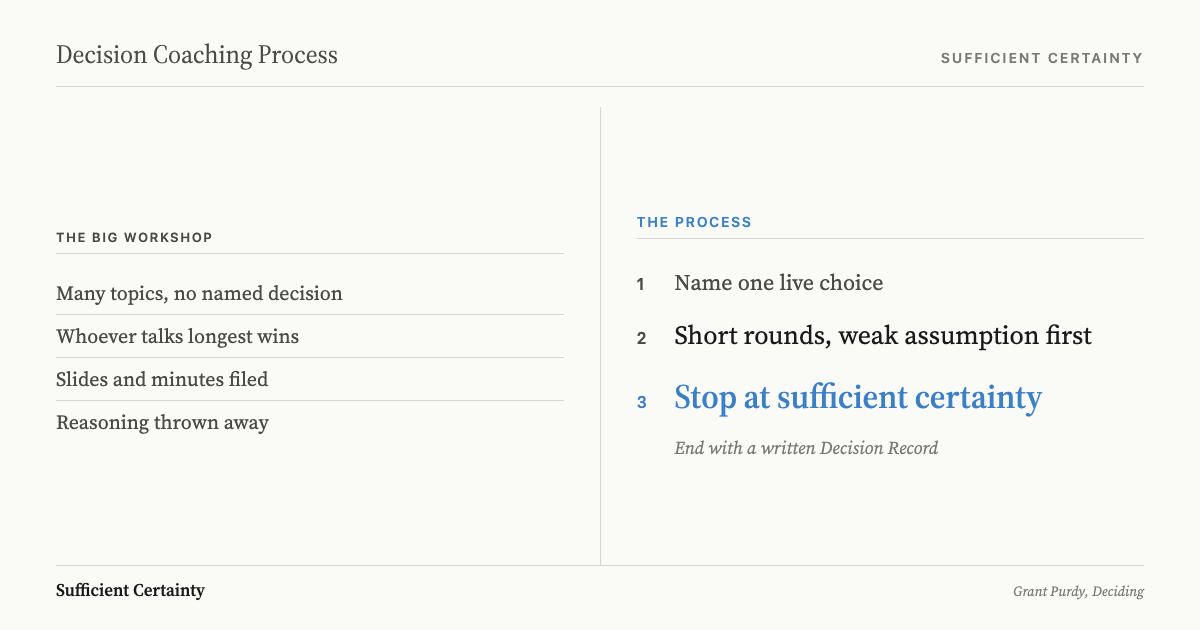
A decision coaching process is a series of short conversations around one live choice. It ends when the person who owns the call knows enough to act and knows what would reopen it.
What the decision coaching process starts with
It starts with a named decision and a named Decider. I want the person with authority to say plainly what call has to be made now and what the rest of us are there to contribute. In the helpdesk case, the room wanted to compare service levels before it had even agreed whether the real question was cost or management attention. We lost twenty minutes before someone said the call was whether to outsource the helpdesk entirely or restructure the internal team. Once that was on the table, the vendor comparison became a subordinate question that belonged to procurement, not the steering committee. People leave meetings like that saying the conversation was useful. They still cannot say what was decided.
The 2025 ICF core competencies insist on clear agreement about focus and ownership. The principle is right. But vague ownership sells better than accountable judgement, so most coaching stops at the agreement and never forces the named bet. I explained in decision coaching why the role is narrower than the brochure suggests.
Work the decision you keep discussing through short sessions until the owner can defend the call without the workshop room. Start the Walk →
Why the decision coaching process runs in short sessions
Short sessions keep the work honest. One big workshop looks efficient on the calendar, but it rewards stamina and status. The person who owns the outcome ends up hiding behind the furniture of the meeting while everyone else performs competence.
I prefer short, explicit conversations tied to the next thing the Decider needs to know. One session to frame the choice. A later session to test the weak assumption. Between sessions, the Decider checks facts, talks to the people who actually know, and comes back with something concrete instead of another round of opinions. I never try to run the conversation and record at the same time. If I am listening properly, I hear the assumption everyone is quietly relying on. If I am typing, I miss it.
The value of structure is not theoretical. In a 2019 anesthesiology study, 37 clinical teams received a semi-structured briefing averaging 2 minutes and 28 seconds. Those teams moved earlier toward the better airway option and acted faster on steps they had named up front. That is the discipline behind the decision coaching process: a short, structured conversation improves the next call when it forces the group to say what matters before activity begins.
Where the decision coaching process stops
It stops at sufficient certainty. That is the discipline most organisations avoid, partly because stopping means somebody has to own the judgement. Endless discussion feels safer. It also lets weak reasoning hide inside respectable delay.
When I say sufficient certainty, I do not mean comfort. I mean the Decider can explain why this option deserves commitment and what would overturn it. If that standard is not met, I go back for the missing fact or I change the option under discussion. I do not keep the conversation alive just because nobody likes the burden of closing it.
The AHRQ SHARE approach builds the same stopping discipline into clinical treatment choices: the conversation has a named purpose, and it ends when the patient can act, not when the clinician runs out of information. In business the standard cannot be perfect knowledge because that standard is fictitious. The honest question is whether the reasoning is strong enough, now, for action. A consultant can add analysis, but the process ends only when the Decider can commit, not when the advice runs out. This is why I only use it for consequential calls that lack clear commitment, not routine choices.
What the decision coaching process leaves behind
A serious process leaves a written decision and a monitoring path. Most organisations keep the wrong residue from meetings: slide decks and minutes, because nobody who circulated the slides has to own the wager. The reasoning that made the choice make sense at the time gets thrown away.
I want a Decision Record that states the call, the reasoning, and the assumptions carrying it, with signs that would tell us the decision no longer holds. Not a minute of who said what. The record captures why this option was chosen over the alternatives, which assumptions are doing the most work, and what change in conditions would trigger a rethink. That is what gives a board, an executive successor, or the Decider six months later enough to judge whether the original reasoning still stands.
The UK guidance on post-implementation reviews puts monitoring plans inside the decision rather than after it. Public Health Ontario's review guidance makes the same point from emergency response: learning works when the review is prompt and tied to follow-through.
That is the difference between a process that leaves something usable and a conversation that disappears. If the Decider cannot revisit the wager without reconstructing the whole meeting from memory, the work was unfinished.
You could book another workshop and still never state the actual decision.
Work through your decisionNo sign-up. Just pick your decision and start.
Grant Purdy is the co-author, with Roger Estall, of Deciding (2020), and the architect of the Universal Decision-Making Method.