
The most consequential choice in CEO succession is made before any candidate is interviewed: the question the board decides to answer. After CEO succession planning, reopen that question and check whether the candidate specification describes the decisions the next chief executive will face, or only the chief executive the company already has. A different question produces a different shortlist.
CEO succession planning is the board's process for defining what the next chief executive must do, identifying and assessing candidates, and appointing one before the role falls vacant.
Turning a CEO shortlist into a board vote
This is not the talent-bench exercise covered in what to do after succession planning, where readiness is rated across many critical roles. CEO succession is one seat, one decision, and it belongs to the board.
The work after the plan follows a familiar path. The nominating or governance committee approves a candidate specification: the experience, capabilities and track record the next CEO should bring. Internal candidates are assessed against it, often through stretch roles, psychometric assessment and presentations to the board. Many boards run an external search alongside, if only to benchmark the insiders.
Interviews and reference checks narrow the field to a finalist. The committee recommends, the board votes, and the appointment is announced with a transition arrangement. A common one keeps the outgoing chief executive on as chair or executive chair for a fixed period, to hand over relationships and steady the organisation.
Every later step measures candidates against the specification. The interview questions come from it, the references are checked against it, and the committee's recommendation cites it. The specification is where the question gets fixed, usually months before the vote and rarely revisited once the search is under way.
A CEO succession plan protects the company from an empty chair
The plan does real work. It forces the board to name candidates while there is time to develop them, rather than scrambling after a resignation or a health crisis. It makes the board state, in writing, what it expects from the next leader. It turns the choice of chief executive into the one decision the board cannot delegate to management, which is the line drawn in governance versus management.
The stakes justify the effort. Fernández-Aráoz, Nagel and Green (2021) estimated that badly managed CEO and C-suite transitions wipe out close to $1 trillion of market value a year in the S&P 1500. Their advice is to judge candidates not on who has performed best until now, but on who is ready for the future challenges of the role.
That advice points straight at the weak spot. A plan can be rigorous on process and still aim every step at the wrong question.
Take the candidate specification your board approved, write down the conditions it assumes the next CEO will face, and name the one that would change the choice if it moved. Start the Walk →
Who is the next CEO being measured against?
CEO succession plans usually frame the question in one of two ways: who can replace the current chief executive, or who will continue the current strategy. Both frames are reasonable. Both fix the candidate profile against today's business and today's incumbent, and that choice carries assumptions the specification never states.
The first is a strategy assumption. The candidate specification is written against the current strategy and the incumbent's operating model, so it selects for the executive best placed to run both. The board is assuming that the strategy the successor is chosen to continue will still be the right one when they take the seat. If a division collapses or customers change how they buy, the strategy itself becomes the decision, and no finalist was assessed on it.
The second is that the incumbent's scaffolding will stay up. Outgoing chief executives carry relationships, judgement calls and informal authority that a successor leans on, often without anyone noticing. When the predecessor stays as chair, that scaffolding is visible and helpful. It also constrains. Quigley and Hambrick (2012), studying 181 successions in high-technology firms, found that retaining the former CEO as board chair restricted the successor's discretion and dampened strategic change.
| Conditions as forecast | Conditions shift | |
|---|---|---|
| Predecessor gone | The successor now owns the calls the predecessor used to make | The plan has no view here, and this is where the CEO is tested |
| Predecessor on hand | The continuity profile fits. The specification was written for this cell | Continuity candidate → rated safe here, untested one row up |
Neither assumption is wrong on the day the board votes. The problem is that the specification treats both as permanent. A plan framed around continuity selects for the conditions it was written in, and has nothing to say about the quadrant where those conditions and the predecessor are both gone.
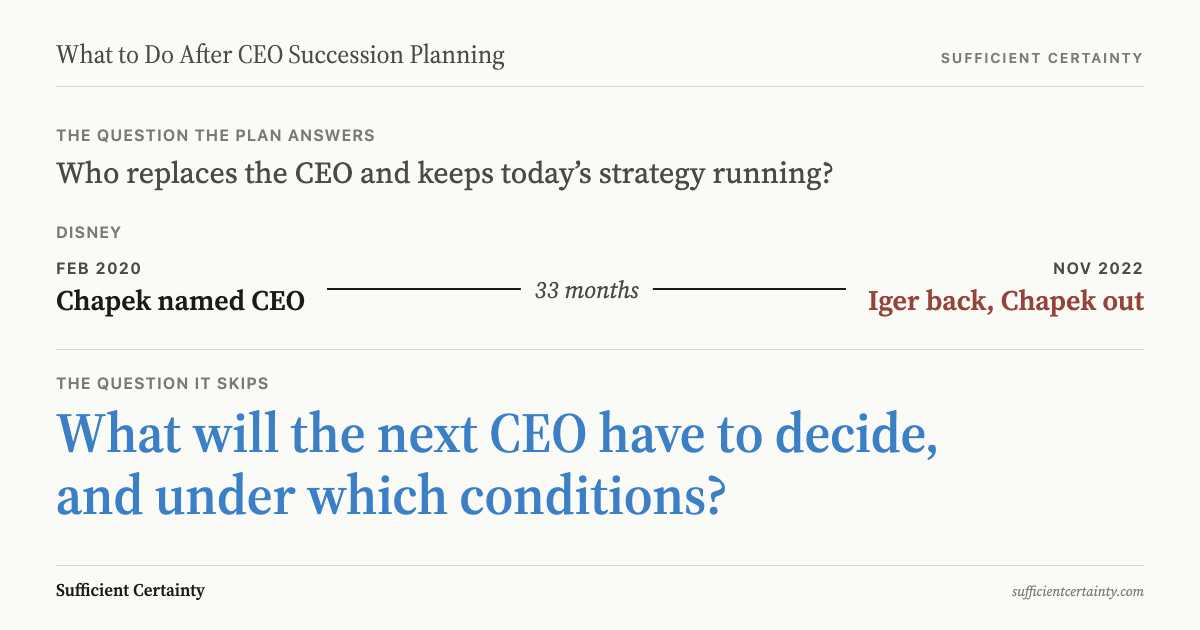
Disney's succession: chosen for continuity, tested by upheaval
On 25 February 2020, the Walt Disney Company board named Bob Chapek chief executive, effective immediately. He had run Disney Parks, Experiences and Products since 2018. Bob Iger became executive chairman, leading the board and directing the company's creative work through the end of his contract on 31 December 2021. Chapek would report to Iger and the board.
The frame is written into the announcement filed with the SEC. Lead director Susan Arnold said the board had considered internal and external candidates, and cited Chapek's "commitment to this strategy". Chapek said he would "continue to embrace these same strategic pillars going forward". The same release set out the division of labour.
Within weeks, COVID-19 shut the company's theme parks, Chapek's home ground, and most of its content production. In October 2020 he reorganised the media businesses, separating content creation from a new Media and Entertainment Distribution group with sole profit-and-loss accountability. Iger continued to direct creative work until he left in December 2021, the date set in the original announcement.
In June 2022 the board unanimously extended Chapek's contract by three years. Less than five months later, on 20 November 2022, it reappointed Iger as CEO for two years, citing "an increasingly complex period of industry transformation" and a mandate to develop a successor. In February 2023 Iger restructured the company into three segments, returning distribution to the creative leaders.
The public record does not show the board's private deliberations. It does show the frame: continuity of an existing strategy, with its author in the building until a known date. Both conditions changed within 22 months. The plan answered who would carry the strategy forward. It did not ask what the CEO would decide once the scaffolding came down, a gap that runs through many governance failures.
Taking the scaffolding down before the vote
The artefact to check is the candidate specification the board approved. Check it before the board votes on the appointment, and again whenever a condition written into it changes, including the date the predecessor leaves. The Universal Decision-Making Method gives the sequence:
- Frame the appointment as the decisions the next CEO must make in the first three years, and under which conditions, not as a replacement for the incumbent.
- Treat the specification and the shortlist as tentative elements. Draft a second frame and see whether different candidates appear.
- List the assumptions in the frame, including every call the incumbent makes today that the successor will have to make alone.
- Decide before the vote what sufficient certainty the board needs that each finalist can make the calls the frame expects without the predecessor on hand, and which evidence would meet that standard.
- Implement and monitor: name the events that reopen the candidate specification, such as the predecessor's or chair's departure date, a strategy reset or a shock to the core business line, and give each one a named owner on the board.
This is organisational governance at its most concrete. A board that removes the scaffolding on paper before the vote learns which candidate can stand without it, and a written record of the frame, the assumptions and the triggers, of the kind described in decision-making tools for boards, shows the next board why that candidate was chosen.
Disney's board chose a successor to continue a strategy. What it didn't have was certainty that the strategy would still be the job once the conditions and the predecessor were gone.
Work through your decisionNo sign-up. Just pick your decision and start.
Grant Purdy is the co-author, with Roger Estall, of Deciding (2020), and the architect of the Universal Decision-Making Method.