
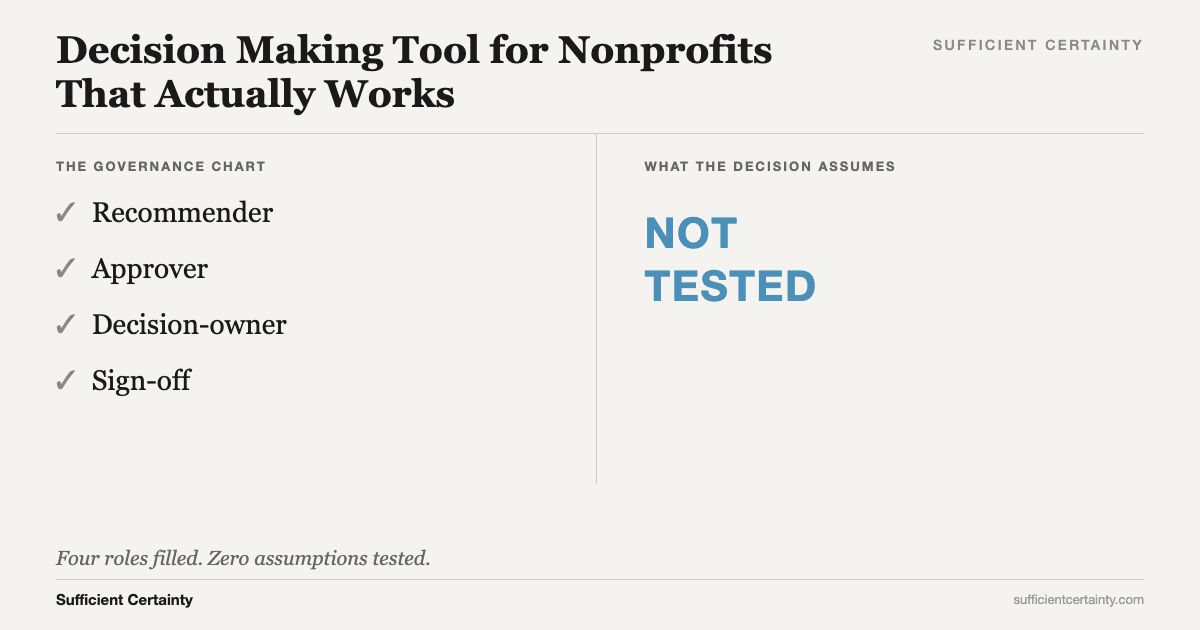
A decision making tool for nonprofits fails whenever it stops at authority and never tests the assumption underneath the commitment. Every governance chart I have reviewed settles who approves and who signs off. Not one asks whether the programme can produce its mission result while the organisation remains able to serve people.
Evidence Action's No Lean Season began with a promising idea in Bangladesh. The programme offered agricultural labourers loans of roughly US$20 to migrate for work, then moved to an at-scale test involving more than 40,000 people. The results showed limited impact, and implementation-partner problems followed. Evidence Action ended the programme rather than keep spending on a proposition that had not established its cost-effectiveness at scale. Evidence Action's account of the exit is worth reading for its restraint.
I built the Walk for this kind of decision. It takes the conversation past who recommends, who agrees, and who decides, towards the assumption that has to hold if the mission result is going to arrive. A role map still has a place. It just cannot carry the weight of the decision on its own.
A decision making tool for nonprofits is a structured test of whether a proposed choice can produce its mission result while the organisation remains able to serve people.
Why a decision making tool for nonprofits still fails
Existing nonprofit tools fail when they make authority the end of the process. A RAPID or RACI table settles who supplies input and who owns the call; consultants who sell these frameworks leave the room once the chart is complete. The chart does not test whether the choice will produce the intended mission result while the organisation remains able to serve people. The broader decision making tool guide deals with that missing test directly.
Keeping Kids Company shows the gap. The charity operated a demand-led service while it expanded, relying on grants, donations, and short-term loans to cover gaps in cash flow. The Charity Commission inquiry found that auditor management letters had warned about low reserves for the 2011, 2012, and 2013 financial years. In 2013, reserves were just over £434,000, about 1.9 per cent of expenditure. The charity kept operating until it owed HMRC an estimated £1.16 million by June 2015.
The trustees knew who was responsible for the expansion. That answered the governance question and left the harder one untouched: could the organisation sustain its chosen level of service if funding or demand moved against it? I have watched the same pattern in three organisations where the reserve fell below operating cost while the governance documents showed full compliance. The paperwork did not make the assumption visible.
The Walk makes that separation explicit. It asks the room to name the mission outcome and the condition that could prevent it, then records what evidence would be enough for this commitment. That is a decision record, not a prettier governance chart.
A role map cannot test a mission result
A nonprofit choice is sound only when its activity is connected to the outcome the organisation exists to produce. Role clarity can move a proposal through a meeting while leaving that connection assumed.
The One Laptop per Child programme in rural Peru makes the point without needing a dramatic collapse. An Inter-American Development Bank evaluation covered 319 primary schools after 15 months. In treatment schools, the ratio of computers to students rose from 0.12 to 1.18. The evaluation found no evidence of an effect on enrolment or mathematics and language test scores, although it did find some positive effects on general cognitive skills. The evaluation report sets out the results.
The delivery decision was visible: put laptops in rural schools. The mission assumption was less visible: access to the devices would produce the educational result the programme was meant to deliver. I have reviewed programme proposals where the only evidence for impact was the number of items delivered; in every case the proposal confused reach with result.
A role-assignment tool could say who recommended the purchase and who performed the rollout. It could not, by itself, ask what would make access change learning, or what evidence would justify another release of money. The same distinction sits behind the board decision tool, where a clean approval process can still leave the central assumption untouched.
This is where the familiar idea of a decision making tool for nonprofits needs widening. Reach, attendance, and units delivered may be useful measures, but they are not automatically the desired outcome. The decision has to say which result matters, what must be true for the intervention to produce it, and what the organisation will do when the evidence does not support the original belief.
Name the assumption underneath your next programme commitment and write the signal that would make the board reopen it. Start the Walk →
When a nonprofit needs the full method
A simple matrix is enough for a bounded operational choice that can be reversed without disrupting service. I have chaired sessions where a nonprofit spent two hours on a matrix for a minor supplier change; the full method would have wasted their time. If the cost of being wrong is small and the options are already known, a quick comparison is a reasonable aid to judgement.
The full method matters when a decision commits reserves or places a material promise to beneficiaries behind a new funding assumption. A program expansion can look like a larger version of an operational choice while carrying a different burden: the organisation may have to keep funding it after the evidence weakens.
No decision can provide total certainty, and a nonprofit cannot spend its way out of every unknown. The question is whether the remaining uncertainty is acceptable for this commitment, or whether more information or a modified choice is worth the cost.
That judgement is the centre of the Universal Decision-Making Method. The Walk matters when the assumption underneath the preferred option reaches the organisation's ability to serve people, not because every staff purchase deserves a formal exercise. A leader should be able to tell the difference before the next meeting starts.
The assumption nonprofits never tested
The assumption most often left untested is that the organisation can continue its chosen service level while its funding and demand change. This is why reserves are part of the decision itself, rather than a finance field filled in after the programme has been approved.
The Charity Commission's current reserves guidance says there is no single reserve level suitable for every charity. Trustees are expected to set a policy for their circumstances (monitor it during the year, review it at least annually). A zero-reserves policy must explain how the charity will deal with the resulting risks.
That guidance is plain enough. Yet a proposal can still present the reserve as available money and the forecast as a fact, without stating what funding continuity or delivery capacity the decision depends on.
I have read board papers where the reserve figure was the only number that changed between quarters, and nobody asked what assumption about demand had moved with it. That is how a decision making tool for nonprofits fails without anyone noticing: the organisation treats the reserve as a number to protect instead of a condition that tells it whether the chosen service model remains viable.
When I use the Walk with a nonprofit, I put that condition beside the Purpose before we debate the options. Then we Recognise assumptions in decision making: which facts could decay and which signal would tell a named person to reopen the call. The exercise is often shorter than the board paper it replaces.
What a decision making tool for nonprofits must actually produce
A nonprofit decision tool must produce a dated Decision Document that connects the mission outcome to the assumptions and actions required to sustain it. A list of approved roles or a ranked score is not enough. The record has to preserve the reasoning that would otherwise disappear when the people in the room change.
The document starts by stating the organisation's Purpose and the result the decision is meant to produce. It then Frames the decision in its current Context and Develops options that fit the opportunity. Those words matter because a balanced budget, a larger programme, or more people reached is not automatically the Purpose. The organisation has to say what those things are meant to achieve.
Next, the record separates what the Deciders know from what they are assuming. I have seen boards list twenty assumptions and then treat every one as equally important; the method identifies those with high influence and low confidence instead. The Deciders then judge Sufficient certainty for this commitment. If the evidence is not enough, they obtain information, modify the choice, or choose again.
Finally, the Decision Document states how the choice will be carried into action and who will interpret a change in the important assumptions. Design monitoring means naming the signal and the response before the result becomes a post-mortem. A dashboard without an owner is a display, not monitoring.
The Walk produces this record through the Universal Decision-Making Method. It gives a nonprofit a short account of its Purpose, the assumptions that matter, and the response conditions, so the board can see what it is committing to and the team knows what would require a change.
Roger Estall and I wrote Deciding after seeing how often organisations confuse a complete process with a sound decision. A nonprofit does not need another report that proves a meeting happened. It needs a record that makes the next judgement possible when the assumption changes.
You could fill every governance role and still leave the funding assumption untested.
Work through your decisionNo sign-up. Just pick your decision and start.
Grant Purdy is the co-author, with Roger Estall, of Deciding (2020), and the architect of the Universal Decision-Making Method.