
The theory of change goes into the funding proposal as a single page: activities on the left, impact on the right, and the assumptions in small type along the bottom. What to do after a theory of change is approved is to test each arrow on that page before the results framework is signed off, because the board has just approved the arrows without anyone checking them. Writing an assumption down is not the same as testing it.
A theory of change is a diagram and narrative showing how a program's activities are expected to lead, one causal step at a time, to its intended long-term impact.
What does a finished theory of change give a funder?
A good deal. The Center for Theory of Change describes the method as mapping the "missing middle" between what a program does and the goals it hopes to reach. It starts from the long-term goal and works backwards to the conditions that must be in place for that goal to occur. For a funder or board, that one page replaces a stack of activity plans with a causal story they can read in minutes.
It also forces a discipline that most planning tools skip. A logframe lists outputs and indicators. A theory of change has to say why output A should produce outcome B, and it usually carries an assumptions column or narrative that names the conditions the chain depends on. Compared with a vision statement or a goals workshop, it is far closer to an argument. The gap between a vision and a plan is precisely what it tries to fill.
Those strengths make it the standard entry ticket for development finance, philanthropy and public-sector programs, and the document any decision tool for nonprofits ends up working from. The diagram becomes the spine of the proposal, the logframe is derived from it, the indicators are chosen to track its boxes, and the baseline survey is designed to measure those indicators. By the time money moves, the theory of change is the organising document for everything that follows.
That is why its assumptions matter more than any other part of it. A theory of change is one of the few planning frameworks that already writes its assumptions down, which is exactly why teams treat them as handled. The column exists, it has entries, and the reviewers saw it. What nobody asked was which of those entries had any evidence behind them. That question is a strategic thinking task, not a formatting one.
Pick the arrow in your theory of change that carries the most money, write down what people would have to do for it to hold, and check whether anyone has seen them do it. Start the Walk →
Every arrow in the diagram is load-bearing
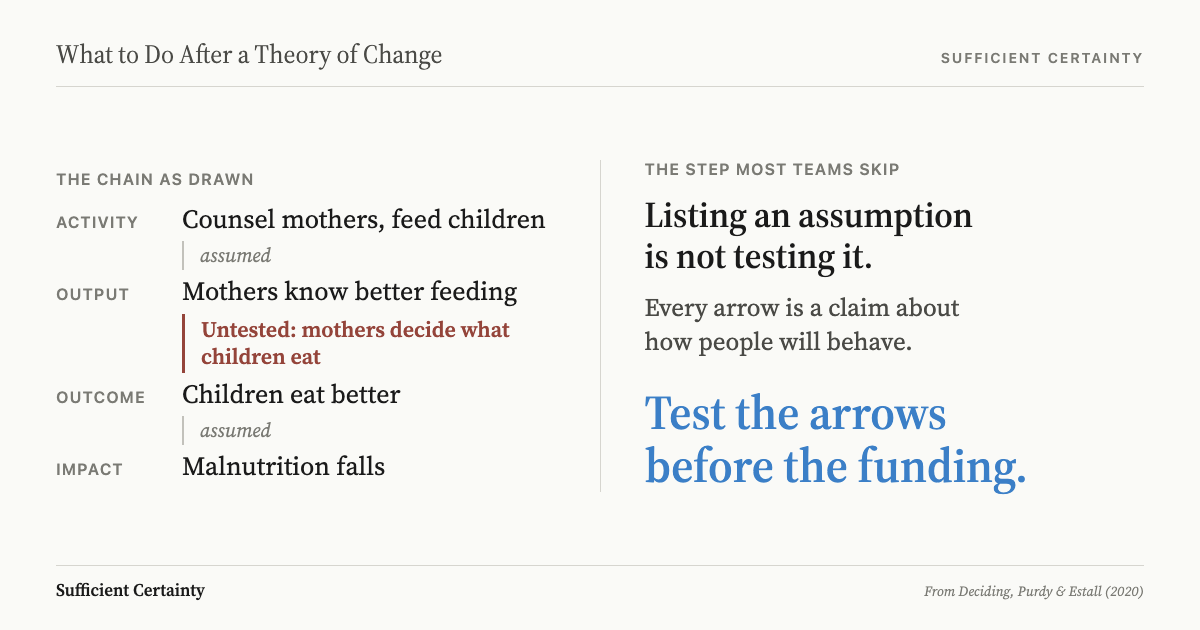
The boxes in a theory of change are mostly things the program controls: train staff, deliver food, run sessions, count attendance. The arrows are not. Each arrow is an if-then claim about how other people will respond, the same structure that sits under most strategic thinking examples. If mothers are counselled, then feeding practice changes. If feeding practice changes, then child nutrition improves. The boxes describe the plan; the arrows carry the risk.
In a 2012 review for the UK Department for International Development, Isabel Vogel reported that several interviewees called the theories of change they had seen "superficial" and mechanistic. In weak logframes, she noted, the assumptions column "has come to be used almost as a 'too hard' column": a place to park factors the program will not try to influence. One approach the review describes is "unpicking the 'arrow'", one causal link at a time.
The list below shows the kind of assumptions that sit on the arrows of a typical community program. Usually one or two have evidence behind them. The rest were written down and then treated as settled, the same pattern that shows up across assumptions in decision-making more generally.
None of these is exotic. Each is the kind of line that appears in the narrative beneath the diagram, reads as reasonable, and passes review. A reviewer's nod is not evidence. Each line props up a specific arrow, and the arrow is the unit to test, not the list.
The Bangladesh Integrated Nutrition Project broke at the arrows, not the boxes
The World Bank approved the Bangladesh Integrated Nutrition Project (BINP) in May 1995, with a US$59.8 million IDA credit toward a total cost of US$67.3 million, according to the Bank's project record. It closed in June 2002. Modelled on the acclaimed Tamil Nadu Integrated Nutrition Project in India, it weighed infants at village stations, admitted children whose growth was faltering, and gave their mothers nutrition counselling and the children supplementary food.
The chain was explicit. Project documents expected the main impact to come through counselling, on the view that ignorance rather than poverty drove malnutrition. Participation looked strong: around 90 percent of eligible women brought their children. Monitoring data showed falling malnutrition, and the Bank decided to scale up to a National Nutrition Program about midway through, before any evaluation.
In 2003, Save the Children UK reported that its own comparison found no difference between project and control areas. The question was which links in the chain had failed.
The Bank's Operations Evaluation Department then compared project areas with a matched control group in Maintaining Momentum to 2015? (2005). It found no significant impact on nutritional status, apart from a positive effect on the most malnourished children. Howard White (2009), who worked on the evaluation, traced the failure link by link.
In rural Bangladesh men did the shopping, and in joint households the mother-in-law ran the women's domain. Participation was significantly lower among women living with their mother-in-law in more conservative parts of the country. Women who learned good practice often did not apply it. One focus group told investigators: "when our mothers-in-law have passed then perhaps we will do these things you are telling us, but until then we will do it the traditional way."
Other arrows failed too. Most community nutrition practitioners could not correctly read the growth charts used to admit children. Supplementary food leaked to others or replaced meals. The fall in malnutrition was national, driven by rice yields and incomes. The National Nutrition Program kept the same model, untested links included, and closed early.
From listed assumptions to tested arrows
The step belongs between the approved diagram and the signed results framework, and at the latest before the baseline survey design is locked. The artefact to check is the assumptions column or narrative, read against each arrow. The method maps onto a theory of change directly:
- Frame: name the decision the diagram supports (fund, scale or redesign) and whose purpose it serves.
- Tentative Elements: treat every box and arrow as provisional until evidence is in.
- Assumptions: rewrite each arrow as an if-then claim and mark which ones have evidence behind them.
- Sufficient Certainty: decide how much evidence the critical arrows need before money is committed.
- Implement and Monitor: build the weakest arrows into the baseline and monitoring plan, with a trigger that returns the decision to the board.
Testing an arrow rarely means a trial for every link. It means ranking the arrows by how much budget rides on them and how little evidence supports them, then choosing the cheapest check that could change the decision: a literature review, a few focus groups, a look at who actually holds the household purse. Thin evidence on an arrow is ordinary decision-making under uncertainty. The same ranking applies after a strategic gap analysis.
For BINP, the third step alone would have asked who decides what a child eats. White traces the evaluation's mother-in-law insight to anthropology of rural Bangladesh published in 1992, three years before the project was approved. Approve the theory of change only after the arrows that carry the money have been tested.
You could list every assumption in a theory of change and still leave the arrow that carries the funding untested.
Work through your decisionNo sign-up. Just pick your decision and start.
Grant Purdy is the co-author, with Roger Estall, of Deciding (2020), and the architect of the Universal Decision-Making Method.