
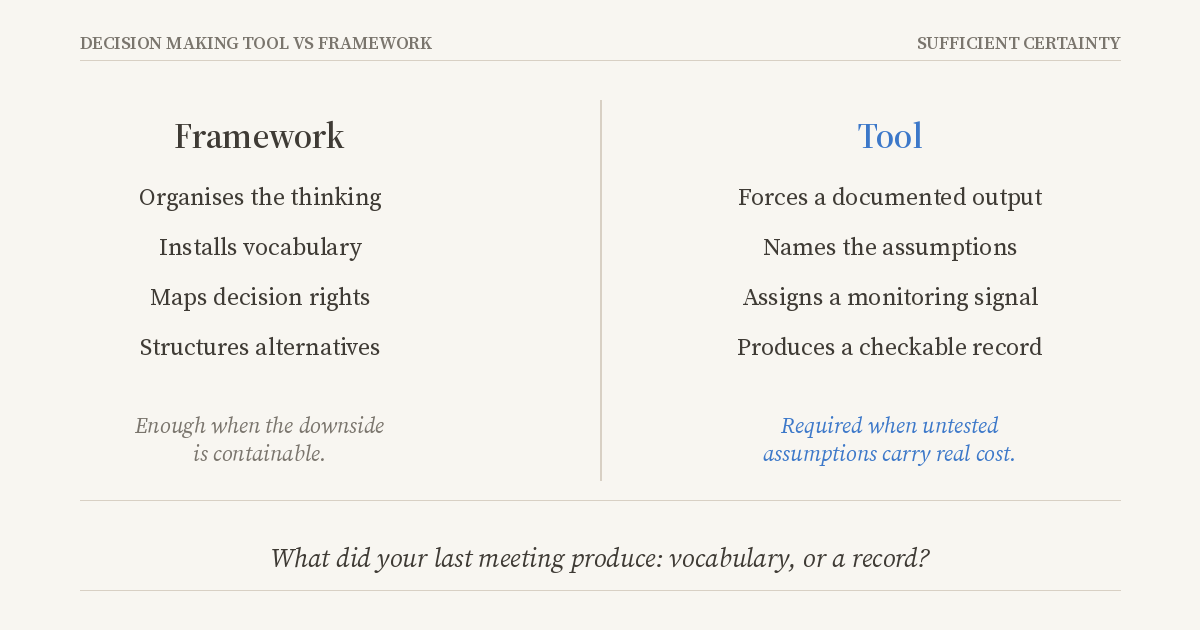
Decision making tool vs framework is a distinction that matters when material commitments are on the table: a framework organises how a team thinks about a decision, while a tool forces the room to produce a testable artifact. Organisations adopt frameworks and never measure whether decisions improved; that measurement gap is what actually costs money.
I have watched teams adopt frameworks with genuine enthusiasm. They run workshops and fill in RAPID matrices. They map decision rights on whiteboards and leave the room feeling productive. Six months later the same team is back in the same room with the same unresolved commitment. The framework installed correctly; the decision never got made.
I built the Walk so that the distinction between thinking and committing is forced. The room finishes with a Decision Record: the commitment at the top, the assumptions ranked underneath, a monitoring signal attached to each one. If nobody in the room can name the assumption that carries the most weight, the session is not finished.
A team lead asking whether the department needs a framework or a tool is really asking: what must exist after the meeting that did not exist before it? I ran a workshop in 2019 where a facilities team adopted a framework, produced a wall of post-it notes, photographed them, and never opened the photograph. The framework had been followed. The decision about which building to consolidate into sat untouched for another quarter.
A decision making tool produces a reviewable output from a single decision event, while a framework organises the approach without requiring that deliverable.
What a decision making framework covers
Carl Spetzler and the Strategic Decisions Group at Stanford built the clearest version of what a framework can do. Their Decision Quality framework names six elements of a sound decision; the first five address how the decision is framed and what alternatives deserve serious examination. The sixth element is commitment to action, and Spetzler is unusually honest that this is the one most decision processes leave out.
I have no argument with any of that. A team that frames the decision properly and generates real alternatives has done serious work. What I have seen, in boardrooms and project steering committees across four decades, is that the serious work ends at the whiteboard. The team disperses; the decision making framework delivered structure; nobody wrote down what the structure rested on.
The Walk forces that separation. It requires the room to name which assumptions carry the decision and what signal will tell them an assumption has failed. If no assumption is written, the workshop produced comfort, not a commitment.
When a framework is enough
A framework is enough when the choice is bounded and the downside is containable. If your team is selecting a vendor from a shortlist, and the cost of switching is a few weeks of disruption, a structured comparison will do. A decision matrix that scores the options is a perfectly adequate tool for that scale of commitment.
The distinction is not complexity; a decision can be complex and still bounded. It becomes a different kind of problem when the assumption underneath the preferred option can hurt capital or the organisation's licence to operate, and nobody has written down what that assumption is.
That is where the decision needs a written record. Not a summary of the meeting, not a set of minutes. A document that names each critical assumption and says who will act when one of them fails. Without it, the team has agreed in principle and committed to nothing in particular.
I sat through a session where a team spent two hours scoring software vendors, then approved a market entry over coffee with no record. The vendor choice can run on a team decisions weighted score. The market entry, where the cost of being wrong is not disruption but jobs and institutional trust, needs every critical assumption written down and owned.
Take the framework your team adopted and find the assumption it organised but never tested. Start the Walk →
What frameworks skip
Bain's research on decision effectiveness found that most companies that adopted a decision framework never checked whether their decisions actually improved. They installed RAPID and measured success by adoption rate: how many teams are using the process, not how many decisions got better. The consultancy that sold the installation benefits from that metric. A framework that is hard to measure is also hard to blame, and a framework that is hard to blame is easy to renew.
I chaired reviews where the risk register had been updated quarterly for years and nobody could name the assumption that mattered most to next quarter's decision. The register existed and the framework had been followed. The decisions kept being made in the corridor, where the real commitments happen and the register never reaches.
ISO has published more than 40 formal definitions of risk. The advocates who draft those definitions have built careers on the vocabulary; one more revision means one more conference, one more consulting engagement, one more edition of the guidance document. The organisations that adopt them get a standard to cite in the annual report and no instrument to apply to a Tuesday afternoon decision. That is the decision making tool vs framework gap: the framework industry thrives on refinement, not on results.
Gary Klein's premortem is the best-known example of a tool that is not a framework. A team imagines the project has already failed and generates concrete reasons why. Research by Mitchell, Russo and Pennington found that prospective hindsight increased identification of reasons for future outcomes by 30 per cent. One session and one output: a ranked list of failure modes. That is what makes it a tool.
The premortem surfaces failure modes, but it does not test the assumptions underneath them. It asks what could go wrong without asking what the room is assuming. I saw a project team run a premortem that surfaced twelve failure modes and missed the one that killed the project: nobody had tested whether the supplier could actually deliver at the volume the business case assumed. The Walk starts where the premortem stops, at the step after a premortem that most teams skip. It names each assumption and tests whether the evidence supports it, then writes the monitoring signal before the commitment hardens.
The output a framework cannot produce
The Walk produces a Decision Record. The document names the decision and its Purpose at the top, then ranks the critical assumptions by influence and confidence. A monitoring signal attaches to each one: who will act when conditions change, and what will trigger that action.
The record is short by design. If a Decision Record turns into a report, people start defending paragraphs instead of owning the call; that is where the framework habit reasserts itself.
The full decision making tool guide covers which tools work and which do not. The Decision Record is what separates them: a framework that does not produce one is a process, not a tool.
The five steps of the Universal Decision-Making Method do both jobs. They structure how a team thinks about a decision (the framework half) and force a documented output at the end (the tool half). That dual nature is what the decision making tool vs framework distinction resolves in practice: only the tool half creates accountability, because only the document can be checked after the event.
Roger Estall and I wrote Deciding because we had sat through too many meetings that produced analysis without a commitment attached. The Walk exists because thirty years of watching that pattern is enough: the room that leaves without a written record of what it assumed will meet again, sooner than it expects, to make the same decision with less information and less time.
Who benefits from that arrangement is clear. The people selling the process and the people hiding behind it prefer the framework to remain vague, because a vague framework is hard to challenge and even harder to blame.
You could debate the difference between a tool and a framework and still leave the assumption carrying the decision unwritten.
Work through your decisionNo sign-up. Just pick your decision and start.
Grant Purdy is the co-author, with Roger Estall, of Deciding (2020), and the architect of the Universal Decision-Making Method.