
A decision science example is only instructive when it shows the recorded reasoning, not just the outcome. Most case write-ups celebrate the result and skip the judgment that produced it. The four cases here expose the assumptions each team tested before it committed to a course of action.
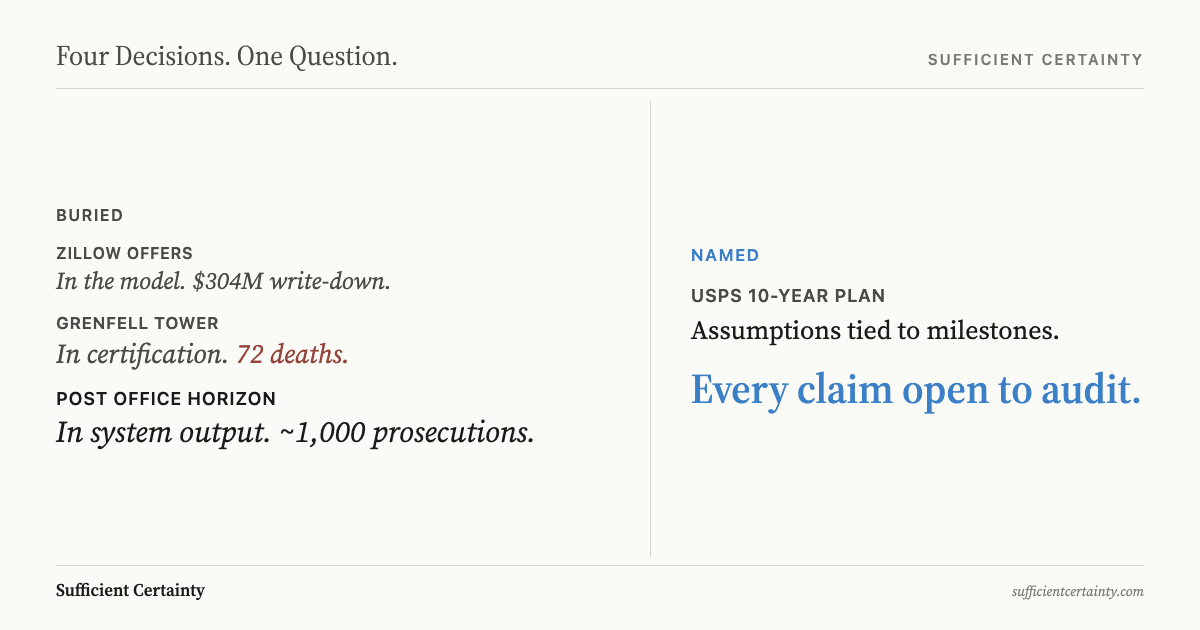
USPS tied a 10-year plan to milestones people could inspect. Horizon turned a faulty system report into courtroom scripture. That gap is the point of a decision science example.
When people ask me for a decision science example, I do not send them to a department website. I look for the point where a real organisation either named the claim it was relying on or buried it in process. Once I can see the hidden claim, I can see whether the room decided anything or merely filed another committee paper.
A decision science example is a real decision shown clearly enough for you to see what had to be true before action and how it would be checked after commitment.
What a decision science example has to show
A real example has to show the decision itself and the premise carrying the weight. If the premise stays hidden, the document is paperwork, not decision work.
This is why I wrote the Universal Decision-Making Method. The discipline is simple: state the decision, name the assumption that has to hold, and set the check before commitment.
Most published examples miss the point because they talk about tools. I do not care how sophisticated the tool looks. If it hides the live assumption, the meeting stops thinking and the paper starts impersonating judgement.
Decision science example 1: USPS tested the plan before commitment
The cleanest case in this set is the United States Postal Service. Its Office of Inspector General review describes a 10-year plan built around 13 strategic focus areas and 175 initiatives, with the review examining 58 of them. The plan aimed for positive net income within three years and break-even over ten, and it tracked risk through milestones and weekly executive reviews.
I call this real decision work because the plan was treated as a set of claims that had to survive contact with events. Postal executives still benefited from presenting a disciplined strategy, of course, but the OIG review left them less room to hide because the assumptions were attached to milestones people could inspect. Nobody hangs an audit schedule on the boardroom wall, which is one reason I trust it.
USPS built the check into the commitment instead of waiting for disappointment to improvise one later. Most teams bolt monitoring on later, once the decision has already started misbehaving. That is the gap between applied decision science and the meeting that merely agreed.
Decision science example 2: Zillow scaled as if the model had answered the question
Zillow Offers shows the opposite pattern. In its November 2, 2021 filing, Zillow said it would wind down the business because home prices had become unpredictable and the operation was running into capacity trouble. The filing recorded a $304.4 million inventory write-down, forecast another $240 million to $265 million of charges on homes under contract, and said the wind-down would cut about 25% of the workforce.
The problem sat in the decision discipline, not the modelling skill. Zillow behaved as if the pricing model settled the matter while renovation throughput and local execution were still sliding underneath it. Executives and investors both benefited while the growth story held together, because the model gave everyone a polished object to point at when the houses and the contractors stopped agreeing with each other. A forecast cannot refit a bathroom or unclog a contractor queue, however flattering the spreadsheet looks.
If the business cannot name what would make it pause, the model has not answered the question. I would have wanted trigger points for pricing variance and operational backlog before scale turned into inventory risk. That is the ground between decision science and data science, and Zillow never stood on it.
Compare your current call with four failed assumptions and pin down the exact claim your team is protecting. Start the Walk →
Decision science example 3: Grenfell Tower certified the assumption it should have tested
The Grenfell Tower Inquiry Phase 2 Report showed what happens when compliance paperwork replaces physical testing. The refurbishment clad the tower in aluminium composite panels with a polyethylene core. Building control officers certified the work without testing whether the cladding system, as actually installed, met fire safety requirements. On 14 June 2017, the fire killed 72 people.
I do not call that oversight. I call it an assumption nobody wanted tested. The manufacturer knew the product had failed full-scale fire tests but kept marketing it for high-rise use. The local authority treated compliance as a paper exercise because physical testing would have slowed the program and cost money. The Tenant Management Organisation wanted the refurbishment done. Everyone who could have demanded evidence had a reason not to.
Britain had building regulations, approved documents, and testing standards. What it did not have was anyone obliged to state the critical assumption, "this cladding assembly is fire-safe as installed," and then verify it before the building was reoccupied. A proper decision standard names the claim carrying the commitment and sets a stopping rule before people are exposed to whatever happens next.
Decision science example 4: Horizon protected a premise too important to revisit
The Post Office Horizon scandal shows the same failure with more cruelty. In Volume 1 of the final report, the chair said there are about 10,000 eligible claimants in the redress schemes. He also said approximately 1,000 people were likely prosecuted and convicted on Horizon evidence, and he could not rule out Horizon as a real possibility in the deaths of all 13 people linked by the evidence before him.
Post Office executives, lawyers, and prosecutors all benefited from treating Horizon as gospel, because reopening the assumption would have wrecked prosecutions and exposed their own conduct. I have no patience for the pious language that arrived later. Horizon acquired the manners of a witness that could never be cross-examined.
In smaller organisations the same trick is cruder: the manager who made the first call starts protecting it because retreat would cost face. Horizon simply industrialised the habit. That is why I do not romanticise intuitive decision making on novel, high-stakes calls. Once the system report outranks contradiction, the institution is protecting itself, not deciding.
What I want asked in the room
The question I want asked in every important meeting is simple: what has to be true for this to work, and how will we know early enough if it is failing? If nobody can answer, I do not think the room has reached a decision standard worth trusting.
This is the standard Roger Estall and I argued for in Deciding: name the claim before the room commits, then name the evidence that would reopen it. Uncertainty does not disappear when the room votes. It merely stops being fashionable to mention. Decision science is the discipline of keeping it visible anyway.
USPS is the exception here because it left its claims exposed to inspection. The other cases turned support tools into alibis. Zillow could hide behind the model, Grenfell could hide behind compliance paperwork, and the Post Office could hide behind system outputs that let responsible people keep their hands looking clean.
You could run another case study and still never name the claim carrying your decision.
Work through your decisionNo sign-up. Just pick your decision and start.
Grant Purdy is the co-author, with Roger Estall, of Deciding (2020), and the architect of the Universal Decision-Making Method.