
Intuitive decision making is compressed experience, not a leadership gift. The instinct fires fast because the pattern has been seen before. One question exposes whether the pattern still fits the terrain: what does this call assume, and has that assumption been checked against current conditions?
Ron Johnson arrived at J.C. Penney in 2012 with Apple's retail glow still on him and the confidence of a man who had already been right in public. He scrapped coupons and reset pricing, then moved fast. Within a year, sales were down 24.8 per cent and the net loss was $985 million. People later dressed this up as intuitive decision making, as though past applause gave him a passport to a different shop.
I do not romanticise the gut. Sometimes it is excellent. A fast judgement in familiar terrain can beat a slow committee. Sometimes it is just memory in a better jacket, though boards prefer to call that a leadership gift. When the setting changes or the feedback arrives late, the gut starts trading on old wins.
Intuitive decision making is judging a choice by patterns learned from prior experience rather than by fully explicit analysis at the moment of action.
Intuitive decision making is compressed experience
Kahneman and Klein tried to settle the argument in 2009. They asked when gut calls actually deserved trust instead of repeating the usual fight. Nobody listened, naturally. Their paper lands on a plain condition: the environment must offer stable cues, and the person deciding must have had enough practice with feedback. There is no magic in that. It is repetition leaving a mark.
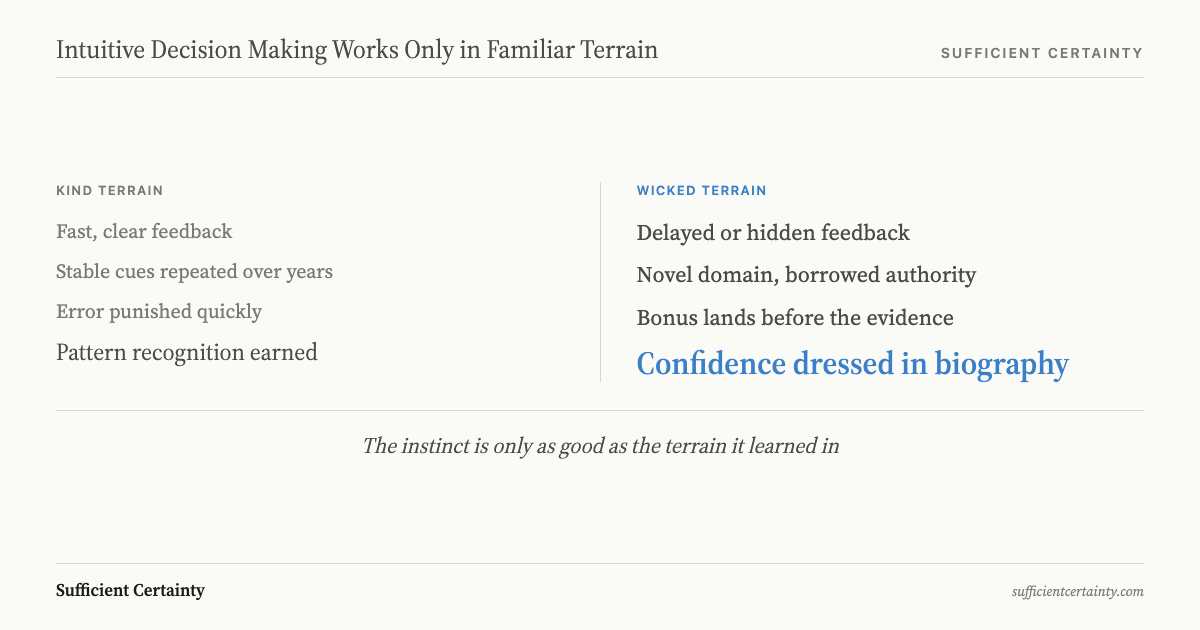
Hogarth and colleagues gave the split a useful name in their paper on kind and wicked learning environments. Kind settings teach clean lessons. Wicked settings pay out late and hide causes, so confidence can outlive accuracy. A firefighter gets corrected in minutes. A venture capitalist can fund the wrong thesis for three years before the market settles the argument. The boardroom version comes back to the same dull truth: intuition helps only inside the edge of actual expertise. Titles do not rescue you from that. A chief executive can be very experienced and still be inexperienced in the decision sitting in front of him.
That is the point I make in behavioural decision science, and I see it in ordinary operations. I trust an experienced plant superintendent when a line sounds wrong before the reading moves. That setting punishes error quickly. The line either behaves or it does not. I do not give the same deference to a strategist who says an acquisition simply feels right. That world hides feedback inside delay and office politics, which is a lovely arrangement if you enjoy being wrong in slow motion.
Pressure-test your instinct on a live call and find out whether memory is reading the terrain or bluffing. Start the Walk →
Intuitive decision making fails when old wins do the thinking
If your instinct was learned at Apple, why should J.C. Penney obey it? The 2012 results are savage reading, and the Harvard case summary makes the failure plain. Johnson pushed through pricing and store changes quickly, with little market testing, because a pattern that had worked in one retail world felt transferable to another. Apple had customers trained to admire a polished experience. Penney had customers trained to hunt bargains. At J.C. Penney he was wearing Apple's badge in the wrong shop.
I have seen the same mistake play out in smaller rooms for decades. The turnaround specialist assumes her retail instincts travel. The mining executive walks into healthcare carrying confidence as though it were a transferable qualification. Nobody stops to ask what the choice actually depends on being true, because that question sounds like doubt, and doubt does not get people promoted. That is why I keep returning to the assumptions inside the decision. If nobody can say what has to hold for the instinct to make sense here, it is still guesswork, only dressed in biography.
Delayed feedback is where intuitive decisions start bluffing
Boyles and colleagues describe a brutal setting in tuberculous meningitis diagnosis: the signals are messy and the tests are imperfect, while delay kills. The conventional approach leans heavily on experience and intuition, and treatment decisions become variable and inaccurate. When the world takes too long to tell you that you were wrong, intuitive decision making can feel expert long after it has stopped being accurate.
Burke and Conway show the better habit in their review of hospital nurses. Nurses used early warning scores, then applied judgement to decide whether escalation was needed. The instrument did not get a veto, and neither did the hunch. The difference is that nurses do not have the luxury of pretending delay is careful thought. That is close to what I mean in the science of decision making: structured challenge, then judgement.
Wicked environments reward the smooth sponsor whose story lands cleanly, and the strategist whose bonus lands before the evidence does. They also suit the committee chair who wants calm minutes more than a live argument. That bad call hardens into folklore before anyone checks the result. By then the presenter has usually moved on, which is convenient when charm outran the evidence. Accuracy gets audited months later, if at all.
Keep the instinct, expose the assumption
I do not tell leaders to ignore intuition. That advice usually comes from people who have never had to decide anything by Friday. The first answer often carries a real pattern. Roger Estall and I built the Universal Decision-Making Method in Deciding for this exact job: put the instinct into words, then test whether the assumptions underneath it have enough support.
Once the instinct is written down, the room can do the hard work behind the broader case for decision science. Does this setting actually resemble the one that taught the pattern? What would tell us quickly that it does not? Those two questions save more bad decisions than any sermon about trusting yourself.
I also want a trigger before the decision closes. If the instinct rests on customers tolerating a new price, say what sales movement proves it wrong. If it rests on a supplier hitting a date, say when the decision comes back onto the table. Used properly, intuitive decision making is the opening bid, not the final vote. We do not need perfect certainty. We need a visible way back when the pattern proves false, and someone willing to name that moment in advance.
You could trust the old instinct and discover the new terrain does not care.
Work through your decisionNo sign-up. Just pick your decision and start.
Grant Purdy is the co-author, with Roger Estall, of Deciding (2020), and the architect of the Universal Decision-Making Method.