
Decision science vs data science is not a career choice. One side builds the model. The other decides when the model is good enough to act on. Most organisations have strong data science and weak decision science, which is how a machine can issue 60,000 fraud determinations with nobody owning the call.
Between October 2013 and March 2015, Michigan's MiDAS system issued 60,324 intentional-misrepresentation determinations on 47,350 unemployment claims. The notices went out as if the machine had already decided. That is where decision science vs data science stops being academic and starts landing on people.
I have watched milder versions of the same dodge for years. A score borrows authority, then the people using it try to leave liability behind.
Vendors sell the blur because "decision" invoices better than "helpful statistics". Committees like it because a score sounds firmer than a judgment. None of that answers who owns the call, which is why many decision-making frameworks glide past the ugliest moment, when the score and the facts on the ground disagree.
The difference between decision science and data science is the difference between analysis that finds patterns and the work of judging whether those patterns are strong enough to act on.
Where decision science vs data science actually splits
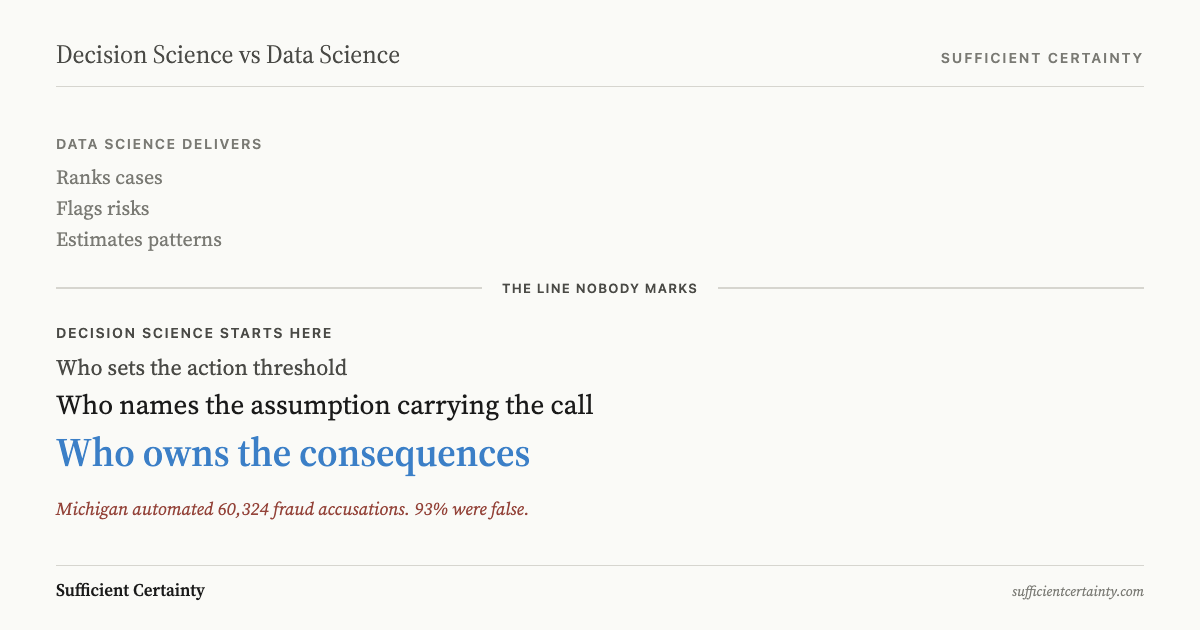
Even regulators, who help generate plenty of paperwork themselves, usually admit the model is only support. In its 2025 review of AI in financial services, the U.S. Government Accountability Office said banks and regulators use AI to flag risks and support staff work, not to serve as the sole source of a decision. Vendors keep trying to blur that line because "decision support" is a smaller sale than "decision intelligence".
That is the real split. Data science can rank cases or estimate patterns. Decision science begins when somebody must set the action threshold and say what evidence would reopen the call. In the Universal Decision-Making Method, the work is to Frame the decision and Recognise assumptions before anybody acts on the score.
This is the awkward gap inside most organisations. The data team thinks its job ended when the score became accurate enough to demo. The operating team thinks the score means the hard thinking is over. In my experience, the dangerous part sits between those beliefs, because nobody has written who may override the model or what evidence beats it when the case is odd.
The first sign of trouble is rarely a bad model. It is a meeting where everyone can explain the metric and nobody can answer a simpler question, what happens to the person on the receiving end if the score is wrong? Committees drop that question because it is awkward, and awkward questions are bad for minutes.
Separate the model from the decision on your next scorecard and decide who owns the judgment to act. Start the Walk →
Why data science turns dangerous when it starts deciding
The FDA draws the same boundary in clinical decision support. If a clinician cannot independently review the basis for the recommendation, the software is not support anymore. It is trying on a white coat, and the sales team would love you not to notice.
The trouble becomes obvious when nobody designs the decision around the model. In a JAMA Internal Medicine validation study, Epic's sepsis model was tested across 27,697 patients and 38,455 hospitalisations. Sepsis occurred in 2,552 of those hospitalisations. At the chosen threshold the model missed 1,709 sepsis cases, 67 percent of the total, while still flagging 6,971 hospitalisations. Those numbers show the hospital still needed a human judgment about when the score counted and what review rule would catch what it missed.
Hospitals are not special here. I have seen the same move in fraud controls and compliance screens. Once a model is treated as a first answer rather than a provisional input, staff start defending the system instead of examining the case. That reversal is useful to managers because "the model said so" sounds cleaner than "we chose to act on thin evidence".
I come back to the same point in my piece on the science of decision making: the missing step is usually the action threshold and the review rule around it, not another layer of analytics. When those are vague, the model becomes a costume for managerial cowardice.
What Michigan proved about decision science vs data science
MiDAS matters because it exposed the arrangement in daylight. The Michigan Auditor General documented the automated fraud regime, and the Michigan Court of Appeals later noted a review finding that about 93 percent of those fraud adjudications were false positives. That is where decision science vs data science stops being a taxonomy problem and becomes an accountability problem.
Later the state announced a $20 million settlement, and the agency said its reforms included more than 62,000 overpayment waivers. The harm came from turning pattern detection into adjudication, which was convenient for agencies that wanted volume and for managers who wanted procedural cover while real people carried the accusation.
When people ask me about Michigan, I do not hear a software story first. I hear officials giving a machine judicial status because fast accusations saved time and shifted blame. Officials granted that privilege, then acted surprised when the bill arrived.
How I keep data science in its place
Roger Estall and I wrote Deciding after watching reports and dashboards take on a life of their own. The trick is always the same: a number arrives looking objective, then the room starts treating dissent as incompetence.
If a board hands me a model output and asks whether it is enough, I slow the room down. I want one plain page that names the action and the assumption carrying it, then says what evidence would reopen the call next week. A board that cannot do that is not using data science well. It is outsourcing judgment while pretending not to.
That is the practical core of the wider decision science argument. We are trying to reach Sufficient certainty, then Design monitoring so the call can be revisited before the damage compounds. If that sounds less glamorous than a machine deciding for you, good. Glamour is usually how the invoice gets approved.
If nobody can do that, the score already has too much power. That suits vendors with a story to sell, committees wanting a shield, and agencies keen to process people at scale, because each of them can pretend the system made the call when a person plainly chose to let it happen. The same evasion runs through every case I examined in applied decision science.
You could forward the next score and leave the judgment to nobody.
Work through your decisionNo sign-up. Just pick your decision and start.
Grant Purdy is the co-author, with Roger Estall, of Deciding (2020), and the architect of the Universal Decision-Making Method.