Decision science is not a department, a degree, or a model stack. It is the discipline that surfaces the assumption underneath the recommendation, tests whether it holds, and forces someone to own the call before the supporting analysis is mistaken for the decision itself.
When people ask me about decision science, they usually expect a department, a degree, or a model stack. I mean the point in a live commercial call when the reports stop helping and somebody has to own the assumption underneath the recommendation.
I am not hostile to academics or analysts. I am hostile to the small fraud by which supporting machinery is treated as the decision itself. That fraud is common because it offers cover. A neat deck can be admired by six people without one of them actually making the call in time.
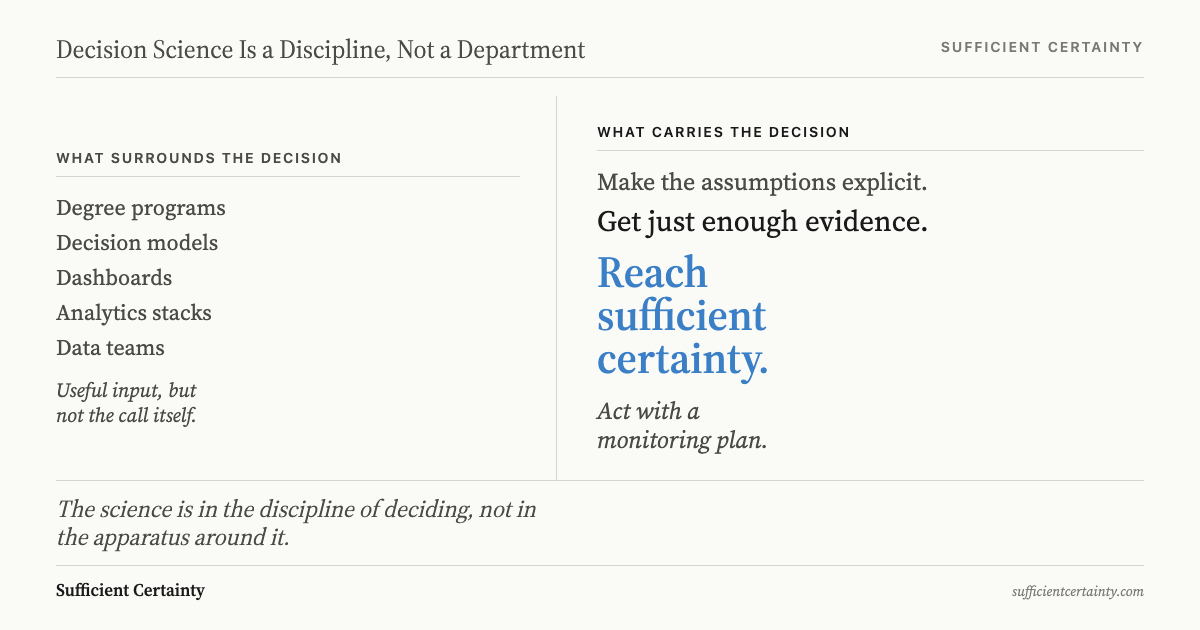
Decision science is the discipline of making assumptions explicit, testing what matters, reaching sufficient certainty, and acting with designed monitoring.
What decision science actually means
I use the price of a new product because it looks factual until time enters the room. Production cost and freight can be known this morning. The selling price still rests on what happens before the first shipment lands.
If resin, freight, or exchange rates can move, the number is only as sound as the conditions beneath it. The useful move is not to add another decimal place. It is to ask which assumption can still hurt the price, then decide whether a price-adjustment clause, a shorter quote life, or a smaller first order reduces the exposure.
The Universal Decision-Making Method exists for exactly that job. It drags the decision out of the spreadsheet and into plain language: what are we deciding, what does it rest on, do we know enough, and what will we watch after we act? That is decision science in working form. It improves the call before another report begins impersonating rigour.
People call this harsh because it refuses to let a number stay decorative. Decorative numbers are usually the start of trouble. A price is useful only if the conditions carrying it have been stated plainly enough that someone can challenge them before the quote becomes a hostage.
Is decision science a business discipline or an academic field?
There is an academic field by that name. Good luck to it. Universities can study decisions, model preferences, and produce useful research. A business discipline has a different test: whether the Decider can make a live call with explicit assumptions, enough evidence, and a review rule that will survive contact with Monday morning.
I once watched an organisation decide whether to outsource its IT helpdesk. The useful question was not whether the outsourcing literature was elegant. It was whether response times, internal capability, vendor incentives, and staff disruption had been stated plainly enough that the recommendation could be challenged before the contract was signed.
That is where many decision-making frameworks stop too early. They arrange the room, catalogue considerations, and then drift away before responsibility lands on someone. The practical question behind the science of decision making is simpler: which assumption must hold for this choice to be defensible?
How decision science differs from data science, analytics, or decision analysis
Data science, analytics, and decision analysis can be excellent servants. They become dangerous when their output is treated as a verdict. The National Interagency Fire Center's Predictive Services gets the language right by calling its products decision support. Support is not ownership.
The near-failure of Long-Term Capital Management in 1998 is enough as a warning label. Brilliant models, brilliant people, and leverage that looked defensible until the conditions changed. The model did not decide how much exposure was prudent. People did, under the shelter of impressive mathematics.
The boundary sits exactly there. Analysis produces inputs. Decision science decides how much weight those inputs deserve, which assumptions they carry, and what happens if the conditions stop holding. The confusion between decision science and data science lives in that gap. The study of how people actually choose under pressure, what behavioral decision science examines, matters when it changes who can challenge the call, not when it merely names the bias.
Apply the discipline to a decision you own and find out which assumptions are load-bearing. Start the Walk →
What makes decision science scientific without perfect data?
The scientific part is not that the room contains numbers. It is that the room permits contradiction, cross-checking, and revision before pride hardens. A method becomes scientific when reality is allowed to answer back. Perfect data is not required. An exposed assumption is.
Ignaz Semmelweis showed the point in 1847. The World Health Organization's hand-hygiene history records the pattern plainly: change the practice, observe the result, and let evidence correct authority. The tragedy was not a shortage of data alone. It was the institution's refusal to let the data disturb its status.
That is why my interest in cognitive biases is practical rather than ornamental. A glossary recital changes nothing. The supposed split between the art and science of decision making disappears once you ask which assumption must be tested. The same applies to intuitive decision making: useful pattern recognition in familiar terrain, a liability when the terrain has changed and confidence has not noticed.
How operations leaders use decision science on ordinary decisions
In ordinary operations work, the questions are smaller and less theatrical. They are also where most organisations do the most damage. A supplier promises volume rebates if you accept thinner service terms. The wrong response is to admire the saving. The right response is to ask what must remain true for the saving not to become expensive.
That one supplier decision may rest on lead-time reliability, substitution rights, exchange rates, demand stability, and the supplier's own capacity. The discipline is not to examine everything forever. It is to identify the assumption that can still break the decision and ask what evidence would genuinely change the call.
Participant selection matters as much as analysis. The room needs the people who know where the decision can break, not the people who think attendance is a status symbol. Too many operations meetings are staffed like weddings: impressive numbers, uncertain purpose.
The deeper operational treatment is elsewhere. Five public failures sit in applied decision science. The practical operating version, including how leaders make the method routine, is in decision science for operations leaders. Four case sketches, from Zillow Offers to the Post Office Horizon scandal, are in decision science examples. This page is not trying to do their job for them.
How much evidence is enough before you act?
Enough evidence is the point at which more waiting improves the call less than it costs, which is the practical test behind knowing when the evidence is enough to act. That sentence annoys people because they want one universal evidence threshold, preferably printed in a handbook and blessed by a committee. The world is under no duty to provide one.
The 2002 Oakland Athletics made this visible in public. Billy Beane did not have perfect knowledge about players, and he did not have the Yankees' payroll. He bought the evidence the market undervalued, made constrained bets, and watched the team win 103 games. There is more judgement in that than in many enterprise analytics programs with better catering.
How much is enough depends on what the decision serves and on the cost of being wrong. A plant shutdown, a customer price, and a minor purchasing tweak do not deserve the same burden of proof. Waiting can reduce ignorance, but it can also consume the option you were trying to protect.
That is much closer to sound judgment than to certainty worship. The Decider's question is never whether everything is known. It is whether the conditions doing the heavy lifting are known well enough to act now, wait deliberately, or change the option.
What should you monitor after the decision?
You monitor the condition that can still injure the decision, and you stay suspicious of the monitor itself. Approval is not the end of decision science. It is the point at which the world begins marking your work.
I once worked with a food manufacturer that had precautionary water testing in place. The protection looked sound on paper. In practice, an instrument drifted out of calibration, the readings kept arriving neatly, and the neatness helped the drift go unchallenged. That is how monitoring decays: a control survives long enough to acquire prestige, then nobody asks whether it still deserves trust.
Good monitoring therefore needs review triggers. If calibration is overdue, if readings stay improbably smooth, if upstream conditions change, or if a key assumption starts to fail, the decision must reopen. I want that rule written before money moves or product ships. I also want it to name a person. If no one owns the signal, monitoring decays into a comfort object.
Decision quality either survives or collapses right here. A monitor that cannot itself be checked is just paperwork wearing a hard hat. Paperwork has many talents. Noticing its own decay is not one of them.
You could learn the research, then default to instinct when the stakes rise.
Work through your decisionNo sign-up. Just pick your decision and start.
Grant Purdy is the co-author, with Roger Estall, of Deciding (2020), and the architect of the Universal Decision-Making Method.