
Applied decision science fails before the model shows up. The failure is always the same: nobody owned the assumption underneath the recommendation, nobody recorded the condition that should reopen the call, and the supporting analysis was treated as the decision itself.
At Signature Bank, supervisors issued 36 targeted-review letters and five annual examination reports while uninsured deposits and liquidity weakness kept growing. Twenty-four targeted reviews took more than 100 days, 17 took more than 250, and the bank still carried a satisfactory management rating until March 11, 2023, the day before it failed. That is what applied decision science looks like when nobody owns the live call and the paperwork is allowed to impersonate judgment.
Applied decision science is the practice of committing to a real decision under live conditions, where one person owns the call and the assumptions behind it are recorded alongside the condition that would reopen it.
Where applied decision science actually starts
In my experience, the work starts when somebody can answer a rude question: who is on the hook if we release this code or sign this supplier today? Until a real person owns a real call, the room is only manufacturing paperwork. Committees enjoy that stage because it spreads blame nicely and lets everyone look diligent without being decisive.
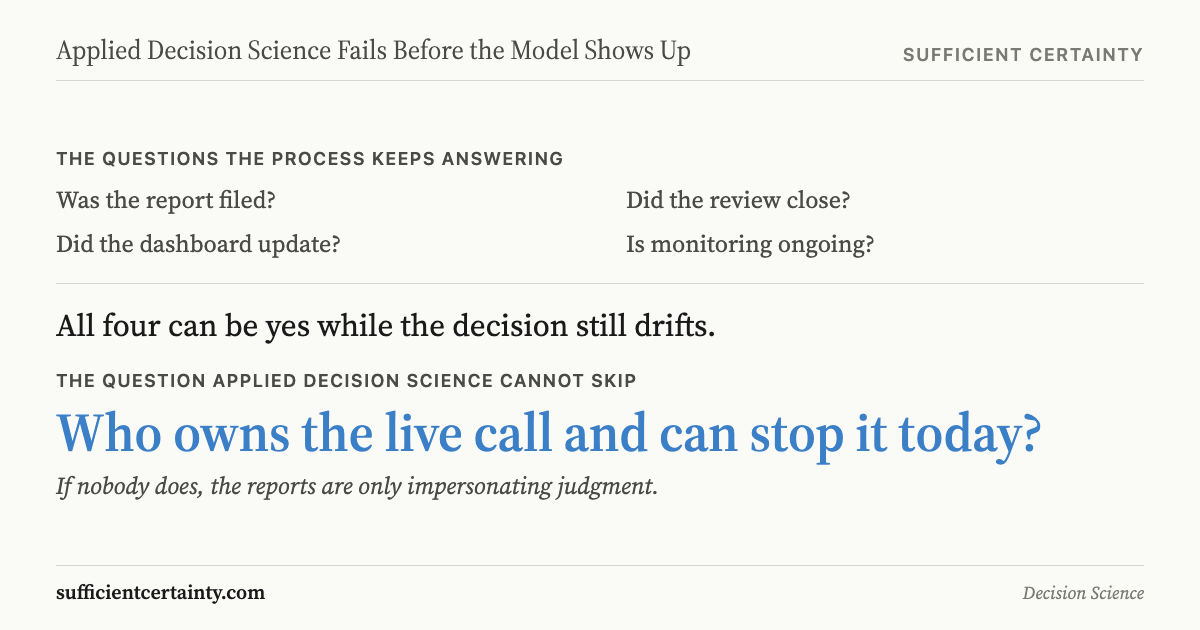
The FDIC's review of Signature Bank shows the operator problem in public. Supervisors kept producing review activity while the bank kept growing more fragile. That arrangement suited plenty of people. The supervisors could prove effort without forcing the ugly call, and the bank could keep enjoying the freedom bought by delay. Specialists can help, but none of them owns the call until someone does.
I make the broader case against that kind of machinery in the main piece on decision science. This piece is narrower. I care about the moment an operator already has the decision on the desk and the reports start trying to chair the room. That is where applied decision science earns the adjective.
The assumption is usually hiding in the ordinary step
Most bad outcomes ride in on an assumption dressed as an ordinary step. In my experience, nobody says, "here comes the fatal assumption." They say, "yes, that was done," and the room moves on.
The NTSB report on Alaska Airlines Flight 1282 says four retaining bolts were missing after nonroutine work on Boeing's door plug, and the required removal record was never created. Nobody needed another coloured status sheet. Somebody needed authority to keep the aircraft on the ground until the bolts were accounted for. Paper systems are very comforting to the people who maintain them. Gravity is less sentimental.
A checklist helps only if it serves the call. Once it starts standing in for the call, it becomes stage scenery, useful mainly to managers who want proof of process without the inconvenience of refusal. I have sat through dozens of assurance reviews where every box was ticked and nobody could tell me what would actually change if the answer had been different.
The CrowdStrike root cause analysis carries the same lesson into software. A content template expected 21 inputs, the sensor code supplied 20, and the mismatch escaped into a global outage. Release machinery often suits teams that are praised for movement, because restraint is harder to celebrate in a release meeting. The science of decision making predicts exactly that kind of social pressure. But the practical miss at CrowdStrike was narrower: nobody had stated the input-count assumption in a form that could halt promotion to the next ring.
Map your ordinary next step through the five stages and surface the assumption hiding inside the routine part. Start the Walk →
Applied decision science stops at Sufficient certainty
Sufficient certainty is the stopping rule, and most organisations resist it because it ends the meeting. That phrase sits in the Universal Decision-Making Method for a reason. People keep pretending that another model or another sign-off round will spare them the discomfort of committing.
NASA's Starliner investigation is a hard public example. The first crewed test launched on June 5, 2024, for an eight-to-14-day mission. It turned into 93 days, the capsule returned uncrewed, and NASA's 2026 report blamed hardware trouble and leadership failure while noting the pressure to keep two crew providers in play. Schedule promises and institutional pride always have champions. In a program that size, dozens of careers depend on the vehicle flying on time. Someone should still have been able to say, plainly, that the evidence was not yet good enough for the call being forced through.
Roger Estall and I wrote about that habit in Deciding years ago. When stopping feels exposed, organisations keep buying more analysis because delay looks responsible and keeps the consultants and internal champions in play. In my experience, the honest question is whether the remaining uncertainty matters enough to reopen the call. That is closer to sound judgment than to bureaucratic courage.
How applied decision science handles monitoring
Monitoring is part of the decision, not a mop-up job afterwards. If nobody names the trigger and the person who must reopen the call before commitment, the organisation is not monitoring anything useful. It is running a ritual, which suits assurance teams nicely because rituals produce tidy records and very little interruption. I have watched organisations spend months building dashboards that nobody is authorised to act on.
After the outage that affected 8.5 million Windows devices, CrowdStrike added staged deployment rings and tighter acceptance checks. After the Alaska Airlines blowout, Boeing created move-ready risk assessments and a Product Safety and Quality Plan. Those changes matter only if someone is obliged to act when the signal turns bad. Otherwise the new machinery simply gives the next postmortem more stationery.
Analytics will surface the anomaly, but analytics cannot own the call. That distinction runs through decision science vs data science, and it matters here because dashboards carry no authority. My test is rougher. Who can stop the release or supplier change today, and what evidence lets them do it? If the answer dissolves into a committee pack or "ongoing review," the machinery is still running the show because it spreads blame and keeps invoices alive. Without that ownership, applied decision science is just a label glued onto a review pack.
I walk through those questions using the Intel and Boeing cases in decision science for operations leaders.
You could commission another model and still dodge the live call.
Work through your decisionNo sign-up. Just pick your decision and start.
Grant Purdy is the co-author, with Roger Estall, of Deciding (2020), and the architect of the Universal Decision-Making Method.