
Decision science for operations leaders is not about data. Operations leaders already have the data. The gap is between the dashboard and the commitment. Five questions before the next capital call turn the decision you keep deferring into one you can defend to the board when the outcome arrives.
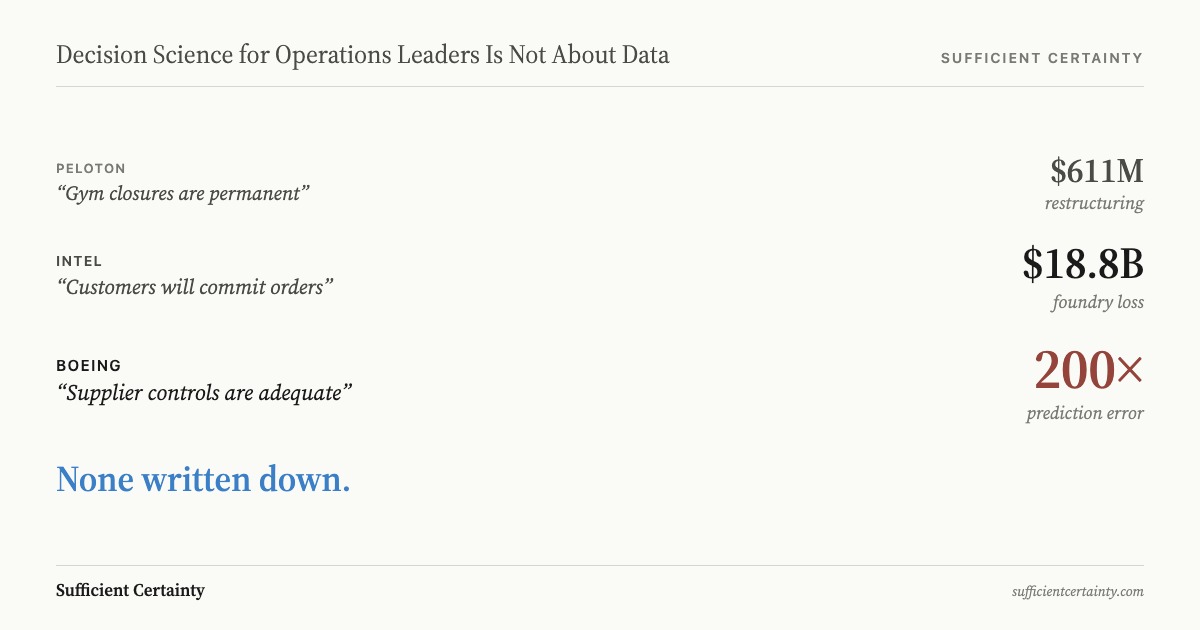
Peloton’s operations team watched orders triple during lockdowns in 2020. They committed $400 million to a new factory in Ohio, spent over $100 million on air freight, and acquired a competitor for $420 million. By 2022, the company had recorded $611.3 million in restructuring charges, laid off 2,800 people, and replaced the CEO.
The assumption that buried them was never written down. Nobody asked whether pandemic demand was structural or temporary. They had data, projections, a demand curve climbing so steeply it felt like fact. What they did not have was a single sentence: “We are assuming gym closures are permanent.” That missing sentence is decision science for operations leaders.
Decision science for operations leaders is the discipline of naming the assumptions behind plant, supplier, quality, and capital decisions before committing resources, and monitoring whether those assumptions still hold.
Decision science for operations leaders is not a specialty
I have spent close to fifty years working with organisations that made operational decisions backed by analytics teams, risk consultants, and modelling software. The organisations that failed most expensively were usually the ones with the longest risk registers. A 47-item register reassures the board. It does not help the person in the room decide.
What saved the ones that survived was somebody asking, before the commitment was made: “What are we assuming here, and how would we know if we were wrong?”
That question is the entirety of decision science for someone running operations. You do not need a team or a budget line for this. You need the habit of asking one question before every significant call, from supplier selection to capital expenditure. The Universal Decision-Making Method compresses it into five steps that fit on a pocket card. The difficulty is not learning them. The difficulty is that most operations environments reward speed and penalise the person who slows the room down to ask what everyone is assuming.
A production manager deciding whether to dual-source a critical component does not need a decision-science degree. She needs to write down the two assumptions behind the choice: whether her current supplier’s lead time is stable and whether the second supplier’s quality is verified. Then she needs to decide whether she knows enough to act.
The capex assumption that cost eighteen billion dollars
Intel’s leadership decided in 2021 to become a contract chip manufacturer for other companies, committing hundreds of billions to new fabrication plants across the United States, Germany, and Poland. Two assumptions underpinned the bet. First, that customer demand for foundry services would materialise once capacity existed. Second, that Intel’s manufacturing process would be ready for high-volume production in time.
Neither assumption was tested against a verifiable commitment from customers. When Broadcom eventually evaluated Intel’s 18A process, it concluded it was not ready for production. Intel recorded an $18.8 billion foundry loss in 2024. The $8.5 billion in government subsidies did not sharpen the thinking. If anything, public money softened it: when the downside is partly someone else’s problem, assumptions go unexamined. The CEO who replaced the original architect of the strategy said the company had “invested too much, too soon, without adequate demand.”
That last phrase is what an invisible assumption sounds like after it fails. If someone had written the sentence, “We are assuming customers will commit orders before we finish building,” the next question would have been obvious: do we have evidence for that? In 2021, the answer was no. That is what the method in Deciding asks you to do: name the assumption, test whether you have sufficient certainty to act on it, and if not, change the commitment sequence.
Walk one deferred operating call through the five steps and expose the capex or forecast assumption carrying the whole bet. Start the Walk →
When the prediction is off by two hundred times
Boeing predicted its 787 Dreamliner lithium-ion battery would experience one thermal runaway event per ten million flight hours. Two events occurred within 52,000 hours. The NTSB investigation found that Boeing had assumed its supplier’s manufacturing controls were adequate. They were not. Battery cells were being hand-flattened from cylindrical to oval shapes, and welding debris contaminated the cells. The entire 787 fleet was grounded for four months.
A prediction error of two hundred times is not a modelling problem you fix with better software. It is a signal that the model was built on assumptions nobody verified. Boeing assumed the supplier’s process was sound. The supplier assumed its own procedures were sufficient. The consultants and certification teams worked from the manufacturer’s own numbers. Nobody’s job was to question whether those assumptions were sound. Several people’s jobs depended on not questioning them.
For operations leaders applying decision science, this is the practical point: a decision is not finished when you commit. Boeing’s battery passed certification, which felt like the end. It was not. The assumptions about supplier quality needed monitoring triggers: incoming cell inspection data, failure-rate tracking against the prediction, scheduled audits of the manufacturing process itself. Designing those triggers before the commitment is the part of the method most organisations skip, because monitoring has no champion and no budget until something fails.
What decision science looks like on a Monday morning
I am not describing a research program. The five steps fit on a pocket card, and I have watched them work in boardrooms, on factory floors, and in procurement meetings where the only available data was the experience in the room. Frame the decision and its relation to what the organisation exists to do. Develop options beyond the one already on the table. Write down what has to be true for the preferred option to work. Test whether you know enough to act on each assumption, or whether you are guessing. Then design monitoring for the assumptions that could shift after commitment.
Every failure in this article traces back to skipping the middle of that sequence. Peloton, Intel, and Boeing all had data and talent, but none of them wrote down the assumptions that mattered and asked whether they had evidence. That habit is what separates the discipline from data science.
A board member once asked me, “Grant, how do you know when you have enough information?” The answer is the same every time: when you can name your assumptions and judge whether the ones that matter most are supported by evidence. If you can do that, you have sufficient certainty. If you cannot, you are not ready to commit, regardless of how many reports are in the drawer.
You could approve the next plant move without naming the assumption underneath it.
Work through your decisionNo sign-up. Just pick your decision and start.
Grant Purdy is the co-author, with Roger Estall, of Deciding (2020), and the architect of the Universal Decision-Making Method.