
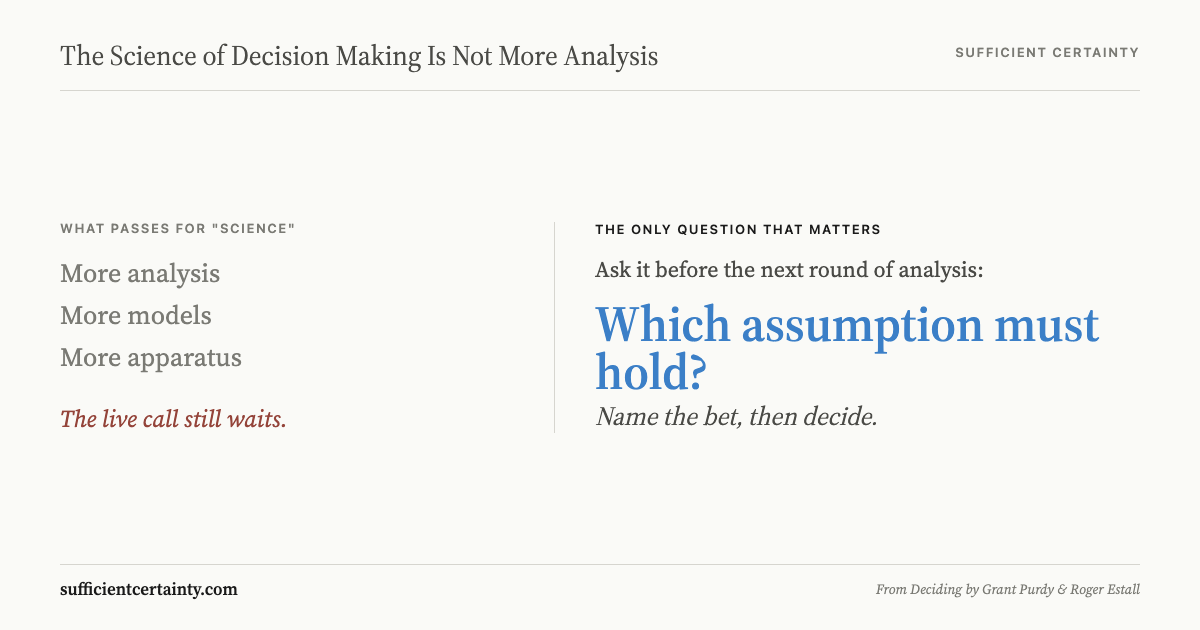
The science of decision making is not more analysis. It starts with the one assumption that must hold for the commitment to work. Miss it and more data only delays the call. Find it and the team knows what to test, what to watch, and when to reopen the decision.
A utilities board once pulled me into a Friday meeting because a regional water-treatment plant had missed turbidity limits twice in six hours. Everyone had papers and a dashboard, yet nobody could say whether the science of decision making required a precautionary shutdown or a narrower response while more samples came in. That is where this phrase becomes useful, or useless.
If you search the phrase, you quickly meet the Decision Sciences Institute, the Society for Judgment and Decision Making, and the Decision Sciences Department at the University of New Hampshire. I have nothing against scholarship. I object when the label is treated as if it settles a live operational question, because it does not.
The phrase is very handy for departments and consultants who would rather widen the paperwork than name the bet. They can keep the committee busy and leave the liability where it always was. That arrangement has paid a lot of invoices and wasted a lot of board time.
I have spent too much of my life watching rooms hide behind vocabulary. ISO has managed to define risk more than forty ways, and one of its early standards managed 29 special labels for ordinary words. People admire that sort of thing for the same reason they admire elaborate hotel lobbies. It looks expensive. It does not tell a Decider whether to stop a plant or back a contractor. The art-versus-science split runs the same trick at conference level.
The science of decision making means naming the bet so you can judge whether you know enough to act and what needs watching after action.
Why the science of decision making starts with assumptions
Once I stripped the drama out of that water-treatment alert, the real work appeared. We were not deciding whether two failed readings looked frightening enough for a board paper. We were deciding whether one assumption was sound: that the spike pointed to a plant-wide process failure rather than a contained sensor or treatment upset. Once that was said aloud, the next questions became ordinary and answerable. Had confirmatory samples already been drawn, and could the affected reservoir be isolated? Suddenly the dashboard had a job instead of a fan club.
That is why I keep returning to the Universal Decision-Making Method. Unlike most decision-making frameworks, it forces Deciders to Recognise assumptions before the room falls in love with its own paperwork. In my experience, once an assumption is visible, one of two useful things happens. You test it, or you change the commitment so the assumption matters less. Both moves are adult behaviour. Pretending the report removed uncertainty is not.
People often say assumptions are soft, as if leaving them unspoken somehow hardens them. Rubbish. An unnamed assumption is simply an unowned one. In my experience, the person who resists naming it is usually the one who benefits most from the ambiguity. That is why so much writing about decision-making frameworks feels bloodless to me. It talks about methods. It dodges ownership.
Why the science of decision making is not maximum certainty
At least the Harvard Center for Health Decision Science points at the right problem in its own description of the field: comparing choices under uncertainty before the outcomes are known. That is the job. In practice, most of the trade wrapped around "science" still sells another round of analysis after the useful question has already been missed.
Sufficient certainty irritates people who want a formula. There is no universal meter and there never will be. The amount you need depends on the Purpose of the decision and on how much damage remains if the assumption fails after action. Anyone promising a neat threshold is selling comfort. Comfort is cheaper than judgment, which is one reason organisations buy so much of it. The same applies to behavioral decision science when it stops at the bias label and never changes who can challenge the call.
I saw that in a poultry-plant audit when a management team had to decide whether to replace a washdown system across the whole kill floor before peak production. They wanted more modelling and more meetings, which is usually another way of postponing ownership. We did not need certainty about every pipe in the facility. We needed enough evidence to decide whether the highest-exposure line had to be replaced at once, while the rest of the site ran under tighter swab testing for the next fortnight. By shrinking the first commitment, we reduced the significance of being wrong. That operational discipline, applied to supplier, quality, and capex calls, is what I mean by decision science for operations leaders. People who miss that then confuse good decisions bad outcomes with bad decisions full stop.
Name what must hold in the decision you are studying before more analysis pretends to be science. Start the Walk →
What makes the science of decision making scientific in practice
What makes it scientific is simple. You let reality answer back. On an infrastructure procurement I worked on, the prized schedule model said the contractor could mobilise heavy equipment inside a window that anyone who had visited the site knew was fantasy. The model was immaculate. The access road was not. We wrote review triggers into the award, tied later spend to equipment arrival and site-readiness proof, and forced the decision back onto the table if those assumptions cracked. That is Design monitoring. It is less glamorous than a dashboard, which is why dashboards remain so popular.
I am not against models. I am against the childish habit of treating them as oracles. The confusion between decision science and data science lives exactly there. Dashboards do not acquire magic properties because somebody colour-coded them. Reports do not cease to be guesses because the appendix is thick. When the artefact starts running the meeting, the meeting has already wandered off.
People now like to blame everything on cognitive biases in decision making. Fine, biases are real. I still worry more about the protected model and the paperwork nobody is allowed to question. That is the only sense in which I bother using the label decision science. If the room cannot name the assumption and say what will reopen the call, the science has gone missing and the paperwork is running the meeting. Five public failures that prove the point appear in applied decision science.
How to use decision science in a real meeting
Decision science in a journal is not decision science in a room. The academic literature proves that structured approaches beat intuition. That finding is solid and widely replicated. The trouble is that the structure offered is usually a model nobody will run during a live meeting. Expected-utility trees, Bayesian updates, multi-attribute value functions. Fine for a thesis. Useless at nine in the morning when the CFO needs a direction before the contractor's quote expires.
The practical bridge is narrower than the textbooks suggest. Three things actually work in a room full of people who did not read the pre-reading: name the assumptions, set a sufficiency threshold, and agree monitoring before anyone commits. Those three disciplines carry most of what the literature means by structured decision making, and they fit inside thirty minutes without a facilitator, a model, or a deck.
I once sat with a water authority executive team that had a thirty-minute slot to approve a pipeline rehabilitation contract. The project manager wanted sign-off. The finance director wanted a risk register. An engineering manager wanted another site visit. Everyone had a reasonable position and nobody had named the actual bet.
I asked one question: what are we assuming here that would change this decision if it turned out to be wrong? The room went quiet for about ten seconds, which is a long time in a meeting that started with confident small talk. Then the engineering manager said it. They were assuming the pipe lining would last fifteen years based on a supplier warranty that excluded the soil conditions at two of the five sites. Once that sentence was in the room, the project stopped being a yes-or-no question and became a question about two specific sites.
That is the first discipline. Write the assumption down. Not in a risk register. On the whiteboard, in one sentence, in front of the people who will own the outcome. If you cannot do that, the meeting is not ready to decide. The method Roger Estall and I set out in Deciding puts this step before any commitment for exactly this reason. An assumption that stays in someone's head is an assumption nobody can challenge.
The second discipline is the sufficiency test. Do we know enough about that assumption to act? Not do we know everything. Do we know enough? The pipe-lining team had soil data for three of the five sites. For those three, confidence was high. For the other two, nobody had tested. So the answer was plain: approve three sites, get soil tests on the remaining two before committing spend there. That is what rational decision making looks like when it stops being a philosophy lecture and starts being a commitment sequence.
The third discipline is monitoring. Before the meeting closed, we wrote down what would reopen the decision. If the soil tests on sites four and five showed aggressive chemistry, the contract scope would change. If the first lined section showed adhesion problems inside six months, the warranty assumption was dead and the whole programme needed review. Those triggers went into the approval, not into a follow-up email that nobody would read.
The entire exercise took twenty minutes of a thirty-minute meeting. No probability model. No decision tree. Three written questions: what are we assuming, do we know enough, and what reopens this? That is the science of decision making stripped down to its load-bearing parts. Everything else is furniture.
I keep saying this because the gap between the research and the room is not a knowledge gap. People know structured methods work. The gap is procedural. Nobody has given them three questions they can actually use between the opening agenda item and the next meeting. Those three questions are the bridge.
You could demand more analysis and still never name the bet.
Work through your decisionNo sign-up. Just pick your decision and start.
Grant Purdy is the co-author, with Roger Estall, of Deciding (2020), and the architect of the Universal Decision-Making Method.