
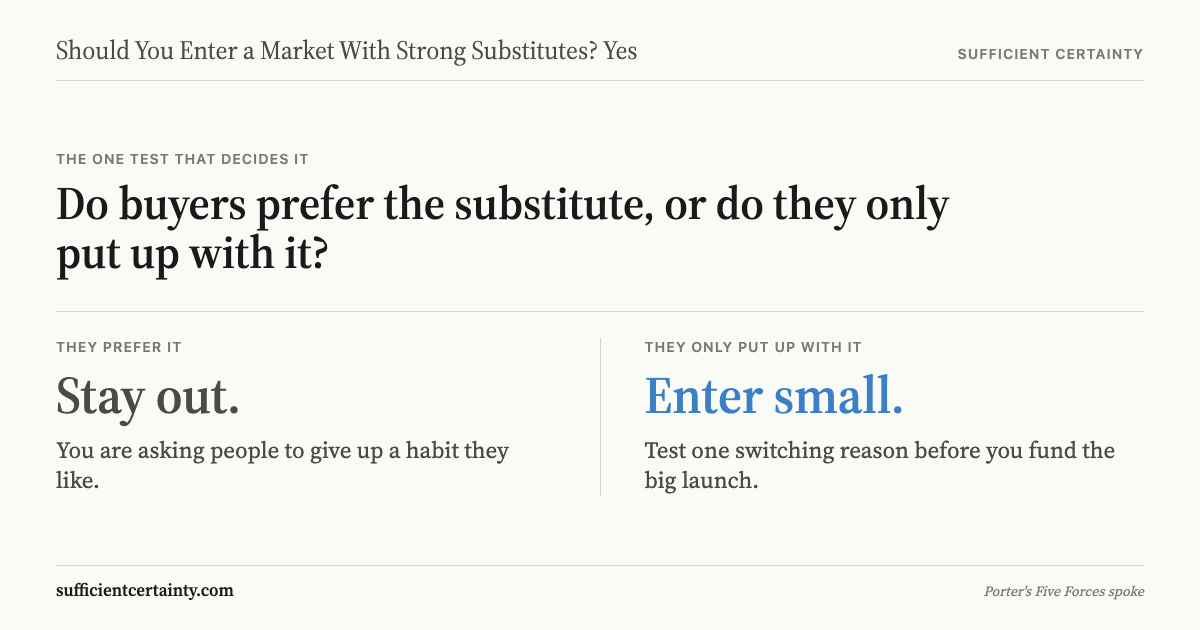
Entering a market with strong substitutes looks reckless until you test one thing: whether buyers actively prefer the substitute or are merely tolerating it. If they are tolerating it, the substitutes rating overstates the barrier. A small, reversible bet reveals which case holds before the full launch burns the budget.
I have sat through too many market-entry papers where a team wants to launch into a city where riders already tolerate long waits and awkward payment, then somebody asks, "Should you enter a market with strong substitutes?" The slide is useful up to a point. It tells me buyers already have another way to get the job done. It does not tell me whether they will keep tolerating that option or drop it the moment somebody offers less friction.
If you want the wider frame, read the full guide to Porter's Five Forces; here I am dealing with the awkward moment after the analysis, when the team still has to write a recommendation a grown-up can sign.
Entering a market with strong substitutes is deciding whether buyers have enough reason to leave an alternative they already find acceptable.
Should you enter a market with strong substitutes if buyers are only tolerating the current option?
Yes, sometimes. I care less about the existence of an alternative than about the quality of the buyer's compromise with it. Teams love to say "the incumbent option is strong" because it sounds analytical and keeps the meeting respectable, but respectable language is cheap. The useful question is rougher: are buyers happy, or are they putting up with something that annoys them often enough to create an opening?
Roger Estall and I used the pre-Uber taxi trade in Deciding because it looked protected on paper. Entry was regulated and medallions were valuable, which let people inside the trade talk as if the structure itself were intelligence. The buyer's real job was getting across town with reasonable certainty and without the usual nonsense. Uber entered because the old service had taught itself to tolerate the customer's irritation. In my experience, that is when a tidy market starts lying to its owners.
Uber's 2019 annual report says the company was operating in more than 10,000 cities across 69 countries, with 111 million monthly active platform consumers, and Cramer and Krueger found UberX drivers had 38 per cent higher capacity utilisation than taxi drivers across five US cities. Those are the only numbers I need here. They tell me the entrant was not offering a prettier brochure. It had a better way to match rider and driver, then take payment cleanly. The old taxi setup preferred regulated comfort over customer aggravation, which is a very common disease in incumbent markets, especially when several people are earning a living from the old inconvenience.
The warning cuts both ways. New York's Taxi Medallion Task Force recorded average daily yellow-taxi trips falling from 485,000 in 2014 to 296,000 in 2019, while app-based companies reached 600,000 daily trips. Medallions had once sold for as much as $1.125 million. That is what happens when people mistake a licensing barrier for a customer bond. They are not the same thing. One can be written into a rulebook; the other has to be earned every day.
Should you enter a market with strong substitutes if the market label is hiding the real job?
Yes, and this is where most entry papers go soft in the head. People define the market by the incumbent category because the category already has a budget line and some confident executive who has spent ten years learning its vocabulary (and now mistakes vocabulary for insight). That fog suits the incumbent and the manager defending last year's plan. None of it means the category still owns the job. I have written elsewhere about defining the industry before you rate it, because people smuggle the wrong market into the analysis and then act surprised when the answer is nonsense. It means the category is well organised, and well organised industries are the last to notice that buyers have quietly moved on.
I watched publishers make this mistake for years. The ACCC annex on Australian news publishers says inflation-adjusted newspaper advertising revenue fell to 41 per cent of its 2008 level by 2016, and print classified revenue fell to less than 10 per cent of its 2000 level. You did not need a mystical theory to explain that collapse. Buyers wanting homes or jobs had found better search-and-match systems, while newspaper people kept talking about the newspaper bundle as if habit were a moat. Executives can become very attached to the bundle that paid for their conferences.
When I am deciding whether to enter, I write one blunt sentence about the buyer's job and another about the clumsy option they are still using. Then I add the specific improvement that would make them bother to switch. If the team cannot answer that in plain English, the analysis is theatre, and theatre mainly helps the sponsor keep a bad idea alive for one more meeting (which is usually the point of the performance). That is also where people misuse the five forces model as a naming exercise instead of a judgment about the buyer's real alternatives.
Should you enter a market with strong substitutes if you can enter in a reversible way?
If I cannot test switching cheaply, I do not enter. I do not mean I ask for another neat deck from strategy. I mean I refuse the large, hard-to-reverse commitment that mainly protects the sponsor from embarrassment. The committee is usually told that a big launch proves conviction. In my experience it often proves the opposite. When people know the evidence is thin, they like to drown that fact in scale.
When someone asks me should you enter a market with strong substitutes, I translate it into a narrower question: what would persuade a real buyer to change behaviour, and what is the smallest move that could test that honestly? In the Universal Decision-Making Method, this is where Recognise assumptions and Sufficient certainty stop being polite chapter headings and start doing useful work. The assumptions here are not abstract. Enough riders care about shorter waits to change habit. We can win one segment without paying every defector to experiment with us. If those claims sound mushy in plain English, they are mushy in the spreadsheet as well.
This is why I usually prefer a smaller first move. One city can tell you more than a national rollout if the right assumption is being tested. Even where supplier bargaining power looks ugly on paper, the entry case still lives or dies on whether buyers will switch for the improvement you are testing. One neglected segment can tell you more than a factory-sized commitment if the question is whether anybody will switch without bribery. If you cannot win even that narrow test without leaning on subsidy or wishful interpretation, the answer is no for now. A high-pressure market does not deserve your capital merely because somebody has built a model with three decimal places.
What I would write in the entry paper
I would write the customer job and the tolerated current option in plain English, then name the switch trigger and the evidence that would kill the idea. Every serious entry case should include its own failure condition. If the sponsor cannot survive that much clarity, what they are really asking for is shelter inside strategy prose, where uncertainty can stay dressed up and nobody has to admit how little is known.
Uber worked because the old arrangement irritated people enough, and the new one improved things in a way buyers felt straight away. Newspapers lost because they mistook category loyalty for owning the job.
Should you enter a market with strong substitutes? Yes, if buyers are only tolerating what they have, and if your first move can test the switching reason without burning real money. That is a recommendation I would sign. It is also the one I would monitor hardest, because this decision breaks the moment we start flattering ourselves.
You could commit the whole budget to a market where nobody was waiting to switch.
Work through your decisionNo sign-up. Just pick your decision and start.
Grant Purdy is the co-author, with Roger Estall, of Deciding (2020), and the architect of the Universal Decision-Making Method.