
The five forces model maps competitive pressure. It does not contain a decision. After the diagram is drawn, most teams skip the only step that matters: turning each rating into a testable assumption with an owner and a trigger that reopens the call when the basis shifts.
I have sat in rooms where the strategy team brought a pricing forecast and a five forces model slide. The slide looked tidy. The people around the table still could not say whether they were being asked to enter the market or wait. That gap between a well-labelled diagram and a decision somebody has to own is where this framework earns its reputation and where it stops earning its keep.
The five forces model is a framework for judging how industry profit is shaped by rivalry among existing competitors, the threat of new entrants, the threat of substitutes, buyer power, and supplier power.
What the five forces model actually shows
It shows where pressure on industry returns is coming from, not what move you should make next. If your manager asks you for one, they usually want a clean read on rivalry, the risk of new entry or substitution, and where bargaining power sits. None of that tells you whether a market with strong substitutes is worth entering.
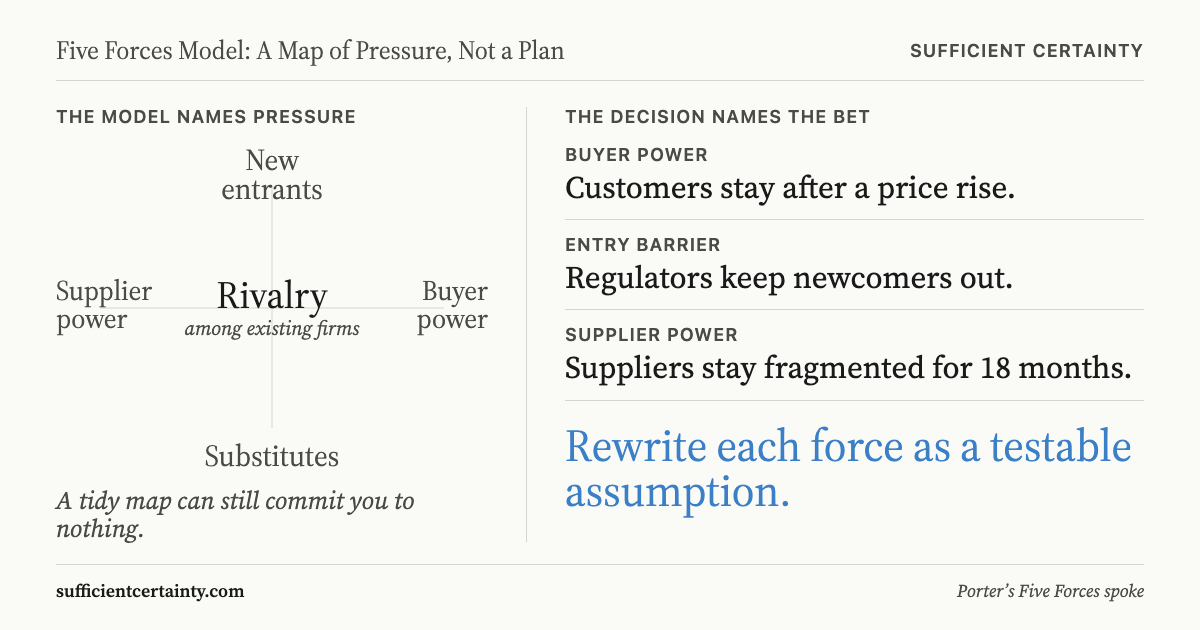
That is useful as far as it goes. A market with concentrated suppliers and restless buyers is a different place from one with weak suppliers and sticky customers. The trouble starts when the diagram is treated as the decision itself. I place the model inside a wider reading of context, which is why my Porter's Five Forces guide treats competitive pressure as one layer of the setting a decision must survive, not the whole picture.
Why the five forces model often stops too early
The process is designed to produce a document, not a commitment. The slide gets built, the boxes get coloured, and the room moves on feeling the work has been done. It has not.
McKinsey surveyed about 800 executives on formal strategic-planning processes of exactly this kind. Only 45 per cent were satisfied with the process, and only 23 per cent said the major strategic decisions were actually made inside it. The other three quarters of decisions happened somewhere else, usually in a corridor or over a crisis, while the planning team was still formatting slides.
Kodak is the clean case. In Harvard Business School's Kodak case, the uncomfortable facts were in full view. Kodak had invented the digital camera in 1975, held about 90 per cent of the US film market, and could see electronic imaging getting better. Yet it kept structuring its response around protecting film profits. The diagnosis was not absent. The organisation simply never converted that diagnosis into a hard commitment it was willing to test. The five forces slide did its job. The decision never got made.
I have seen milder versions of that failure for years. A board receives a force map, nods at it, then returns to the habit it brought into the room. Nobody objects because the slide gives everyone cover. The strategy team gets to say they did the analysis. The board gets to say they reviewed it. The consulting firm gets to bill for the deck. The decision that actually needed making sits untouched because writing it down would mean somebody had to own it.
Turn your market pressure map into a decision record and test which competitive pressure would actually change the commitment. Start the Walk →
Turn each force into an assumption
A force becomes useful only when you rewrite it as an assumption that could be wrong. A buyer force often hides an assumption such as customers staying after a price rise. An entry barrier often hides an assumption such as the regulator keeping newcomers out. Once you write the statements that way, the work changes.
Now you can ask what would disprove the assumption, how quickly you would know, and what the cost would be if you were wrong. That is far closer to a decision than colouring in a template. In the Universal Decision-Making Method, this is the move from establishing context to recognising assumptions. Managers resist this step for a simple reason: a diagram with coloured arrows commits you to nothing, but a written assumption can be proved wrong next quarter.
If you are the junior analyst building the deck, this is the sentence your manager can actually argue with. "Supplier power is moderate" rarely changes a meeting. Nobody can act on it, nobody can disprove it, and nobody can blame you for writing it. "Our margin works only if suppliers stay fragmented for the next 18 months" does all three. The supplier-specific version of that move is unpacked in bargaining power of suppliers.
I would rather receive a one-page note with that sentence in it than a polished slide with no exposed bet. Once the bet is visible, the room can challenge it, test it, or reject it. Until then, everyone is admiring the furniture.
When Roger Estall and I wrote Deciding, we used a simple example of a government agreement removing tariff or regulatory barriers almost overnight. A threat of new entrants that looked low on Monday could be very different by Friday. That is why I distrust any reading of competitive structure that speaks in the tone of settled fact. The model gives you a snapshot, not a guarantee, as the Peloton five forces example showed when five favourable ratings collapsed together.
Monitor the force most likely to move
The force most likely to hurt you is usually the one everyone has quietly treated as fixed. Before Uber, New York taxi medallions looked like a permanent barrier to entry. Then the barrier collapsed.
R Street's account of the medallion crisis tracks the numbers. A medallion that sold for $10 in 1937 rose to more than $1 million at the 2014 peak, then fell to about $150,000 to $160,000 by 2018. More than 2,000 drivers were left carrying debt built on the old assumption. The structure looked solid because people mistook regulation for permanence.
The taxi trade had other warnings. Smartphones, mapping, and contactless payments were making the cab-hailing experience look antiquated, and customer frustration was open knowledge. Each shift was visible on its own. What mattered was the combination, and the industry never treated those signals as a single threat to the regulatory barrier holding their prices up. They watched each pressure separately and reassured themselves that the barrier was permanent. It was not.
That is why monitoring sits inside the Universal Decision-Making Method. If a decision rests on a barrier, a buyer habit, or a supplier arrangement, someone should be watching for the conditions that would break it. The framework is static on the page. The world it describes keeps moving whether you watch or not.
Use the five forces model for a real decision
If you have been asked for this framework this week, do the work, then refuse to stop there. Ask what decision the analysis is supposed to support.
A 2020 study in the Technology Innovation Management Review confirmed what practitioners already feel: the framework has become frozen in time. That is not a reason to throw the model out. It is proof that any force map ages the moment the meeting ends. Use the five forces model to read the industry, then turn the ratings into a five forces industry analysis somebody can argue with: name the assumption that would sink the decision if it failed and test it hard. Watch the force most likely to shift after the room disperses. The Universal Decision-Making Method bridges the gap between a tidy diagram and a commitment somebody can be held to. Most strategy decks leave that bridge out, which suits the people who would rather keep formatting than sign the bet.
You could present the next five forces slide and still leave the real decision unsigned.
Work through your decisionNo sign-up. Just pick your decision and start.
Grant Purdy is the co-author, with Roger Estall, of Deciding (2020), and the architect of the Universal Decision-Making Method.