
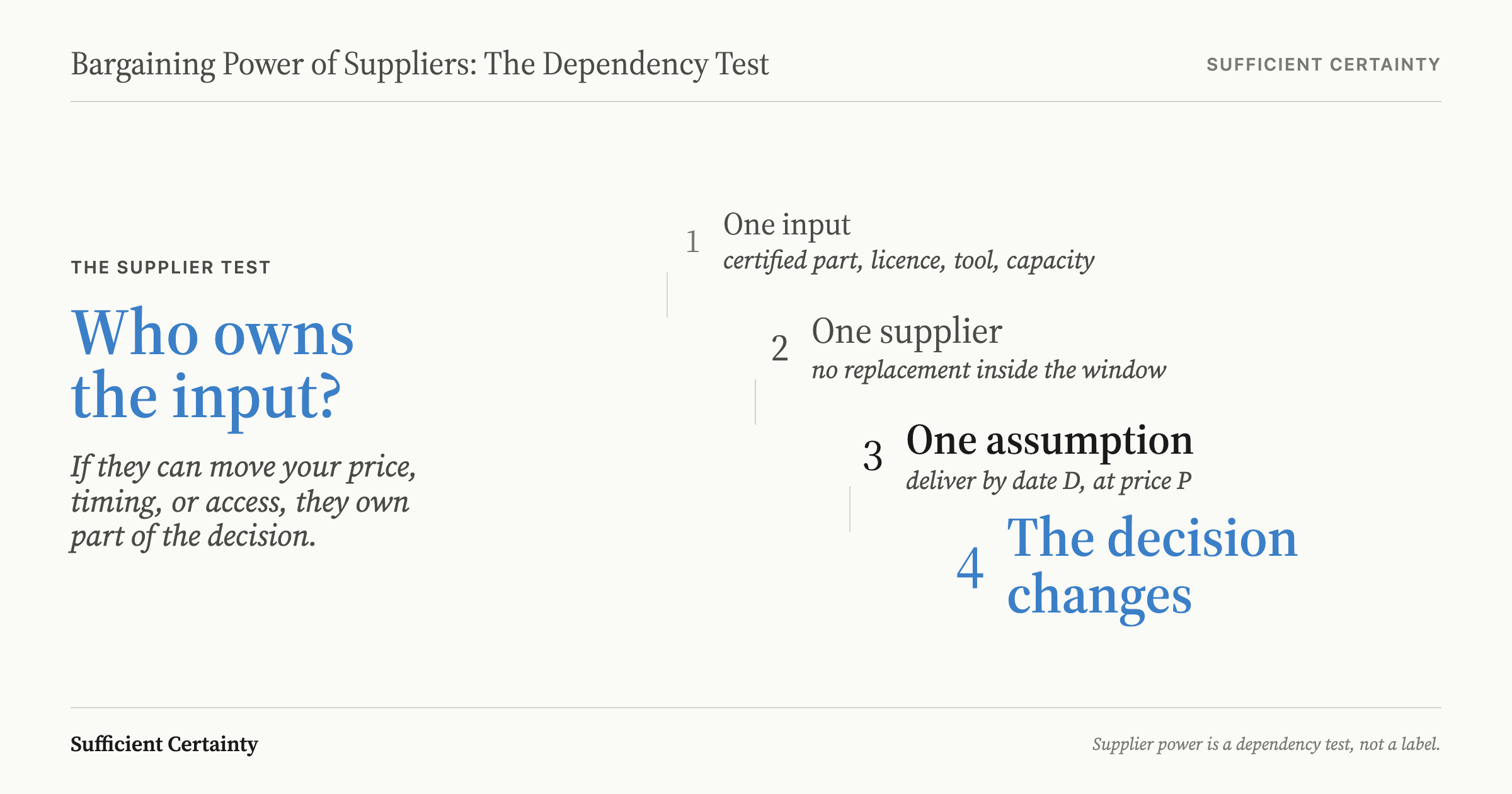
Bargaining power of suppliers is not a rating to colour amber on a slide. It is a dependency with a due date. If one supplier owns the input your plan needs by September, it owns part of the decision. The test is whether you can name that dependency in one sentence.
The supplier does not care that your Five Forces cell is amber. If it owns the one input your plan needs by September, it owns part of the decision. That is what the bargaining power of suppliers means in practice: not a tidy label, but a dependency with a due date.
I have seen teams treat suppliers as a category to be scored rather than as people and firms who can stop the plan from working. Procurement knows the contract. Operations knows the lead time. Finance knows the margin. Nobody writes the sentence that joins them: this decision fails if that supplier moves. Marvellous. The supplier still has the part, the licence, the tooling, or the delivery slot.
The bargaining power of suppliers is the ability to change price, timing, quality, or access when buyers depend on scarce or hard-to-replace inputs.
What the bargaining power of suppliers really tests
Porter was right about the mechanics: concentration, differentiation, switching cost, and forward integration create supplier force. The mistake is treating that list as an answer. The danger is not that Porter's force is wrong. The danger is that organisations use it to make dependency look analysed when it has merely been named.
| Supplier-power factor | Supplier-power question | Decision assumption |
|---|---|---|
| Concentration | How many credible suppliers can serve this need? | The chosen supplier will not use scarcity to change cost or timing. |
| Switching cost | Can we move before the damage arrives? | An alternative can be qualified and operating inside the decision window. |
| Specialised input | Does the supplier control a capability, not just a product? | The required system, licence, or service capacity will remain available. |
For a live decision, I want the sentence underneath it. "Our expansion works only if the resin supplier holds price for twelve months." "The launch works only if the foundry slot arrives before September." "The acquisition works only if the target's single-source component can be dual-sourced within one quarter." Those are assumptions. They can be tested. They can also be wrong.
This is why I put suppliers in the part of context made of actors who can alter the decision directly. They are not vague market weather. In Porter's Five Forces, they can change cost, timing, quality, capacity, and your freedom to act. The point is to find the dependency strong enough to alter the decision.
Customers sit in the same part of context and can squeeze from the other direction. That version of the problem has its own test, because a buyer demand has to be answered with a price, a term, or an exit.
Bargaining power of suppliers is dependency, not inconvenience
Many suppliers are annoying. That does not make them powerful. A supplier becomes powerful when you cannot replace the input inside the window that matters. A late stationery order irritates people. A missing certified component stops production. The difference is not mood. It is dependency.
A chipmaker depending on EUV tool access is not buying stationery. It is depending on ASML's roadmap, export permissions, installation timetable, and service capability. ASML's 2024 annual report describes systems complex enough to make replacement fantasy look like planning if nobody names the dependency plainly.
That does not mean every buyer is helpless. It means the Decider has to stop using a soft label and name the exact constraint. Is the dependency price, qualification time, or regulatory permission? The answer changes the decision. If the problem is qualification time, negotiation is theatre with a procurement badge.
The Semiconductor Industry Association's 2021 industry report gives the broader test. Manufacturing is capital-intensive, specialised, and geographically uneven. Before approving a capacity decision, ask whether the alternative supplier is actually qualified, contracted, delivered, and integrated inside the damage window.
For a mid-size manufacturer, this can be painfully ordinary. A plant expansion may depend on one certified component arriving before a board deadline. The useful assumption in the decision is not "supplier risk exists." It is "this supplier can deliver the certified component before the shutdown window closes." That sentence is narrow enough to test.
Do not let the purchasing file hide the decision. A signed agreement can still rest on tooling that is late, a licence that is fragile, or a second supplier that exists only in a spreadsheet. I would rather see one ugly dependency sentence than a neat supplier table that leaves the Decider blind.
Map the supplier dependency in your decision and mark the condition that would let one input break the plan. Start the Walk →
Turn the force into a decision assumption
Roger Estall and I made this point in Deciding and built it into the Universal Decision-Making Method: translate the force into an assumption that could prove false. Do not write "supplier power: high." Write: "This decision works only if supplier X can deliver input Y, to standard Z, by date D, at price P."
I use a three-part test. What input can stop this decision from working? Who controls it? What trigger would reopen the decision before the damage arrives?
Those questions are less elegant than the model, which is why they are more useful. A red box in a deck has no purchase order, no tooling lead time, and no penalty clause. The supplier does. If the decision rests on a supplier staying fragmented, write that. If it rests on a single supplier keeping capacity available, write that. If it rests on a contract clause that nobody has tested in anger, write that too.
The distinction matters because supplier power can push a decision in opposite directions. If the constraint is price, negotiate or change margin. If it is qualification time, redesign or delay. If it is permission or capacity, do not approve until the dependency is made survivable. A tolerable supplier constraint can be accepted; a critical dependency has to change the choice. The same discipline holds before you pick up the phone: test the assumption behind your price position before you call it a negotiation strategy.
Monitor the supplier condition that can break the plan
In 1997, a fire at Aisin Seiki interrupted Toyota's supply of P-valves, a small brake component large enough to threaten production. Nishiguchi and Beaudet's MIT Sloan account records the recovery effort, with suppliers improvising production across the network. I read it first as a dependency lesson.
The component was not glamorous. It did not need to be. A small part can carry a large decision when the operating model assumes it will arrive continuously. Toyota's supplier network recovered quickly because there was capability around the system, not because the dependency was imaginary. Most organisations prefer to discover this difference after the fact, when everyone can call the failure "unprecedented" and look grave in the review meeting.
Monitoring after commitment exists to prevent that little ceremony. If the decision depends on supplier availability, decide in advance what signal reopens it. Capacity warnings and price movement beyond the margin assumption are enough if they reach someone with authority to act, not merely appear in a dashboard for decorative anxiety.
Use bargaining power of suppliers to change the decision
If you are approving a decision supported by a five forces industry analysis, refuse the supplier-power label until it names the supplier assumption. Which supplier condition could break this decision, and what must change before you sign?
That may lead to procurement action, but it may not. Sometimes the right answer is a different product design. Sometimes it is a narrower launch. Sometimes it is a deliberate buffer that offends the lean purists, a group never short of confidence when somebody else carries the stockout. Sometimes it is simply a refusal to approve until the dependency is understood.
This is where the companion article on the five forces model matters. Supplier power becomes useful only when it names the input that can stop the plan, the person watching it, and the action that follows if it moves. Otherwise it is merely a tidy label for a dependency nobody owns.
You could sign the supplier deal and discover the missing input owns September.
Work through your decisionNo sign-up. Just pick your decision and start.
Grant Purdy is the co-author, with Roger Estall, of Deciding (2020), and the architect of the Universal Decision-Making Method.