
A five forces industry analysis finishes when every cell is rated and nothing is decided. The rating is one person's judgement typed into a template and coloured amber. Until each rating becomes a dated claim that can be proved wrong, the grid decorates the strategy deck without informing the strategy.
A strategy manager showed me a market-entry pack: forty pages, five forces rated across two competitor sets, and a recommendation to enter. The finance director asked one question. How do you know buyer power is moderate? Nobody could answer, because the rating had measured nothing. It was one person's judgement, typed into a cell and coloured amber.
That is what a five forces industry analysis usually leaves you holding when the meeting turns serious.
The pack was unarguable rather than wrong, which is worse. Every challenge that came at it landed on the analyst rather than on a stated position, so the discussion became about confidence and seniority instead of about the industry. Two hours later the room approved the entry anyway, on the strength of nobody having a better answer.
Look at who that amber cell served. The analyst could not be shown to have been wrong, because nothing had been claimed. The sponsor could not be refused, because there was nothing on the page to refuse. The firm that produced the forty pages had been paid on delivery, whatever the industry did next.
An unarguable rating is not the technique failing. It is the product working exactly as the people who buy it need it to work.
Five forces industry analysis is a method for assessing how profitable an industry is likely to be, by rating rivalry, new entrants, substitutes, buyer power, and supplier power.
What a five forces industry analysis actually produces
It produces a set of claims about how an industry will behave, and every one of them can be false. The failure is in what happens to the output: a rating gets treated as a measurement, and a measurement does not need defending. That is the whole point of my how the five forces map industry pressure.
A force map describes the setting a decision has to survive. It never tells you whether to make the decision.
Ford shows the distance between the two. Its 2024 annual report records Model e wholesales down 9 per cent, revenue down 35 per cent to $3.858 billion, and an EBIT loss widening to $5.076 billion on lower net pricing under industrywide competitive pressure. Nobody at Ford was short of industry analysis.
Electric vehicles were correctly identified as a growth category with intensifying rivalry. What that reading could not carry was the sentence the capital commitment actually rested on: we can hold price within this band while moving this volume.
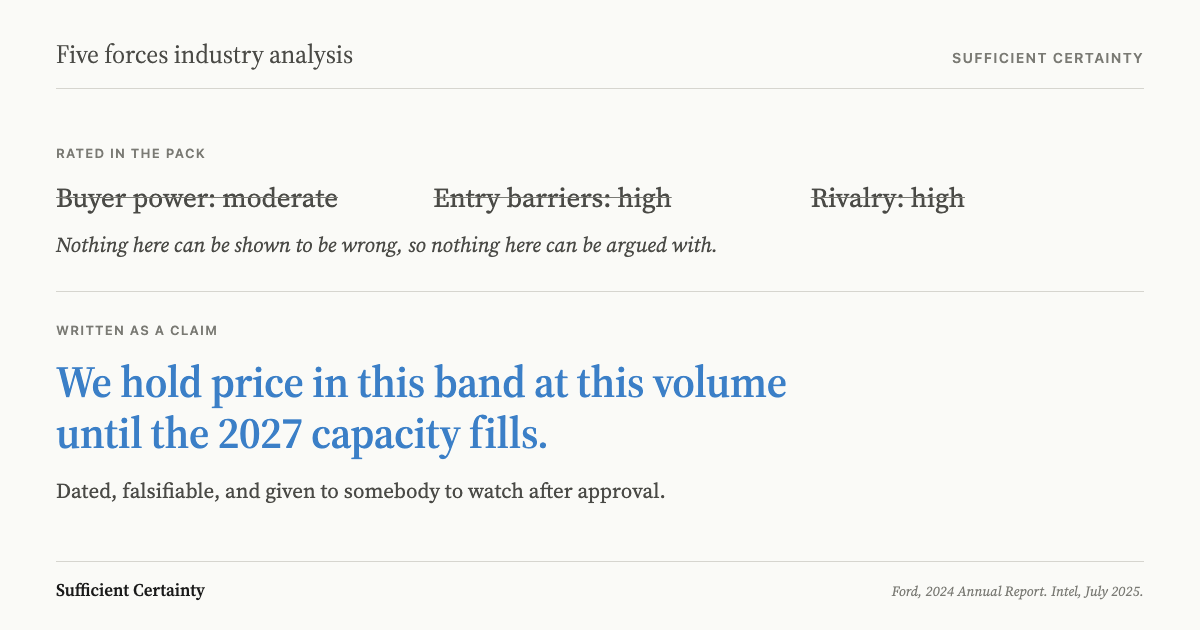
Rivalry rated "high" is a description. A price floor with a volume attached is a position you can be wrong about in public.
Give the room something to attack. That is the only way a recommendation gets stronger before it gets approved.
Every rating is a bet with a date on it
Write the date down and the analysis changes character immediately. "Entry barriers are high" is a permanent-sounding statement about the world. "Entry barriers hold long enough for us to fill this capacity by 2027" is a bet, and bets have owners.
Intel is the expensive version. In July 2025 its chief executive Lip-Bu Tan told staff the company had built ahead of demand, writing that Intel had invested "too much, too soon" without the customer commitments to justify it. Planned projects in Germany and Poland stopped.
Ohio construction slowed until customer wins caught up, and the workforce came down by roughly 15 per cent. Capital intensity in advanced semiconductor manufacturing is one of the highest entry barriers in industry.
The doubt sat somewhere the grid has no box for: whether Intel could win enough committed volume to make the barrier pay for itself rather than sit on the balance sheet.
A high barrier protects whoever is already inside it and can fill it. For anyone else it is a bill. Which of the two you are holding depends on demand nobody has won yet, and no version of the five forces model has ever had a column for that.
The test I use on any pack that reaches me is blunt. Take each of the five ratings and ask what would have to be true for it to still read that way on the day the capacity comes online. If the answer is "nothing in particular, it just is", the rating is decoration, and somebody was paid to produce it.
If the answer names a regulation or a customer who has not signed yet, you have found the assumptions the recommendation is resting on, and there are usually one or two of them rather than five.
Turn your force ratings into dated bets and see which one collapses first when a rival changes the route. Start the Walk →
Barriers hold until somebody changes the route
The most overstated claim in a five forces industry analysis is that entry is hard. It is hard by the route incumbents used. Nobody is obliged to use that route.
Incumbents rate their own barriers by looking at what it cost them to build the position they hold. That is the wrong measurement, and it is a flattering one, which is why it survives every review. The question is what it would cost somebody arriving now, with a different cost base and no obligation to protect the existing business. Those are rarely the same number.
Shein and Temu did not enter US fast fashion through the incumbent structure of stores, wholesalers, and buyers at all. They shipped direct to the customer under the de minimis threshold, which exempts low-value parcels from duty and much of the inspection burden.
The US-China Economic and Security Review Commission recorded the shift: de minimis packages rose from 410.5 million in the 2018 financial year to 685.1 million in 2022, and more than 10 per cent of Chinese imports by value arrived that way.
An incumbent retailer rating its entry barriers in 2019 would have looked at store networks and buying scale and rated them high. Every one of those assets was real. None of them was load-bearing, because the thing holding the line was a customs threshold that had nothing to do with retail at all.
Roger Estall and I devoted part of Deciding to running this in reverse, on purpose. If you can list the conditions holding an industry's barriers up, you can look at a competitor and ask which of their conditions you could remove.
Most organisations only ever use industry analysis defensively, to reassure themselves that their position is sound, which is also the version that sells. Nobody has ever been thanked for a report explaining that the moat belongs to somebody else. The same method aimed outward is how you find the competitor whose position is resting on something that is about to move.
The forces interact, and the grid cannot show it
Five separate boxes imply five separate pressures, and the compounding happens between them. In the Peloton five forces example, every force rated favourably because every rating rested on the same pandemic demand, and the grid had no way to show that one reversal would break all five.
The UK Competition and Markets Authority published work in May 2026 on supply chains and market power that puts numbers on this. UK supply-chain lengths grew by between 5 and 40 per cent over the past decade, with service-sector chains in postal and engineering services lengthening by 65 to 75 per cent. The finding that matters for anyone rating supplier power: markup distortions accumulate along those linkages even where no single upstream sector looks dominant.
Score each tier on its own and every one comes back moderate. The cost still arrives.
This is why I refuse to let "the market" or "the environment" stand as a single undifferentiated thing in any decision I am involved in. Context is not one lump; it has bands.
Suppliers, buyers, and direct competitors sit close in and can act on you deliberately. Regulation and social habit sit further out and change the terms everybody operates under. Substitutes and new entrants almost always arrive from that outer band, which is precisely why the incumbent competitor list never sees them coming. It also means a substitutes rating on its own cannot tell you whether buyers would actually switch.
The bargaining power of suppliers is where the compounding shows up first, and it repays working one dependency all the way through instead of scoring the tier and moving on.
The same holds on the customer side. Once you can say what a buyer would actually do if you held price, the amber rating becomes a decision about whether the account is worth keeping.
The competitor dimension responds to the same treatment. Once the profile exists, the question is what to do after a competitor analysis so the profile becomes a set of claims you can actually monitor.
Give the five forces industry analysis a shelf life
An analysis with no expiry date and no owner does not quietly retire. It gets quoted in board papers two years after the industry stopped behaving that way, usually by somebody who was not in the room when it was written and has no idea what it was ever supposed to mean.
McKinsey's 2024-25 research on strategy execution surveyed 416 senior executives and found only 21 per cent said their strategies passed four or more of its strategy tests.
The detail I keep coming back to is one chief executive who required leaders to state the assumptions behind every commitment. Every six months somebody had to sit in a room and say out loud which of those assumptions had stopped being true. That is an uncomfortable meeting, and the discomfort is the whole value of it, which is why almost nobody holds it.
Recognising assumptions and designing monitoring are two of the five steps in the Universal Decision-Making Method, and they are the two that industry analysis routinely skips.
You can monitor a claim about price realisation, or a customs threshold. Each has a number attached and a point at which it stops being true. Giving somebody the job of watching them is the whole of it, and it costs less than one page of the pack did.
So when a pack reaches me now, I turn to the last page first, and I want to find something there other than the grid. I want the claims the recommendation depends on and the name of the person watching each one. Then, when the finance director asks how you know, you point at the claim and say who will notice first. That is what a defensible five forces industry analysis looks like, and it runs to one page rather than forty.
You could approve the entry on an amber rating nobody in the room can challenge.
Work through your decisionNo sign-up. Just pick your decision and start.
Grant Purdy is the co-author, with Roger Estall, of Deciding (2020), and the architect of the Universal Decision-Making Method.