Porter's Five Forces maps competitive pressure across five categories and produces a diagram that looks like strategy. It is not strategy. It is a description of pressure at one moment in time. Until somebody asks what assumption inside the map needs testing before capital is committed, the analysis is unfinished.
Before Uber, the taxi trade in many cities looked settled. Licenses were controlled, dispatch systems were familiar, margins were predictable enough, and most incumbents treated customer irritation as background noise rather than a strategic weakness. That is exactly the sort of setting where Porter's Five Forces seems useful, because the model helps you map who holds power, where rivalry sits, and why the industry works the way it does.
I do not dismiss that value. Porter's Five Forces gives a disciplined picture of competitive pressure. The problem comes one step later. After you have drawn the map, what decision follows? What assumption inside the map needs testing before anyone commits capital, changes price, or enters a market? Most write-ups stop before that question is even asked.
That gap matters more than people admit. A neat force diagram can make a team feel informed while leaving the real work untouched. I have seen the same thing happen with strategy decks, board papers, and competitor scans: diagnosis is completed, then action is smuggled in as if the map itself were a decision. It is not. It is a description of pressure at one moment in time.
Porter's Five Forces is a framework that maps competitive pressure across five categories: rivalry, new entrants, substitutes, supplier power, and buyer power. It shows where pressure comes from but not what to do about it.
What Porter's Five Forces actually measures
Porter's Five Forces measures competitive pressure on an organization's margins and freedom to act. The five forces are rivalry among existing competitors, threat of new entrants, threat of substitutes, bargaining power of suppliers, and bargaining power of buyers.
What is being measured is not market size, brand quality, or managerial competence. It is the pressure created by relationships around the firm: who can squeeze price, who can raise cost, who can tempt customers away, and who can change the rules of entry. An industry can be growing and still be structurally unattractive if those pressures are strong. It can be mature and still be attractive if those pressures are weak.
That distinction matters because people often ask the model to answer questions it was never built to answer. It does not tell me whether my team can execute better than a rival, whether the timing of an acquisition is right, or whether one product launch serves our Purpose better than another. It measures the shape of competition, not the quality of a particular decision.
I therefore treat Porter's Five Forces as a context map, not as a decision method. It is useful for showing where profits can be squeezed, where incumbents are protected, and where customers or suppliers can dictate terms. It becomes misleading when people slide from "this is the structure" to "therefore this is what we should do" without surfacing the assumptions in between.
For a closer look at where models stop and decisions start, read our piece on the five forces model as a decision tool.
The five forces explained
When I look at supplier power, I ask how easily the organization can be squeezed by the people who control a key input. If suppliers are concentrated, switching is costly, or the input is hard to replace, they can take margin or slow execution. In the three-band model this sits in the external band, because suppliers are direct actors pressing on the decision from outside the firm.
For the supplier version of that problem, read bargaining power of suppliers, which turns supplier pressure into the dependency sentence the decision actually rests on.
Buyer power is the mirror image. If customers are concentrated, well informed, or free to switch, they can force down price or demand better terms. A company can tell itself that its buyers are loyal, then discover that loyalty was only convenience. This also belongs in the external band, because buyers are immediate counterparties whose choices can overturn a pricing or growth decision very quickly.
When that pressure arrives as a specific demand, read what to do when buyers have leverage, which prices the concession against the option of reshaping the account or leaving it.
Rivalry among existing competitors is the force most people think of first, but it is only one part of the picture. I treat rivalry as the external band at its most visible: direct contests over price, service, distribution, or capacity. Strong rivalry tells you that even a sensible internal plan may struggle to earn returns if competitors can copy it, undercut it, or drag the whole market into a margin war.
Substitutes live mainly in the wider band. They are not always the current competitors across the street. They are other ways for the customer to get the job done, often made possible by shifts in technology, behavior, or regulation. That is why substitutes so often surprise incumbents. They arrive from outside the industry's usual line of sight, then suddenly change what buyers compare you against.
That is also why a high substitutes rating does not settle an entry call on its own. The question underneath it is whether buyers actively prefer the alternative or are merely putting up with it, which is the difference between a real barrier and a market worth entering on a small, reversible bet.
New entrants also belong mainly in the wider band, even though they eventually become direct rivals. What matters first is not their market share but the conditions that let them in: falling capital requirements, weaker regulation, new distribution, a platform shift, a trade agreement. Once I map entrants this way, entry barriers stop looking like permanent walls and start looking like assumptions about context that may not hold for long.
Name the assumption your competitive position rests on and test whether it still holds. Start the Walk →
Why Five Forces analysis stops too early
Most Five Forces guides end where the real work starts. They help you rate each force, summarize the industry, and maybe add a recommendation line at the end. That recommendation usually arrives by assertion, not by method. Nobody names the assumption carrying the recommendation, and nobody asks what evidence would make the Decider reverse it. The analysis is finished, but the decision has not actually been made.
I see the same weakness in a great deal of SWOT analysis material. It is good at sorting observations into boxes. It is weak at forcing a commitment that can later be reopened if the basis changes. Diagnosis matters. Stopping at diagnosis is the problem.
The taxi industry is the cleanest example. It could describe its suppliers, its buyers, its licensing barriers, and the nature of rivalry. Then Uber arrived with lower charges and answered old frustrations about high prices, poor reliability, and no visibility of arrival times. The incumbents were "caught flat-footed" because they had not monitored "post-decision change in context." They had a map of the current industry, but not a way to watch the assumptions beneath that map decay.
That is why I do not treat a force diagram as sufficient. Competitive structure is only a diagnosis. Until someone asks "now what?" and forces the answer through a decision process, the analysis is unfinished.
To see what that step looks like in practice, read the worked five forces example, which takes one company through all five ratings and surfaces the assumptions each one was concealing.
For the step between completing the analysis and committing resources, read what to do after a five forces analysis.
Five Forces and the three-band context model
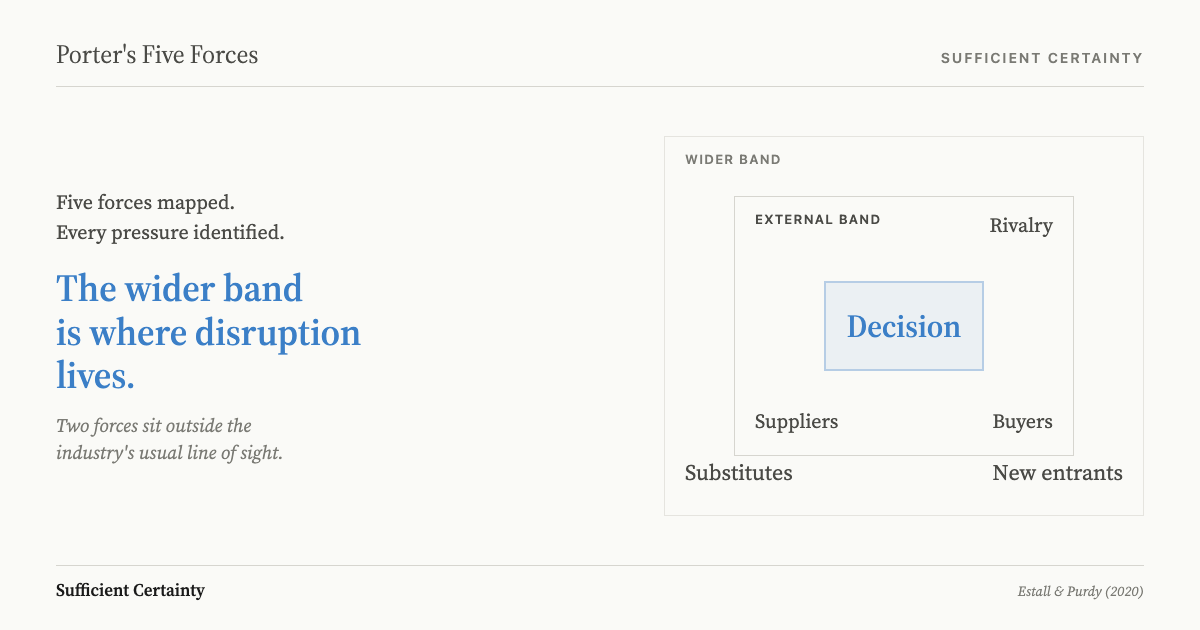
In the Universal Decision-Making Method, Stage 1e is where I build Context in three bands: internal, external, and wider. This is where Porter's Five Forces fits neatly. Supplier power, buyer power, and rivalry sit mostly in the external band because they are direct actors around the organization. Substitutes and new entrants belong mainly in the wider band because they often come from changes that are not yet pressing on you through today's visible competitors.
This matters because people often compress everything outside the firm into a vague category called the market. I do not let that pass. Principle 8 is blunt: "Don't let 'the market' or 'the environment' stand undifferentiated. Always include the wider band, that is where disruption lives." Once you separate the bands, you stop pretending that current rivals are the whole story.
That is also why this framework is only one part of situation analysis. The competitive structure may be stable while technology, regulation, or social behavior is shifting just outside the industry's field of view. A team can therefore feel confident about its supplier contracts and customer relationships while missing the substitute or entrant that changes the economics altogether.
The practical payoff is sufficient certainty, not tidy classification. The goal is to know enough about Context to act, while remaining explicit about what still has to hold true after the action is taken. That wider-band discipline is where Porter's model becomes decision-relevant rather than merely descriptive.
That discipline is also what separates a defensible five forces industry analysis from a rated grid, because it forces each band to produce a claim somebody can test rather than a colour somebody can assert.
How to act on a Five Forces analysis
Once the force map is drawn, I translate each force into statements that can prove false. Suppliers will remain fragmented. Buyers will accept the next price rise. No substitute will cut switching costs fast enough to matter. Entry barriers will hold for two years. That move is Stage 3 in practice. It turns industry description into assumptions that can be challenged.
Then I bring the decision back to Purpose. A company trying to defend margin will use the same map differently from one trying to enter aggressively, acquire, or reposition. The force diagram does not decide between those paths. A Decider does, after testing which assumptions matter most to the move under consideration.
Roger Estall and I wrote Deciding for exactly this gap. The point inside the book is simple: after the analysis comes the five-step decision method, where the key assumptions are surfaced, judged for significance, and recorded in a Decision Document before commitment.
That is the step most Five Forces work misses. People finish the map and jump straight to action. I want the jump slowed down just enough for the real bet to become visible.
When competitive forces shift after you decide
Competitive forces do not freeze when the slide deck is approved. Stage 5 exists because the world keeps moving after we decide. Monitoring is not a housekeeping step. It is the control that tells us when the force map on which the decision rested is no longer good enough.
Before Uber, the taxi industry looked remarkably solid. Entry was regulated. Margins were predictable. Drivers often worked under contract arrangements. Innovation pressure was weak, even though customer and driver frustrations were not hard to find. Many incumbents took those features as if they were permanent characteristics of the industry rather than temporary conditions that could be broken by a change outside the old structure.
That is where the boiling-frog problem bites. Satellite location improved. Smartphones spread. Mapping became ordinary. Payment systems became frictionless. Customer dissatisfaction accumulated. Each shift was detectable individually; the industry simply did not "join the dots." Principle 9 matters because a substitute or entrant rarely announces itself in one clean event. It arrives through several changes that only look important once they are seen together.
I also prefer Principle 17 here: focus on vulnerability rather than probability. I may not be able to say how likely the next entrant is, or when regulation will move, but I can ask how exposed we are if buyer switching suddenly becomes easy or a platform strips power from our licenses. That question is actionable. It changes what we watch and what we prepare.
Using Five Forces for strategic disruption
Five Forces can also be turned outward. In Appendix B, we wrote that more organizations are "actively seeking to be the perpetrator of disruptive events" so they can exploit a vulnerable competitor. That is why strategic thinking cannot stop at reading the field. It also asks where a rival's assumptions are weakest.
Sometimes the opening is political or regulatory. "A new government-to-government agreement might remove or lessen tariff or regulatory barriers" that used to protect an incumbent. Sometimes it is operational: a rival believes supplier lock-in is secure when in fact an alternative channel is forming. Sometimes it is commercial: buyers look sticky until one substitute changes convenience or visibility enough to make switching obvious.
I have seen too many companies treat barriers to entry as if they were walls. Often they are only conditions that have held so far. Once I map a competitor's force structure that way, the question changes from "How strong are they?" to "Which assumption would hurt them most if it failed?" If their assumptions about barriers or supplier lock-in are wrong, that is the opening.
For the structured move from competitor profiles to testable claims, read what to do after a competitor analysis.
Used like this, the model stops being passive diagnosis. It becomes a search for vulnerability, your own or someone else's, and a way to act before the rest of the industry notices the structure has already changed.
If this is a live decision, the Walk should begin where the force map ends: with the assumptions you still need to test and monitor.
Your Five Forces map shows where pressure sits. Now test whether the assumptions behind it hold before you commit.
Work through your decisionNo sign-up. Just pick your decision and start.
Grant Purdy is the co-author, with Roger Estall, of Deciding (2020), and the architect of the Universal Decision-Making Method.