
Change readiness assessments measure how people feel about a change. They do not test whether the change rests on a sound decision. A workforce can score high on readiness and still be heading into a rollout that should have been reconsidered before the survey was designed.
A change readiness assessment usually measures how prepared people feel. That is the wrong question. Readiness is whether the conditions the decision depends on are in place: the assumption has been tested, the monitoring exists, and the authority to act sits with a named owner. Surveying sentiment tells you how people feel, not whether the change is sound.
Every change readiness assessment I have reviewed in the past decade follows the same pattern. Forty to sixty survey items distributed to department heads, each scored on a five-point scale, aggregated into dimensions with names like leadership alignment, stakeholder engagement, and training preparedness. The scores come back above threshold, the sponsor presents them to the steering committee with a summary slide, and the organisation is declared ready to proceed.
I have reviewed this kind of document across industries and jurisdictions for nearly fifty years, and while the structure varies, the conclusion almost never does. At National Grid in November 2012, readiness was declared through a different mechanism (system testing rather than stakeholder surveys), but the blind spot was the same.
Wipro, the implementation partner, had tested the new SAP platform under standard operating conditions and declared it fit for launch. The testing followed what the industry calls the happy path: each function exercised under ideal circumstances, with no load testing and no operational stress scenarios.
Within weeks of go-live, the system could not process payroll. Employees were underpaid, overpaid, or not paid at all. The backlog of unpaid supplier invoices exceeded 15,000 in two months. The cleanup cost $585 million, roughly one and a half times the original implementation budget, and required some 850 contractors at approximately $30 million per month for two years to stabilise the platform.
The change readiness assessment had answered the wrong question. It tested whether the system worked under conditions that would never exist in production, and it did not test whether the assumptions behind the go-live decision would survive contact with real operational load. Teams planning a rollout that must keep operations running need to set their service floor and hold points before launch.
A change readiness assessment is a structured evaluation of whether an organisation is prepared to implement a chosen change, typically measured through survey instruments scoring leadership support and stakeholder engagement.
What a change readiness assessment actually measures
The most widely cited theoretical framework for organisational readiness was published by Bryan Weiner in 2009 in Implementation Science. Weiner defined readiness as a shared psychological state composed of two factors: change commitment, the shared resolve to implement a change, and change efficacy, the shared belief in collective capability to do so.
His definition is unambiguous: readiness, as the field's own foundational theory describes it, is a psychological construct that measures how people feel about their capacity to change, not whether the change itself rests on sound assumptions.
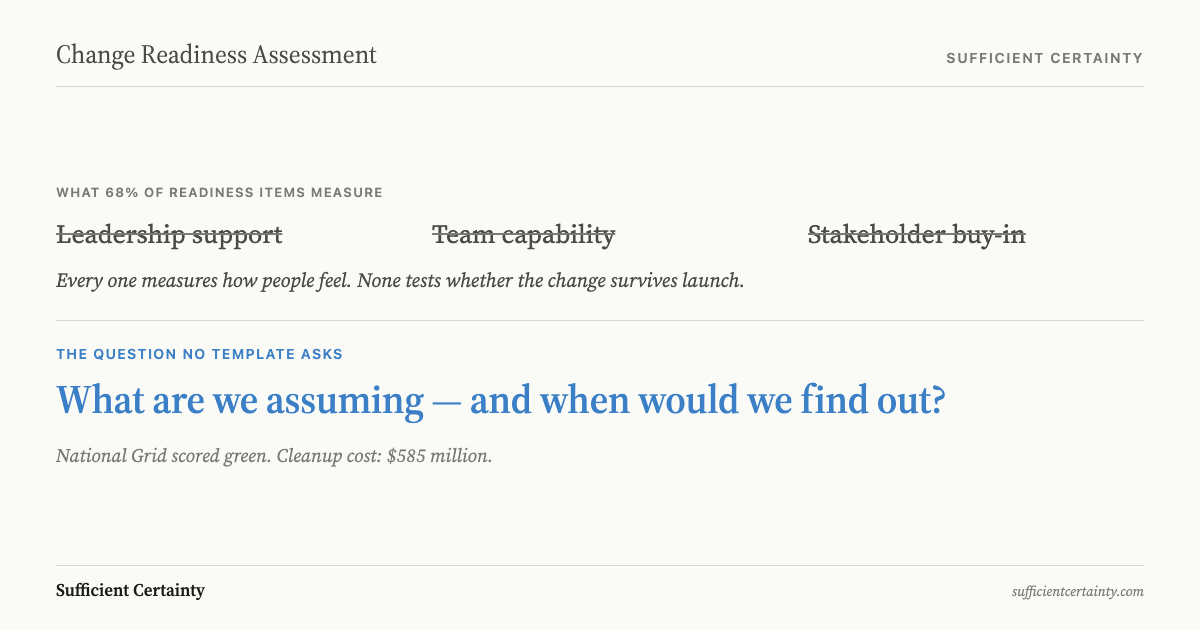
The instruments built on this theory inherit that limitation. In 2020, Isomi Miake-Lye and colleagues published a systematic review of readiness assessment instruments used in health services in BMC Health Services Research. They mapped 1,370 individual survey items from the published instruments to the Consolidated Framework for Implementation Research and found that 897 of those items, fully 68 per cent, mapped to inner-setting constructs: perceptions of the internal organisational environment such as culture, leadership, and communication networks.
External context, assumptions about the change itself, and operational capacity were dramatically underrepresented.
These instruments serve a legitimate purpose: measuring whether the people who will execute a change feel aligned and capable is relevant to implementation. But two-thirds of everything they ask is about how people perceive their organisation. The factors that actually determine whether a change survives contact with reality, such as untested assumptions about timing and system interdependencies, occupy a fraction of the measurement space.
When an organisation runs a change readiness assessment and gets a passing score, the score reflects whether department heads feel that leadership is aligned and training has been scheduled. It does not tell anyone whether the assumptions the change depends on have been articulated and tested against the conditions the change will actually encounter.
A cultural assessment built on survey responses rather than observed behaviour inherits the same limitation: the profile reports declared values, but the assumptions underneath remain untested.
This limitation extends beyond bespoke survey instruments. ADKAR, one of the most widely adopted change management frameworks, structures its readiness check around five individual-level stages from awareness through to reinforcement. Each stage can be assessed and scored.
Nevertheless, the entire sequence begins after the decision to change has already been made and approved, and it contains no stage for testing whether the decision itself was sound. An organisation can score highly on every ADKAR dimension and still be heading into a change whose foundational assumptions have never been examined. When resistance does surface, sorting the cause before choosing a model prevents the most common mismatch.
Why passing scores precede expensive failures
National Grid is not an outlier; the pattern shows up even in organisations with the most rigorous assessment governance.
The UK Infrastructure and Projects Authority publishes an annual review of the Government Major Projects Portfolio, the most extensive assessment regime of its kind for public programmes. Their 2023-24 report reviewed 227 major projects using independent gateway reviews, structured assurance processes, and formal readiness evaluations.
The results: 27 projects rated Red, meaning successful delivery appeared unachievable; 163 rated Amber, meaning significant issues already existed; and just 25 rated Green. In total, 84 per cent of the portfolio was Amber or Red. These projects operated under arguably the most mature project assurance governance of any national government. The readiness governance produced detailed documentation of why each project was at risk, but a document that names the risk without triggering a decision about it serves accountability, not the project.
A measurement artefact baked into the instruments themselves helps explain how passing scores emerge even when sharp disagreement exists within the organisation. In 2014, Christopher Shea and colleagues published the psychometric validation of ORIC, the most widely used operationalisation of Weiner's readiness theory. The instrument contains ten items across two subscales.
Individual-level reliability for the change-efficacy subscale came in at alpha 0.51, well below the 0.70 threshold accepted for meaningful measurement. Organisational-level reliability, by contrast, was alpha 0.97. That gap is consequential: individual responses are too inconsistent to interpret reliably, but the averaged organisational score comes back looking solid and actionable.
An individual respondent who knows the system has never been tested under peak load registers as noise in a group-level score. The instrument may be smoothing away informed dissent or simply averaging out inconsistent interpretations of the same survey items. Either way, the readiness score goes green while the assumptions behind it remain untested, the same gap that sits under each rating in a change management risk assessment.
Put your next readiness assessment through the five steps and test the assumptions the survey was never designed to surface. Start the Walk →
The failure rate the industry never verified
The most cited claim in the change management field is that 70 per cent of change initiatives fail. Consulting firms, framework vendors, and readiness assessment providers repeat it as the premise that justifies their services. In 2011, Mark Hughes traced the claim through its five most prominent published sources, from Hammer and Champy through Beer and Nohria to Kotter, and found that each either stated the number without evidence or cited another source that also lacked evidence. No valid and reliable empirical study has ever produced the figure.
The statistic persists because it is commercially useful. It creates urgency for assessment templates, change management frameworks, and consulting engagements. Every firm that quotes the 70 per cent number then offers its own methodology as the solution. The change readiness assessment industry is partly marketed against a threat that the field itself has never verified.
Roger Estall and I wrote in Deciding that facts decay into assumptions over time whenever nobody pauses to re-examine them. The 70 per cent figure is the field's own demonstration of that principle. It began as a rhetorical claim in the early literature on business process re-engineering, was repeated as established fact by successive authors who cited a predecessor rather than primary data, and now underpins a commercial ecosystem of tools and services.
An industry that advocates rigorous readiness assessment while resting its own case on an unverified number has not done the work it asks its clients to do. The question that would have caught this is the one no standard assessment template asks: what are the assumptions we are making here?
What a change readiness assessment should test instead
If the standard instruments measure sentiment when they should measure soundness, the question becomes practical: what should an organisation test before declaring a change ready to launch?
The replacement is a context check, not a survey. Instead of distributing a questionnaire about how department heads feel, ask the project team to state the assumptions the change depends on and make them visible by writing them down. For each assumption, three questions matter: what are we assuming is true, how confident are we in that assumption today, and would we detect a failure in time to act before the rollout becomes irreversible?
The first of those questions is the one no readiness template I have encountered asks: what are the assumptions we are making here? It sits at the centre of the Universal Decision-Making Method, and it is the question that would have caught the assumption behind National Grid's happy-path testing and exposed the convention that projects rated Amber proceed regardless.
The context template that Roger Estall and I developed for this purpose forces a team to describe the operating reality the change depends on, rather than the mood of the people who will carry it out. For each significant assumption, the template requires the team to assess the characteristics of the environment the change enters, how quickly those characteristics could shift, and whether the shift would be detectable early enough to respond.
That is a fundamentally different form of readiness. It asks whether the conditions the change was designed for still exist, not whether people feel comfortable with the plan.
In practice, this means asking the project team to answer one question for each critical assumption: if this turns out to be wrong, when would we find out and what would we do?
If the answer is "we would not know until the rollout is already irreversible," that assumption is the one the steering committee most needs to see. Naming it gives the committee something a readiness score cannot: a list of conditions that need to be true for the change to work, and a plan for watching each one.
A change management plan built on this foundation has something that a sentiment-scored assessment cannot provide: a defensible basis for saying "not yet." If the critical assumptions have not been tested, or if the remaining uncertainty exceeds what the organisation can absorb for the expected duration of the change, the readiness gate stays closed.
A change readiness assessment that tells the steering committee to proceed while the assumptions remain unexamined is ritual compliance dressed as readiness.
Organisations that run a genuine assumption test before launch consistently find that the conversation shifts. The discussion moves from "are our people on board?" to "do we understand what this change requires the world to look like in order to succeed?" The first question measures comfort; the second tests the decision. Organisational change management can support implementation once the decision has been examined, but it cannot repair a decision that was never tested.
You could run the next readiness survey and still launch on assumptions nobody tested.
Work through your decisionNo sign-up. Just pick your decision and start.
Grant Purdy is the co-author, with Roger Estall, of Deciding (2020), and the architect of the Universal Decision-Making Method.