
Resistance to change carries diagnostic data about the decision that launched the change, not about the people asked to live with it. When someone objects to a rollout, the objection has survived layers of organisational silence and self-censorship before it reached you; treating it as a behaviour problem discards the most expensive feedback your organisation produces.
I have sat in a steering committee where 200 people across four business units were being moved onto a new procurement system. Twelve weeks into the rollout, the program office reported 47 formal concerns from the field. The sponsor's immediate response was to commission a resistance management plan and schedule a second round of town halls.
There is an industry waiting for exactly that commission. Consulting firms and internal change offices produce resistance management plans because resistance management plans are what they sell; they do not produce re-examinations of the original decision, because nobody has ever bought one.
Nobody in that room asked what the 47 concerns were actually saying about the decision that had set the change management effort in motion. The concerns were statements about procurement workflows the new system could not replicate, and about handover steps that had been designed out of the migration plan without consulting the people who used them. The people closest to the work were describing a premise the project had never examined: that the existing workflow could be mapped onto the new platform without losing steps that mattered.
That definition separates what most organisations treat as a single problem. In nearly 50 years of working with organisations, I have found that the separation matters. Each dimension points at a different weakness in the decision, and responding to the wrong one wastes the time and trust needed to respond to the right one.
Resistance to change is the pattern of cognitive, emotional, and behavioural responses that people produce when an organisational decision affects their work, each signalling a different weakness in the decision.
What resistance to change is actually carrying
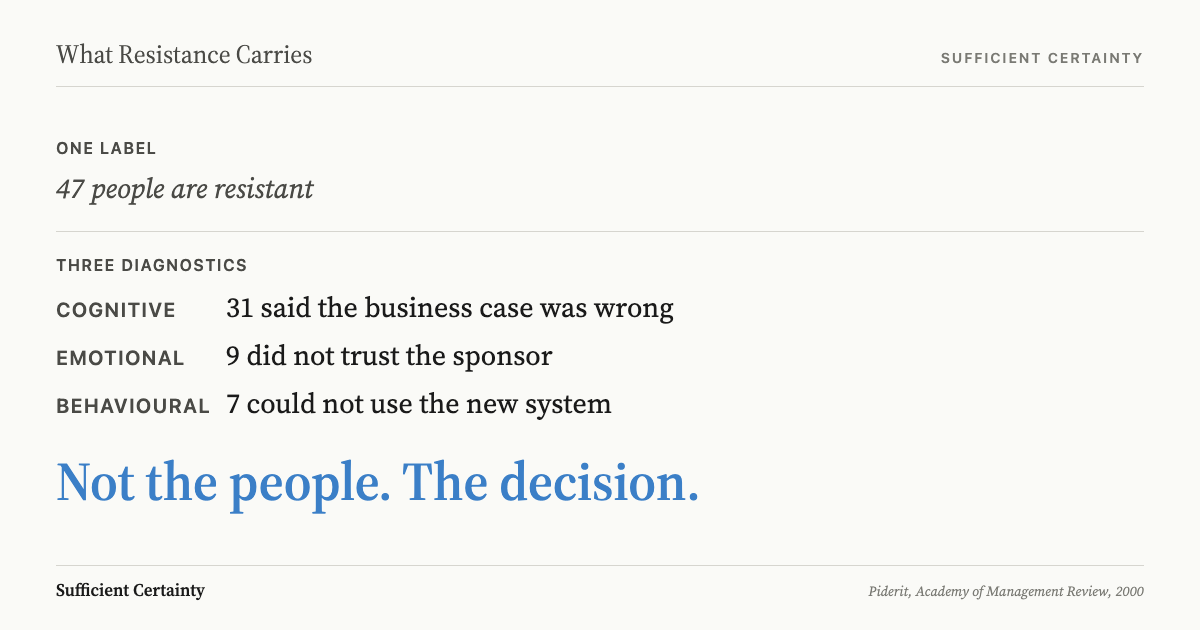
In 2000, Sandy Piderit published a paper in the Academy of Management Review that changed how I think about what resistance carries. She showed that resistance has three independent dimensions, and that they do not move together. A person can think the change is wrong while remaining perfectly willing to comply with it, or endorse the business case while feeling threatened enough to drag their feet. The dimensions are cognitive, emotional, and behavioural.
A cognitive objection says the rationale behind the change is weak; the person has examined the case and found it unconvincing. An emotional reaction points to a trust deficit or a political context that makes the change feel unsafe, regardless of whether the business case holds. A behavioural gap, where someone agrees with the change but does not act on it, usually indicates that the implementation plan is missing a practical requirement the planners did not consult on.
Piderit's more interesting finding is that ambivalence is the norm; most people hold genuinely mixed attitudes toward any significant change. A procurement officer who understands why a system is being replaced may simultaneously distrust the timeline (because she has seen how the last migration went and remembers what it cost). That ambivalence is not confusion; it is a person holding two pieces of evidence that the project team has not reconciled, and the project benefits from hearing both.
In my experience, collapsing all three dimensions into a single label destroys the diagnostic value. A project team that records "47 people are resistant" has a political data point for a steering committee update. A project team that records "31 said the business case was wrong, 9 said they did not trust the sponsor, and 7 said they could not use the new system" has three different problems to solve, and only one of them is about training. That is the difference between managing resistance and diagnosing it.
Take the strongest objection your team has raised and write the assumption about your decision that it is describing. Start the Walk →
Why organisations suppress the signal instead of reading it
Morrison and Milliken documented in 2000 what they called organisational silence: a systematic climate where employees perceive speaking up as futile or dangerous. The effect is structural; the organisation's information architecture filters dissenting views before they reach anyone with the authority to act on them.
Detert and Edmondson identified the individual mechanism in 2011. They found implicit rules that operate below conscious awareness and cause self-censorship even in workplaces that claim to welcome feedback. Two were particularly consistent across their sample: do not raise a problem unless you already have a solution, and do not bypass your direct manager even when the issue sits above their authority. In my work with organisations across industries, I have found these rules consistent; they filter voice before it reaches the people making the decision.
The combined effect is that whatever pushback does surface as resistance to change has passed through two suppression filters, one organisational and one personal, before anyone with authority hears it. The signal is disproportionately strong precisely because the bar to express it was disproportionately high.
The most carefully designed change communication plan cannot compensate for this structural silence, because the plan assumes that people who have concerns will voice them through the channels provided. When the implicit rules say otherwise, the channels stay quiet and the sponsor interprets the quiet as agreement.
I have watched executives interpret a quiet room as alignment when it was compliance; the distinction matters because compliance lasts until the first thing goes wrong, and then it vanishes without warning. That is what makes the absence of resistance unreliable as evidence that a decision is sound.
The cost of overriding resistance to change
In 1999, Hershey Foods launched a $112 million ERP deployment combining SAP, Manugistics, and Siebel systems across its operations. The recommended implementation timeline was 48 months; Hershey compressed it to 30 (a decision that was itself never examined against the advisors' objections). Internal advisors warned that the compression would compromise testing, and the project went live in July, directly before the Halloween ordering season that generates a disproportionate share of the company's annual revenue.
The result was $100 million in unfilled orders during the peak period, a 19 per cent decline in quarterly profit, and an 8 per cent drop in the share price. The system's order-processing and distribution functions failed under load conditions that a full testing cycle would have identified but the compressed schedule had prevented.
What the company overrode was not irrational opposition; the internal advisors who recommended 48 months were identifying an untested assumption, that the system could handle peak-season volume without completing the planned test cycle. The testing teams who flagged inadequate coverage were identifying the same assumption from a different angle, and both signals were treated as obstacles to a timeline that had become more authoritative than the evidence supporting it.
That is the predictable cost of treating resistance to change as an obstacle rather than a diagnostic. The decision to compress was a second decision: that internal expertise was less reliable than the project plan. Once the organisation made that second decision, the first one became untestable, because the people who could have identified the failure conditions before launch had been told that their information did not matter.
I have seen this pattern repeat in other settings, always with the same structure: the moment an organisation treats its own advisory process as an obstacle to the project timeline, it forfeits the one source of feedback that could have saved the project. Hershey's advisors were attempting productive disagreement, and the organisation converted it into a compliance exercise; the company paid for that conversion at the point in the calendar where it could least afford to.
Turning resistance into tested assumptions
If resistance carries diagnostic data, the question is what to do with it before the rollout compounds whatever problem the resistance is describing. The first step is the one most organisations skip: returning to the decision that launched the change and asking which of its premises remain unexamined.
In Deciding, Roger Estall and I describe what we call Stage 0: the pre-decision conversation where the Decider listens to all affected parties before framing the decision. Applied to a change that is already generating resistance, Stage 0 means treating each objection as a claim about a premise the decision has not examined (rather than evidence that the person has not been sufficiently communicated at). The claims get sorted by significance. The work belongs before implementation in the Universal Decision-Making Method; that it works after a rollout has started breaking is a concession, not a design feature.
The naysayer is the operational mechanism. In practice, this means inviting the strongest objector into the room and asking a direct question: what do you believe has to be true for this change to work, and what evidence would show it is not true? That is the purpose of seeking other views: to find the assumption that carries the most risk before the rollout finds it for you.
I have seen this produce results in a systems migration where one dissenting voice identified an assumption about customer data that nobody on the project team had examined. The team had assumed that existing customer accounts would transfer to the new platform with their full order history intact; the dissenter, who managed the largest accounts, knew that 30 per cent of those accounts used custom pricing agreements the new system could not import. That single objection, which the program office had initially classified as resistance to change, prevented a customer-facing failure that would have cost substantially more than the delay.
Encouraging other views is the broader practice: the deliberate habit of seeking dissent rather than suppressing it. The question shifts from "how do we get people on board?" to "what are they seeing that we are not?". The output is a decision that either survives scrutiny with stronger assumptions or gets revised before implementation compounds the original error.
The difference matters because a revised decision is cheaper than a failed rollout. Stakeholder buy-in that is earned by demonstrating a tested decision holds under pressure in a way that buy-in manufactured by messaging does not. Organisations that treat genuine readiness as something to be assessed before mobilisation, rather than manufactured during it, discover that the decision, not the resistance, needed the work.
You could commission another resistance management plan and still leave the decision underneath it unexamined.
Work through your decisionNo sign-up. Just pick your decision and start.
Grant Purdy is the co-author, with Roger Estall, of Deciding (2020), and the architect of the Universal Decision-Making Method.