
Group decision making techniques become useful only when they force the room to name the assumption the preferred option depends on. Most techniques stop at process: they score options, distribute dots, and build matrices. None of that tests whether the winning option quietly rests on something untrue.
Group decision making techniques are popular because they create the feeling of rigour without requiring it. Sticky dots, scoring matrices, and weighted criteria give a room the comfort of structure while the actual assumption the decision depends on goes untested. The technique that works is simple: name the assumption, test it, and let the decider commit.
I once sat through an outsourcing meeting with 14 people and 86 sticky dots on the wall. The facilitator was congratulating everyone on a second round of nominal group technique. Ninety minutes in, nobody had said whether cheaper service mattered more than response quality at the sites that could not tolerate delay. That is the usual failure in group decision making techniques.
Most published lists of group decision making techniques give you Delphi and dot voting, then act as though the job is done. Roger Estall and I wrote Deciding after years of watching rooms mistake those props for judgment. Facilitators sell workshop choreography, and in-house 'risk' people keep the templates alive. A thicker paper trail seldom offends anyone with a governance title. None of that tells the room what question it is answering or what assumption is carrying the answer.
I use seven techniques, but I do not run them as little meeting tricks. I use them in sequence so the room opens properly and does not harden around a tidy-looking answer before anyone has checked what that answer is betting on. I set out the full team decision making process separately; the techniques only earn their keep inside that wider sequence.
Group decision making techniques are conversational moves run in sequence to force a room to name the assumptions carrying the decision before the Decider commits.
Group decision making techniques start with the opening script
The first two moves, Clarity of Purpose and Providing Context, are not warm-up patter. I start by stating the decision and the constraint that actually bites, then I make my authority plain. I also say where I want challenge, because polite nodding turns up without being invited.
I used that approach in an IT helpdesk outsourcing discussion. The room kept drifting toward headline savings, so I rewrote the opening in plain English: are we buying a cheaper service, or are we protecting response quality for the sites that cannot sit and wait? Once the decision was framed properly, the background material stopped floating around as general noise and started behaving like evidence. In my experience, half the confusion in a room comes from the first sentence lying about what is really being decided.
The evidence is better than most advice pieces admit. In a 2019 anesthesiology briefing study, 37 interprofessional teams handled a simulated airway emergency. The teams that spent 2 minutes 28 seconds on a semi-structured briefing performed better on the contingencies they had actually discussed. A briefing should change what happens next, not just make the meeting look organised. The people in the room matter just as much, which is why who belongs in the room has to be settled before anybody starts passing around marker pens.
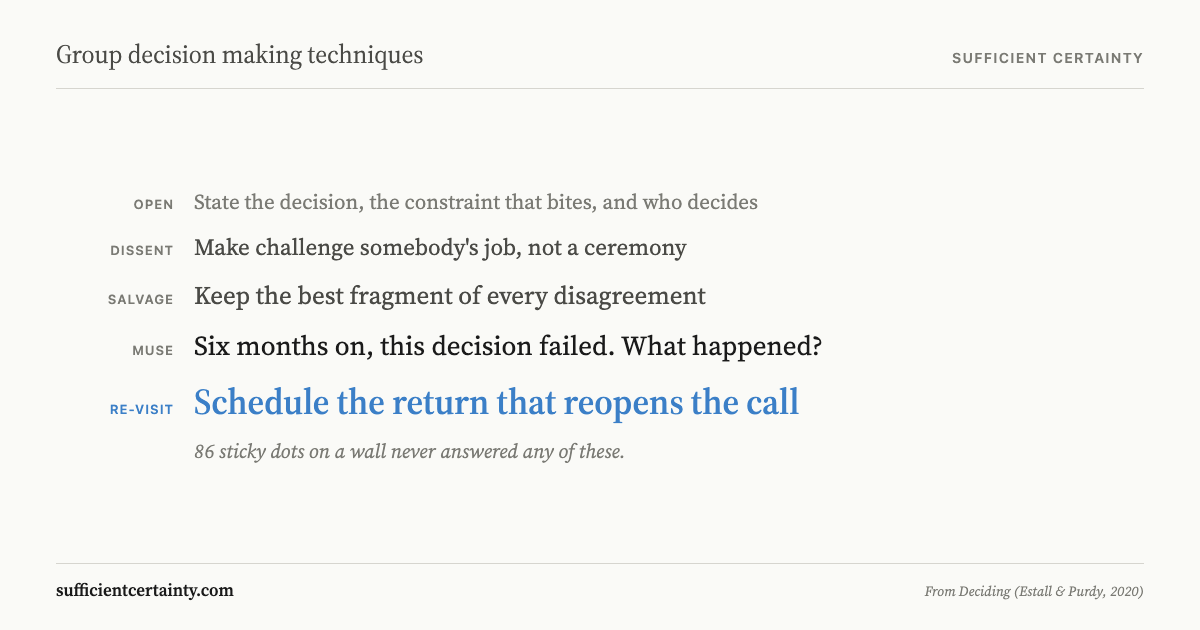
Group decision making techniques need real dissent, not theatre
These challenge techniques only work when disagreement is genuine. Give one person a temporary licence to be awkward and most of the room treats that as permission to relax. The official naysayer has done the unpleasant bit for everyone else, and the minutes can record that challenge was "built in". Meanwhile the live assumption slips out the side door.
That is close to what Stefan Schulz-Hardt and his colleagues found in their study of genuine versus contrived dissent. Using 201 employees and managers, they found that authentic disagreement reduced biased information search better than ceremonial devil's advocacy. I am not surprised. Ceremonial dissent suits governance staff and any internal specialist whose job depends on saying challenge was present, without anyone important having to feel the sting of an actual challenge.
Best Idea Wins becomes useful when I stop demanding total agreement. If someone tells me the whole outsourcing direction is wrong but overnight support must stay local, I keep that fragment and test the assumption underneath it. I write down the part I am keeping, then I ask what must be true for that fragment to hold. I do not force the person into a false choice between surrender and total resistance, because that is how rooms turn useful disagreement into performance.
There is another reason I run this hard. A 2025 study on defensive decision making used 315 managers and showed what happens when speaking up feels unsafe: people choose the personally safer option instead of the better organisational one. The authors estimated forgone opportunity at 10.8 per cent of annual revenue in the organisation studied. When a room starts trimming its objections to stay socially safe, I stop and ask the objector to write the dangerous sentence in full. Then I ask what evidence would make that sentence true.
Sequence your next team decision through the five steps and give dissent a job before technique turns into theatre. Start the Walk →
The last two group decision making techniques keep certainty provisional
Musing is disciplined speculation used to expose what the preferred answer is quietly assuming.
I often run it with a blunt question: imagine we are six months on and this decision has failed, what happened? I want people writing their reasons before they start speaking. That move has serious backing. In a premortem study by Veinott and colleagues, groups using prospective hindsight generated stronger challenge and built in a return to the failure list later. The paper also points to earlier work showing that certainty-framing can lift the number of reasons people produce by about 30 per cent. The paper gives that a tidy label. I call it making the room admit that optimism is not analysis.
Re-visiting is the return you schedule because reality has a habit of humiliating yesterday's confidence. A 2020 paper on team reflexivity looked at 82 startup teams and found a positive link between reflexivity and decision quality. That fits what I have seen for decades. A client review once landed on my desk complaining that I would not leave a finished decision alone. It was not meant kindly. Yesterday is where the weak assumption usually hides.
Sequence the moves, then schedule the return
In the helpdesk decision the sequence looked like this. I opened with the purpose script and my authority to decide. Before anyone touched preferences, every option-owner answered one question: what are you assuming away? When a favourite emerged, I named it and asked the room where it breaks. Best Idea Wins came last, not as a vote but as a search for the fragment worth keeping once the vanity had been stripped off.
Before I committed, I asked what had to be true for the answer to still look sensible in three months, and what signal would reopen the call. Then I settled who watched that signal and how fast it came back. Those two questions are the tail end of the Universal Decision-Making Method, and they are the part of collaborative decision making that most group decision making techniques never reach. The overnight-support assumption tripped its signal inside the first quarter. We reopened the decision in one meeting, because the room already knew which bet had failed.
You could run another dot-voting round and still dodge what matters most.
Work through your decisionNo sign-up. Just pick your decision and start.
Grant Purdy is the co-author, with Roger Estall, of Deciding (2020), and the architect of the Universal Decision-Making Method.