
A situation analysis goes stale the moment the plan is signed off. The assumptions it identified were true on the day of approval. Unless you tie the critical ones to a short watchlist with a trigger to reopen the plan, the analysis expires and nobody notices until the assumption breaks.
A situation analysis is only useful while the assumptions it tested still hold. Most organisations file theirs after approval and never open them again. That is when the analysis becomes dangerous, because the context drifts while the confidence stays fixed. Keeping the analysis alive after approval is not optional maintenance. It is the monitoring the original decision required. The same expiry hits a due diligence review once it closes: the findings freeze on signing day while the assumptions behind them keep moving.
I have sat in rooms where a three-year plan was approved after six weeks of workshops and a 47-page situation analysis that had already been revised twice. Three months later a funding assumption moved, or a competitor cut price, and the plan stayed "approved" because nobody had written down what kind of change would put it back on the table. If you want to keep situation analysis useful after approval, that sentence has to exist before execution begins.
In my experience, approval does not end the analysis; it leaves the assumptions exposed. The document goes stale when those assumptions are not rechecked, which means a neat appendix quickly turns into a historical record of a world the organisation no longer inhabits. Plenty of people can still admire the paperwork, especially the ones paid to maintain it, but the decision itself is now running on memory.
Keeping a situation analysis useful after approval means monitoring the assumptions behind an approved plan and reopening the plan when those assumptions stop holding.
Why a situation analysis starts expiring at approval
The analysis starts expiring because the world it described keeps moving while the document sits approved and untouched. A funding assumption shifts, or a competitor reprices, and nobody checks whether the logic that won approval still holds. In my experience, the organisation itself often moves faster than the market: budgets get trimmed quietly, hires are delayed, and the approved plan is reinterpreted before anyone admits that has happened.
Mintzberg and Waters wrote in 1985 that realised strategy is usually a mix of deliberate intent and emergence from events. I have never seen a board pack disprove them. Once the plan meets reality, the analysis is either a dated baseline someone monitors or an ignored appendix everyone admires. That is why the situation analysis guide belongs beside Design monitoring in the Universal Decision-Making Method; one surfaces the assumptions, the other tells you when they have stopped being true.
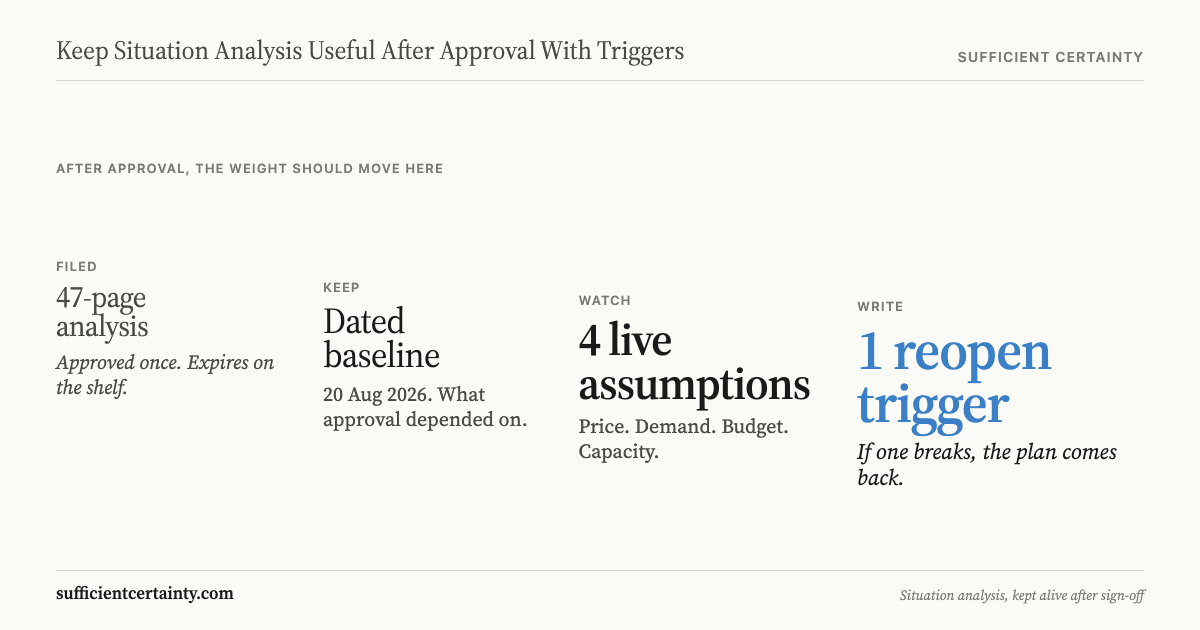
Keep situation analysis useful after approval by shrinking the watchlist
Most organisations handle this badly in one of two ways. They file the analysis and hope nothing important changes, or they build a monthly reporting pack that watches everything and decides nothing. The second option looks diligent, which is convenient for the people who produce the pack and the people who sell software to colour it in, but it rarely helps a Decider decide whether the original approval still makes sense. To keep situation analysis useful after approval, I would cut the list to the few assumptions that would actually change the decision.
Roger Estall and I built the method, and later wrote it up in Deciding, around significance for precisely this reason. A plan can contain fifty observations and only four or five assumptions that really carry the result; the rest may matter descriptively, but they do not justify reopening the decision. In my experience, if a team cannot explain in one plain sentence why a change matters, it has not found a critical assumption, it has found another line in a report.
Boston Consulting Group argued in 2023 for early-warning systems with trigger points and predefined actions. Fair enough, the useful part is trigger points; the rest too often mutates into enterprise theatre, where a larger scanning process protects the reporting ritual while the actual decision goes untouched. If you need a worksheet for the hard part, the situation analysis template is useful only when it forces you to name the assumption that matters, and the same discipline starts earlier in which context changes matter before you commit.
Take the assumption your approved analysis depends on most and write the signal that would tell you it has stopped being true. Start the Walk →
Keep situation analysis useful after approval with reopen triggers
A reopen trigger is a written condition that sends the matter back to the Deciders because the reason for approval may no longer hold. It is not a vague request to keep an eye on things, which is what people write when they want the comfort of monitoring without the inconvenience of reopening the plan. In my experience, if the trigger sentence does not tell you what changed and who has to look again, it is not a trigger at all.
Ford's August 21, 2024 reset of its electric-vehicle strategy shows the point in public. Ford said margins had compressed and buyers were more cost-conscious under stronger Chinese competition. It then scrapped the all-electric three-row SUV and cut pure-EV capital spending from about 40 per cent to 30 per cent; Project T3 moved into the second half of 2027, and the company disclosed about US$400 million in special non-cash charges while warning of up to US$1.5 billion more to come. That was not routine execution management; it was a decision logic problem surfacing late.
If the original analysis had been kept alive properly, the board would not have needed clairvoyance; it would have needed a sentence stating that sustained price compression or weaker-than-assumed EV demand reopened the mix decision. That is what Design monitoring is for: not predicting the future, but telling you when the future has already moved far enough that the approved plan deserves another look.
What Ford and Ørsted show about dead analysis
The same failure is even clearer when the economics turn vicious. Ørsted announced on October 31, 2023 that it was ceasing development of Ocean Wind 1 and Ocean Wind 2 after supplier delays and higher interest rates combined with weaker tax-credit assumptions to break the case. The company disclosed impairment losses of DKK28.4 billion in the first nine months of 2023, with DKK19.9 billion tied to Ocean Wind 1, while Revolution Wind kept moving. Offshore wind was not the issue; the assumptions behind those two approved projects had moved outside a viable range.
I watch boards mislabel this constantly. They call it execution trouble because admitting that the approval logic failed is politically unpleasant, but execution trouble and broken decision logic are different jobs: one asks management to perform better, the other asks Deciders to decide again. A stale situation analysis protects the first story because it lets everyone pretend the second one does not exist.
McKinsey made the same point in July 2025 from the capital-project angle, drawing on Bent Flyvbjerg's 16,000-project database: only 8.5 per cent met cost and schedule targets, and only 0.5 per cent achieved all promised benefits. McKinsey's own sample of 300 billion-dollar-plus projects showed average cost overruns of about 80 per cent and delays of about 50 per cent. I do not cite those numbers because consultants have suddenly become philosophers; I cite them because even the people who make money governing distressed projects are now admitting that approved assumptions collapse in flight.
What I would put in the board paper now
If I had just won approval for a major plan, I would not rewrite the whole analysis. I would add one short page to the board paper or Decision Document, and beside each critical assumption I would write the signal and the plain-English sentence that sends the matter back to the right desk when the threshold is crossed. Anything more elaborate usually means the machinery is again serving itself.
The point of the board paper is to keep situation analysis useful after approval while execution is still unfolding, not to console the people who approved the original plan. The underlying mechanics sit in how to do a situation analysis, but the harder discipline begins after the signatures, when someone has to say that the assumption no longer holds and the decision must come back.
In my experience, dead analysis does not protect the organisation. It protects the approval and the people who signed it, while the reporting machinery stays untouched. When nobody is allowed to challenge stale assumptions, the document is no longer informing the decision; it is helping the wrong people save face.
You could approve the analysis and never name what would force the room to reopen it.
Work through your decisionNo sign-up. Just pick your decision and start.
Grant Purdy is the co-author, with Roger Estall, of Deciding (2020), and the architect of the Universal Decision-Making Method.