
How to do a situation analysis that informs a real decision means starting with what you are deciding, not with a framework to fill in. Every grid, matrix, and acronym in the usual toolkit sorts observations. None of them tests whether the observation carries an assumption that could break the recommendation.
How to do a situation analysis that actually serves a decision starts with stating what the decision is. Most guides skip this step entirely. They teach you to fill in a grid, not to test whether the grid connects to anything the decider needs. A situation analysis without a stated decision purpose is data collection dressed as rigour.
I have sat in rooms where teams spent three months building analyses that changed nothing. Colour-coded matrices. Gorgeous slide decks. The senior leader made the same call they would have made without any of it. The analysis was decoration, and everyone knew it except the people who built it.
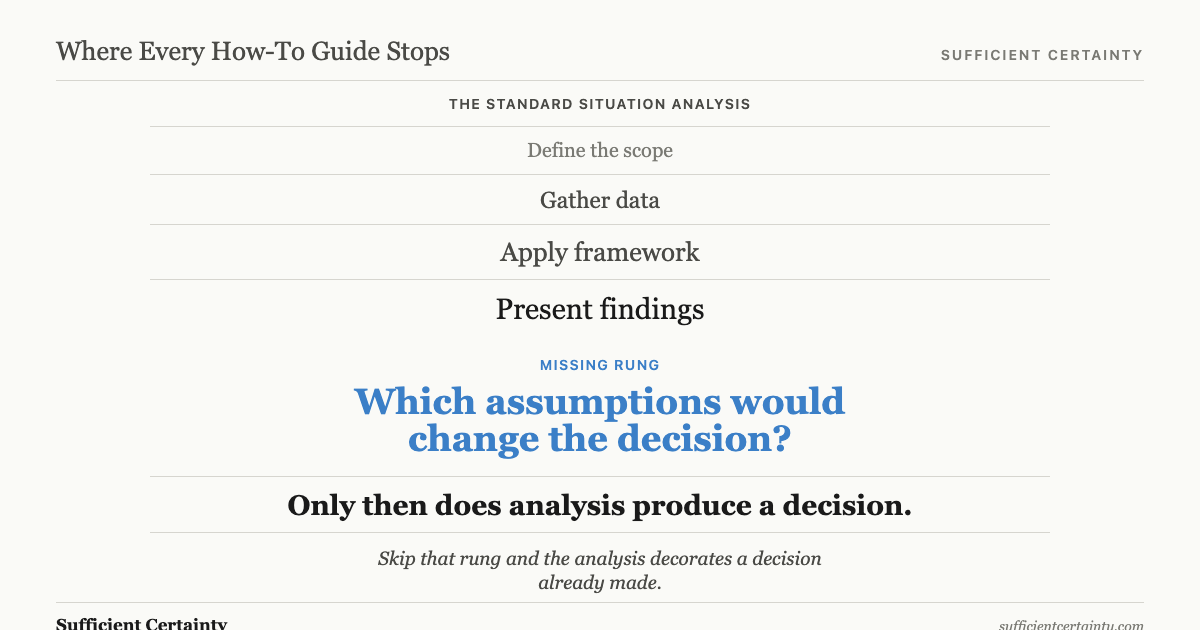
Search for how to do a situation analysis and the advice is uniform. Pick a framework, SWOT or PESTEL, fill in the boxes, present your findings. Every guide ends at "present findings," as though the hard part is populating a matrix rather than knowing what to do once it is full. If you want the meeting-room version of that trap, read how to do a SWOT analysis. These frameworks create the appearance of diligence. That is dangerous, because it hides untested assumptions and leaves the decision untouched. Nokia, Volkswagen, Toys R Us, and BP each had a completed grid; the PESTEL analysis examples show what one unexamined premise cost each of them.
That last clause is the one nobody teaches.
A situation analysis is a decision-specific assessment of the factors that bear on a choice you are about to make, conducted to determine what is known, what is assumed, and what must be verified before acting.
Tie the analysis to a specific decision
Most guides tell you to "define the scope." That is too vague to be useful. You need to name the decision. Not "evaluate our market position" but "decide whether to enter the Southeast Asian market in Q3." Not "assess our competitive position" but "decide whether to acquire CompanyX or build the capability internally."
Name the call, why it matters, and by when. Roger Estall and I built a decision-framing discipline over years of consulting, and the single biggest predictor of a useless analysis was a missing decision statement. When teams skip this step, they gather data about everything and decide about nothing.
Rumelt found the same disease in Good Strategy Bad Strategy. Fewer than one in ten corporate strategy documents contained a genuine diagnosis. They had goals and initiatives. They did not have a statement of "this is the specific challenge we face." Without a decision statement, your analysis produces exactly this kind of document.
Map context by proximity, not category
Here is where I part company with the standard frameworks. SWOT and PESTEL organise information by category: strengths here, political factors there. The categories are arbitrary, and adding two more of them does not make them less so. A supply chain constraint is simultaneously a weakness, an economic factor, and a threat. Filing it in one box loses the other two. Worse, the filing feels productive.
Organise by proximity to the decision instead. Think of three concentric rings. The innermost ring is your internal context: culture, capability, resources. The middle ring is external: customers, competitors, regulators. The outer ring is the wider world: macroeconomic forces, technological shifts, things you cannot influence but must account for.
This is not cosmetic. Proximity forces you to ask different questions. Instead of "is this a strength or a weakness?" you ask "how close is this factor to the decision, and can I influence it?" That second question matters because it determines whether a factor is something you manage or something you monitor. PESTEL never asks this. The full process gets sharper when you stop categorising and start locating.
Test your situation analysis through the five steps and see which contextual assumption actually changes the call. Start the Walk →
Surface the assumptions behind your findings
This is the step that does not appear in any of the ten guides on page one of Google. It is the only step that matters.
Every finding in your analysis rests on assumptions. "Our market share is 12%" assumes the market boundary you drew is correct. "Customer satisfaction is high" assumes the survey reached the customers who matter for this decision. "The regulatory environment is stable" assumes the current government stays in power, or that the next one shares its priorities. Separating what you know from what you assume is the whole point of the exercise.
Kahneman and Lovallo showed the pattern years ago. Their research on the planning fallacy found that 86% of large-scale projects came in over budget and behind schedule. The root cause was not bad data. It was untested assumptions about scope and cost that everyone treated as settled when they were anything but.
Go through each finding and ask: what am I assuming here? Write it down. You will be surprised how many "facts" dissolve into "things we believe but have not checked." That list of untested beliefs is more valuable than the SWOT matrix that produced it. A proper situation analysis generates this list as its primary output, not as an afterthought. If your team needs a worksheet for that step, use a situation analysis template that makes assumptions visible, then study the situation analysis example to see how those assumptions read in a finished case. The findings are raw material. The assumptions underneath them are the product. Even a completed gap analysis can miss the column that matters if it treats every gap as worth closing by default.
Test which assumptions would change the decision
Not every assumption deserves investigation. Some are low-influence: even if wrong, they would not change what you do. Others are high-confidence: you have strong evidence they hold. The assumptions that matter are the ones with high influence on the decision and low confidence in their accuracy.
Plot them on two axes. Vertical: how much would this change the decision if it turned out to be wrong? Horizontal: how confident are you that it is correct? The upper-left quadrant contains the assumptions that could sink you. Those are the ones to investigate before acting. The lower-right quadrant is where most teams spend their time: high confidence, low influence. Safe territory. Comfortable to research. Completely irrelevant to the decision. This is the step that prevents analysis from becoming its own justification.
Skip assumption-testing and everyone gets their slide deck while nobody has to own the decision. The extra step takes hours, not months. It is the difference between an analysis that informs a call and one that postpones it.
Reach sufficient certainty, then act
The final failure mode is the one nobody warns you about: the analysis that never ends. I have watched organisations spend so long refining their understanding that the conditions changed underneath them. Leave it in a drawer for a year and it turns into an obituary for a world that has already moved on.
The goal is not certainty. It does not exist in decisions worth making. The goal is sufficient certainty: enough confidence in your critical assumptions that the risk of acting is acceptable and the risk of waiting is not. The same test settles how much due diligence is enough before a transaction closes. You do not need every question answered. You need the questions that would change the decision answered. That is a much shorter list, and you can work through it in hours rather than months.
CIMA spends eighty pages of its strategic management syllabus on environmental analysis tools and none on when to stop. Training bodies can package frameworks. Knowing when you have analysed enough to act is harder to sell, and it is the part that actually matters. A 2019 McKinsey study found that fewer than one-third of executives said their strategic decisions were made with adequate information. The gap between "we did a thorough analysis" and "we had adequate information for the decision" is exactly what assumption-testing fills.
One more thing. A situation analysis belongs to a moment. When the context shifts, the assumptions you tested may no longer hold. Build in a trigger: name the conditions that would reopen the decision. Without that, today's analysis becomes tomorrow's stale certainty.
So here is the process, compressed. Name the decision. Map context by proximity. Surface the assumptions behind your findings. Test the ones that would change the call. Reach sufficient certainty, and name what would reopen it. The first two steps are in every textbook. The last three are not. They are the difference between analysis and action.
You could present three months of analysis and watch leadership make the same call anyway.
Work through your decisionNo sign-up. Just pick your decision and start.
Grant Purdy is the co-author, with Roger Estall, of Deciding (2020), and the architect of the Universal Decision-Making Method.