
Negotiation strategy is usually taught as technique at the table. The outcome is decided before anyone sits down. The costliest concession happens in the first twenty minutes on an assumption nobody checked. Prepare by naming your walk-away, the claims it rests on, and what would force you to move.
Negotiation strategy is usually taught as technique at the table. The outcome is decided before anyone sits down. The costliest concession happens in the first twenty minutes on an assumption nobody checked. Prepare by naming your walk-away, the claims it rests on, and the conditions that would force you to move.
I sat across from a procurement team that held every advantage. Two alternative suppliers shortlisted, a budget ceiling already approved by their board, and a deadline that belonged to our side, not theirs. The team I was advising had spent a fortnight rehearsing responses to likely objections. Their negotiation strategy was thorough on tactics. Not one person had tested whether the assumptions behind the opening position were true.
The concession that cost them most came in the first twenty minutes. They gave ground on a contract term they believed was non-negotiable for the other side. It was not. That belief was an assumption nobody had checked, and once it was conceded under pressure, no amount of tactical skill could retrieve it.
A negotiation strategy is a deliberate plan for reaching agreement in a dispute or transaction, governing what to seek and when to walk away.
The preparation step your negotiation strategy is missing
The most widely taught negotiation framework is principled negotiation, introduced by Fisher, Ury and Patton in Getting to Yes. Its four pillars separate people from the problem and insist on objective criteria, and the book has sold more than fifteen million copies as the foundational text in MBA negotiation courses worldwide.
It also treats the position you are defending as a given. BATNA, the best alternative to a negotiated agreement, is positioned as your safety net. A BATNA built on untested assumptions about what your team actually needs, or what the other side's constraints really are, is not a safety net; it is a second position on the same unexamined ground.
Victor Martinez Reyes, writing in the Journal of Global Initiatives, argued that principled negotiation is "not the all-purpose strategy of negotiation promised" and regularly leads to suboptimal results. His diagnosis: the method conflates a communication philosophy with a strategy. When the position behind your negotiation strategy has not been tested against evidence, refining how you communicate that position is working on the wrong layer.
Consider the position you are taking into your meeting this week. You might assume the other side cannot wait another quarter, or that the cost of no deal is higher for them than for you. Each of those assumptions is either supported by evidence or it is not; the difference determines whether your position will hold under pressure when the other side pushes back.
What deal pressure does to your position
Deepak Malhotra and Max Bazerman at Harvard Business School measured what happens when competent negotiators operate under realistic pressure. In experiments where MBA students' outcomes were tied to their course grades, about 75 per cent of pairs that reached agreement had one party accept a deal detrimental to their own interest. That is not a finding about weak negotiators; it is a finding about what negotiation training omits.
The motivation to avoid impasse overwhelms the motivation to seek a good outcome, and that imbalance compresses whatever assumptions you carried into the room. Every negotiation-skills program teaches you to resist that compression through willpower, but the evidence says willpower is not the variable that matters.
A separate study from Harvard's Program on Negotiation measured how labelling shapes acceptance. When an option giving participants fewer points was labelled "Agreement," they chose it 24.55 per cent of the time. When the identical option was labelled "Option A," acceptance dropped to 3.99 per cent.
I have seen this in every kind of commercial negotiation: people become six times more likely to accept an inferior outcome because the word "agreement" is attached to it. If you are walking into a room where the other side holds more leverage, that pressure is compounded. The weaker position creates stronger motivation to reach agreement on any terms, which makes the labelling effect more potent and the compression of assumptions more severe.
ENS International, a professional negotiation consultancy, states that untested assumptions are the leading cause of negotiation failure and recommends testing them before negotiating. Their framing treats assumption-testing as one element of preparation rather than as the prior decision the strategy should implement. The difference matters: if the testing happens inside the negotiation process, it happens under the same pressure that distorts everything else at the table.
List the assumptions your negotiation position depends on and test each one against evidence before you sit down. Start the Walk →
When experienced teams still got it wrong
In 1998, Daimler-Benz and Chrysler completed a $36 billion merger. Both sides brought advisory teams and due-diligence operations spanning two continents. What neither side tested was the assumption that two organisations with fundamentally different decision-making cultures could operate as one entity.
The cultural mismatch was visible before the ink dried. Daimler's leadership favoured formal documentation and multi-level approval chains; Chrysler's product teams operated with delegated authority and rapid iteration. By 2007, when Daimler finally divested Chrysler, the net position was roughly $1.5 billion in the wrong direction on a $36 billion deal.
Two years later, AOL and Time Warner merged at a valuation of $103.5 billion on the assumption that internet distribution and traditional media content would produce results neither company could achieve alone. The convergence thesis was an article of faith in late-1990s boardrooms, not a conclusion drawn from evidence. When the dot-com bust arrived, the merged entity reported a $99 billion annual loss in 2002.
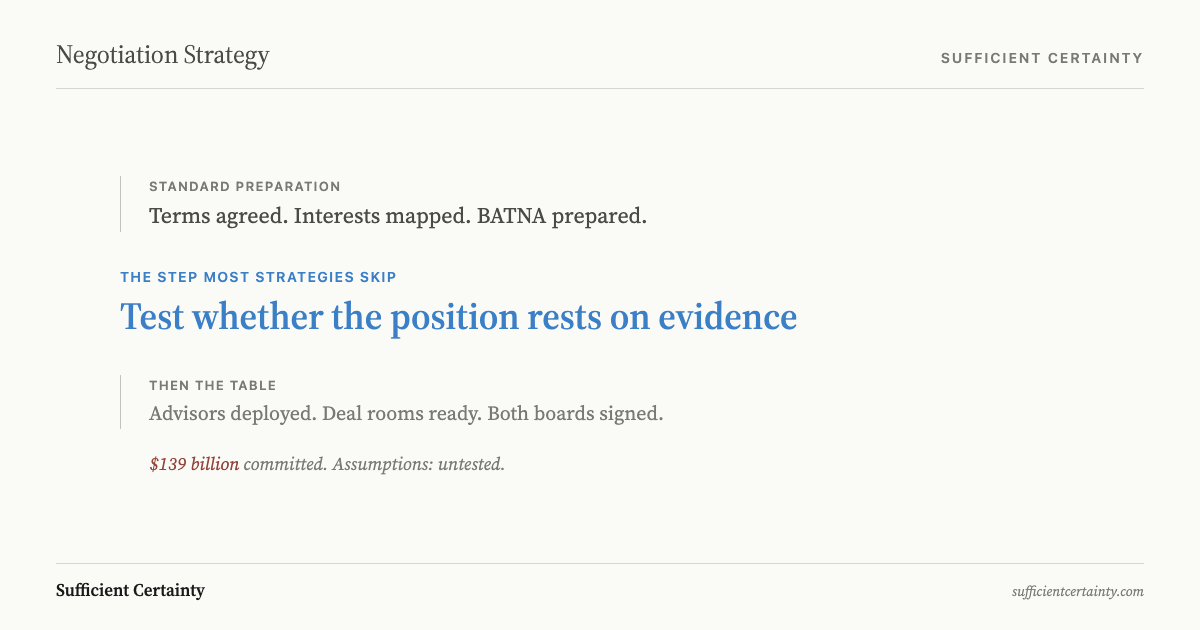
Between those two transactions, $139 billion in deal value was committed on assumptions nobody had tested. Securing buy-in for terms is not the same as testing whether those terms rest on sound assumptions. Both were organisational alignment failures: the people who had to make the merged entities work did not share the assumptions the deals were built on.
The Camp David II talks in 2000 are the geopolitical version of the same pattern; analysis in the Harvard Negotiation Law Review found that no zone of possible agreement existed between the parties, but nobody tested that before committing heads of state to a summit.
Testing your negotiation strategy before you enter the room
The Universal Decision-Making Method makes a cleaner separation. Its five steps produce a tested decision before the conversation starts. You frame the decision: what are you actually trying to achieve, and what authority do you have?
You develop options, and then comes the step most negotiation preparation skips: the assumptions behind your preferred position are stated explicitly and tested against available evidence, while revision costs nothing.
Take a vendor renewal where the supplier has proposed a 15 per cent price increase and your procurement team believes the switching cost makes walking away impractical. Before that belief shapes your strategy, state it as an assumption and test it. What does switching actually cost? Not the number someone quoted in a corridor eighteen months ago, but the current figure: retraining, data migration, the gap between contracts.
When one team I worked with tested that assumption, the switching cost was less than half what the brief assumed. The supplier's leverage rested on a number nobody had verified since the original contract was signed. That single test changed the negotiation. The team walked in with a fallback they had priced, not one they had inherited. The supplier, accustomed to renewals where switching cost was treated as infinite, adjusted within the first hour.
That observation holds whether the negotiation involves a $36 billion merger or a $200,000 vendor contract. The scale changes; the failure mode does not. If you have not tested the assumptions behind your position, you do not have a negotiation strategy; you have a preference with a brief attached to it.
When Roger Estall and I wrote Deciding, we kept returning to the same observation across the cases we studied: organisations that failed in negotiations did not lack skill at the table; they lacked a tested position before they reached it.
Stakeholder alignment depends on the same discipline. If the people who must act on a negotiated outcome do not understand what was decided and what it assumed, the gap cannot be repaired after the fact. When a negotiated deal fails during implementation, whether through operational breakdown or outright dispute, the assumptions that held at the table did not hold once real operations began.
Your vendor renewal, your budget request: the meeting is this week and the other side has more leverage. In my experience, that leverage matters less than you think if the assumptions behind your position have been tested and theirs have not. The side with the tested position does not always win the negotiation, but it rarely signs a deal it regrets.
You could sharpen the negotiation strategy and still walk in with a position built on an assumption nobody tested.
Work through your decisionNo sign-up. Just pick your decision and start.
Grant Purdy is the co-author, with Roger Estall, of Deciding (2020), and the architect of the Universal Decision-Making Method.