
A power interest matrix example is useless until someone writes down the decision it maps. Most stakeholder grids sort names by influence and interest without stating what those people are influential about. The matrix works only when it serves a specific call, and that call must be written first.
A power interest matrix example is useless until someone writes down the decision it maps. Most stakeholder grids sort names by influence and interest without stating what those people are influential about. The matrix works only when it serves a specific call, and that call must be written before the first name goes into a quadrant.
I once watched a program director present his stakeholder map to the board. Every quadrant was filled. The grid was colour-coded, the contact plan attached. I asked one question: what is the decision? He looked at the chart, then at me, then back at the chart. He had sorted forty people by influence and interest without writing down what they were influential about.
That is how most power interest matrix examples are built. Someone gets a blank slide, sorts names into boxes, and the meeting feels like progress. I start with the decision, because a stakeholder's power means nothing without a particular call to affect. A person can be peripheral to the policy choice and indispensable once it has been made. Put that person in a box too early and the box becomes a private judgement about how much they matter.
A power interest matrix example is a completed stakeholder map that places people by their ability to affect a decision and their interest in its outcome.
A Power Interest Matrix Example Starts With a Decision
Before anyone is plotted, Heathrow needs a sentence: should the government adopt a policy supporting expansion and, if so, what conditions must it meet? Without that sentence, the grid is only a list of names. That is where a matrix stops describing a decision and starts avoiding one.
I have watched senior people placed in the high-power box merely because they were senior, while everyone else was put under a soothing label such as "monitor". Nobody had tested how a supposedly lower-power person could change the answer. The consultant who supplied the standard template gets a finished chart; the Decider is left without an evidence route. That is office hierarchy dressed up as stakeholder analysis.
Write the decision in one sentence and name the Decider. Then ask how each person can change the answer or the result after the answer has been made. In the Universal Decision-Making Method, this belongs in Step 1, Frame the decision. A contact list does not supply either a decision rule or a route for evidence to reach the owner.
In my experience, an organisation can call itself organisationally aligned while the people doing the work have received only a list of names and a request to consult them. They still do not know whose evidence can alter the call. That is an ownership gap, which leaves the people who must decide without the evidence that could change the call.
The Department for Transport has made the distinction unusually visible. Its published approach separates the policy-review team from the team dealing with the promoter, and says ministers will not entertain private representations while the review is open. The Department's statement of approach fixes how evidence enters the decision and closes the private side channels that contaminate it. I have worked on calls where an unofficial briefing changed the terms while nobody outside the room knew it had happened. Promoters benefit from that arrangement because their claims arrive before they can be tested. That is a decision safeguard, not a public-relations arrangement.
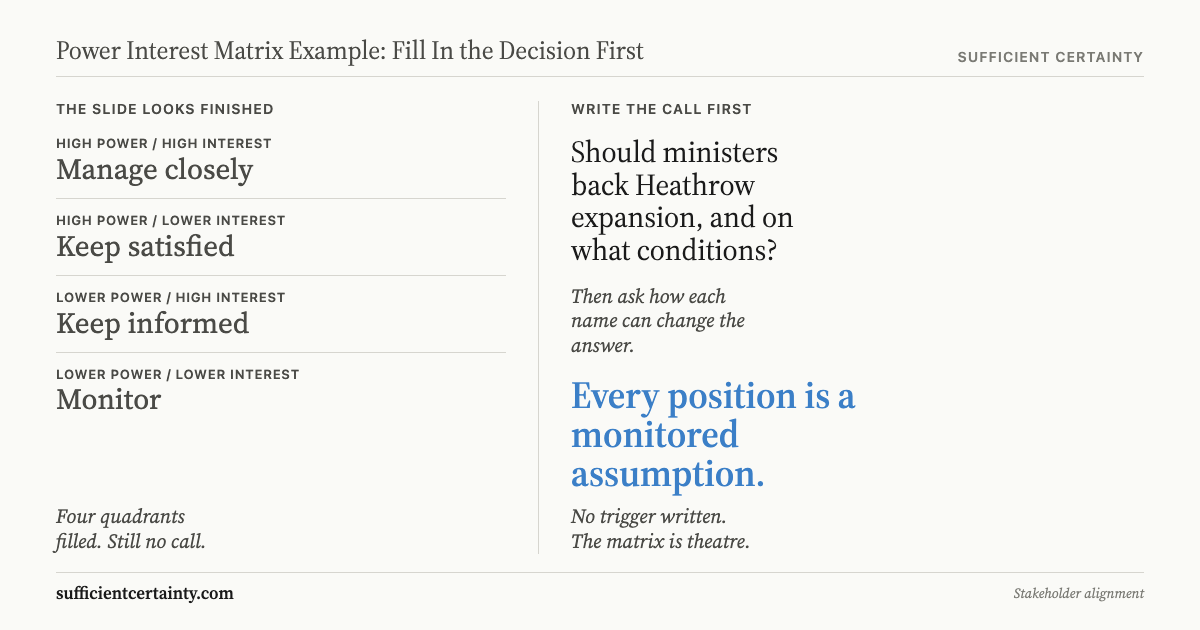
The Heathrow Power Interest Matrix Example
Each position in this completed map is provisional and records an obligation. I have used maps in this form to stop an owner leaving a meeting with generic labels instead of a written request or a warning sign.
| Heathrow stakeholder map |
|---|
| High power, high interest. Department for Transport ministers and policy officials own the call. They are owed a published decision rule and a record of the evidence used. Heathrow Airport Limited supplies the scheme and key inputs. It is owed written evidence requests and testing independent of the promoter. |
| High power, lower interest. Transport bodies with surface-access responsibilities may have authority without treating the policy as their central issue. They are owed a formal request for conditions that could change delivery. |
| Lower power, high interest. Friends of the Earth and local community groups have strong reason to contest the outcome. They are owed access to the consultation evidence and a recorded response to material objections. |
| Lower power, lower interest. The wider travelling public has limited direct influence at this stage. It is owed clear public information, with a signal that moves its concerns upward if the evidence changes. |
One party owns the policy decision; the other controls much of the proposal and evidence. The consultation announcement shows how much technical and financial material is in play. I have sat with boards that treated a promoter's model as independent evidence because nobody had written down who would test it. The promoter then sets the terms of the call. That is how untested evidence gets waved through.
Local authorities and the Mayor of London are the harder judgement. In the earlier policy challenge, they used formal processes to contest the government's approach; the Court of Appeal summary records that route. Their position may put them alongside the decision owner rather than in a lower-power box. I have seen a local authority treated as a communications problem until it became a formal opponent. A dated reason beside the name makes that judgement open to challenge. That is what a generic quadrant label cannot do.
Pick the stakeholder your matrix labels high power and write the one action the Decider owes them before the call. Start the Walk →
A Smaller Power Interest Matrix Example
The Heathrow case involves a national policy process and thousands of affected parties. Most decisions are smaller, but the same discipline applies. I was asked to help a board that was considering whether to close a regional manufacturing site. The decision sentence was plain: should the company cease production at the site by the end of the financial year, and if not, what investment is required to continue?
The general manager had produced a stakeholder map with thirty names sorted by seniority. The union representative was in the lower-power box because union membership at the site had declined. I asked what would happen if the representative went to the media with the closure plan before the board had made its call. The general manager moved the name upward. That is what a decision-first map exposes: power is not a permanent attribute, it is a function of what the person can do to this particular call.
| Site-closure stakeholder map |
|---|
| High power, high interest. The board and the site general manager own the call. They are owed a financial case that separates sunk cost from avoidable cost, and a record of what investment would change the answer. |
| High power, lower interest. The parent company's group finance function controls capital approval without treating the site as its central concern. It is owed a request that states the conditions under which the closure case fails. |
| Lower power, high interest. Site employees and the union representative have the strongest reason to contest the outcome. They are owed early notice of the decision criteria and a response to claims that the financial case is incomplete. |
| Lower power, lower interest. Local suppliers and the municipal authority have a commercial or planning interest but limited direct influence on the board. They are owed a timeline and a point of contact if the closure changes their own commitments. |
The map took twenty minutes. The general manager's original version had taken an afternoon with a consultant. The difference was that every name now had a reason and an obligation beside it, not just a quadrant label.
The Same Grid at Team Level
I have used this approach for decisions as small as replacing a department's core system. The IT director framed the call: should the department migrate its case-management platform before the licence renewal, or extend for another year? She had four stakeholders who mattered, not forty. But she had placed the vendor in the lower-power box because she assumed negotiations were settled. I asked whether the vendor could change the renewal terms once migration was announced. She had not tested that assumption.
| System-migration stakeholder map |
|---|
| High power, high interest. The IT director owns the call. The operations manager whose team uses the system daily is owed a written comparison of what the new platform does and does not carry over. |
| High power, lower interest. The finance controller approves the spend without using the system. She is owed a cost case that names the condition under which extending is cheaper than migrating. |
| Lower power, high interest. The case workers who enter data every day cannot block the decision but will determine whether the new system works. They are owed a test period and a route to report gaps before go-live. |
| Lower power, lower interest. The incumbent vendor has a commercial interest but no seat at the decision table. It is owed a clear timeline so its renewal offer reflects the actual commitment. |
Four names, four obligations, one page. The scale changed; the discipline did not. A national policy and a department platform both need a decision sentence, a named owner, and a reason beside every position.
A Position on the Grid Is an Assumption
Every position on a stakeholder map needs a condition that could prove it false. In my experience, formal power is only part of the matter; an urgent, legitimate claim can make a group decisive without giving it formal control. Ronald Mitchell, Bradley Agle, and Donna Wood made the same point in their study of stakeholder salience. Roger Estall and I made stakeholder movement a monitoring problem in Deciding, because we found that a position on a chart must survive the work.
The stock instruction to "keep satisfied" or "monitor" treats the first assessment as a fact. For Heathrow Airport Limited, a missed evidence request or an unsupported cost claim would change the relationship quickly. For a community group, a new environmental finding or a credible legal issue can turn a consultation respondent into a material source of delay. The Decider needs those signals before they become a headline or a court timetable. A completed contact plan is of little use once the decision has been delayed. That is the weakness of the standard labels.
Omar ElWakeel and Bjorn Andersen studied stakeholder movement across 12 projects in five Norwegian sectors and found that users were the most dynamic group. Their research on stakeholder evolution shows why a chart cannot be treated as a fact after the workshop ends. I have watched the opening of a consultation change who has authority, because new evidence gives an apparently peripheral group a route to challenge the call. That is why the chart expires as its Context changes. Redraw it at decision gates and name the warning sign that requires it sooner.
I have put that warning sign beside each name in review sheets, then returned to it when the decision moved. This is Step 5, Design monitoring. Before people are declared aligned enough to start execution, the Decider needs to know which change of influence or evidence requires another look. A map without that requirement is merely a meeting record.
The Decider Owes More Than a Communication Plan
The phrase "manage closely" avoids the obligation. Someone who can block a decision is owed a legitimate route to relevant evidence and a clear account of what has been decided; someone supplying crucial evidence is owed a written request, with a response showing whether their claim changed the decision. I have seen generic labels conceal those duties because the sponsor wanted the chart finished before the argument began.
The National Audit Office made the authority problem plain in its review of the UK major-project portfolio. At 31 March 2024, the portfolio held 227 projects with a combined whole-life cost of GBP834 billion. Its review of governance and decision-making shows why a stakeholder map cannot repair a decision with no accountable owner. I have sat in governance meetings where everyone could name the stakeholders and nobody would name the person who could settle the issue. The committee chair still had a completed report for the minutes. That is an ownership failure; no matrix can repair it.
I have seen a sponsor ask for stakeholder buy-in when what was needed was a decision rule and a record of the assumptions behind it. The matrix may identify the people who need that record. It cannot create understanding by itself. Apparent agreement buys the sponsor a quiet meeting, then the people doing the work arrive with private interpretations of the call. That is what false buy-in costs.
Use the grid before engagement, then keep it alive after the call. The stakeholder alignment guide covers what follows: people who must act need the decision recorded with the assumption that would send the issue back to the Decider. That is the duty the matrix exposes.
You could map every stakeholder and still leave the blocking route unnamed beside the label.
Work through your decisionNo sign-up. Just pick your decision and start.
Grant Purdy is the co-author, with Roger Estall, of Deciding (2020), and the architect of the Universal Decision-Making Method.