
Aligned enough to start execution does not mean the team agrees. It means everyone can state the decision, name the assumption it depends on, describe their own responsibility, and say what change would send the work back for review. Most stalled projects launched with enthusiasm and no alignment test at all.
Aligned enough to start execution does not mean the team agrees. It means everyone can state the decision, name the assumption it depends on, describe their own responsibility, and say what change would send the work back for review. Most stalled projects were launched with enthusiasm and no visible alignment test at all.
I arrived at a project office six weeks after the board had approved the work. Fourteen people were preparing to mobilise, and not one of them could tell me what the decision required. The team was not aligned enough to start execution.
When I asked the site manager to state the scope, she described a boundary her sponsor had not signed. Two readings of the same approval had been circulating since the board meeting. Neither named who owned the assumption that the client would supply the access the schedule depended on.
I have sat in rooms two weeks after a strategy offsite where the chief executive wanted movement and the team leads wanted cover before committing people and money. Asking everybody for agreement let both groups postpone ownership.
Committee members could keep their hands clean of the start decision they were supposedly considering. The question of stakeholder alignment ended when the people below the meeting had to begin work on Monday without knowing what the decision required of them.
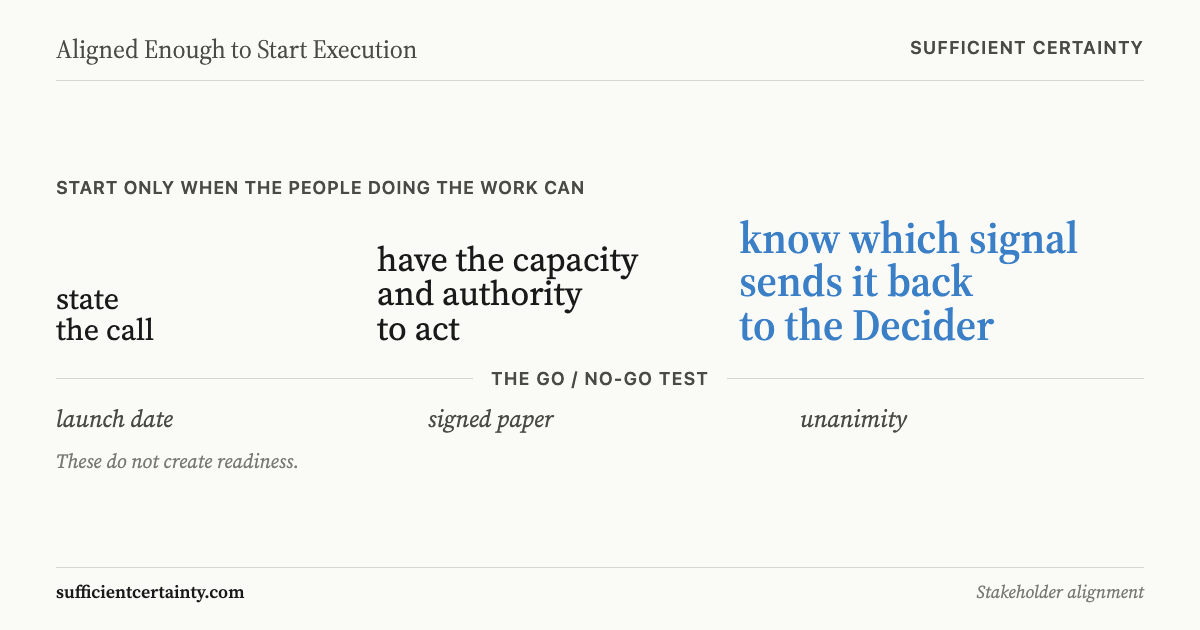
Aligned enough to start execution is the point where the people doing the work can state the call, act on it, and know what sends it back.
Aligned enough to start execution is a readiness test
A launch date or a signed paper tells me little about readiness. The real test is whether the next piece of work can begin without someone privately inventing what the decision omitted.
The Government Accountability Office found that incomplete requirements meant the VA and its contractor did not share a common understanding of what they were building. Almost two years later, 87 defects that should have been fixed before the second stage remained open. That is what happens when the date outranks the gate.
I have seen Deciders proceed with known defects when the effect was understood and a condition for stopping was recorded, which can be a sound decision in the circumstances. The VA instead treated progress against the timetable as if it proved readiness, allowing executives to report movement while delivery teams carried defects they had no authority to accept. A date creates an obligation to examine readiness; it does not create readiness.
Roger Estall and I built the Universal Decision-Making Method around making the assumptions visible before work begins, then deciding how their failure will be detected. As we argue in Deciding, a team is aligned enough to start execution only when the people doing the work can act. They must also know what signal would reopen the call. I am asking for evidence that the reopening condition was named, not for confidence or applause.
Can each person state what the decision requires?
I have asked the person about to do the work to state the call back to me more times than I can count. Their answer shows whether the decision has arrived.
They need not repeat the board paper. Their account must create the same practical work boundary as the Decider's account; if it creates another boundary, somebody is about to begin a different job.
The Transportation Security Administration failed this test while preparing biometric access technology for maritime facilities. Officials at all 15 locations visited by the Government Accountability Office reported ineffective communication and coordination, and questions at two facilities went unanswered for months. The final testing report was not provided to participating facilities even though those facilities had to act on what the testing established.
The decision and the evidence supporting it never reached the people expected to execute it, so their work began with guesses rather than the basis for the call.
I have seen meetings treated as proof that a decision was understood, although attendance lists show only that people were present when somebody spoke. Unanimity is often how a group avoids naming the owner. The difference between alignment and consensus is that alignment requires each person to carry the work boundary, not merely record a mood.
Name the one assumption your team has not assigned to anyone and decide whether the work can begin without that answer or must wait. Start the Walk →
Does somebody own the assumption that could stop the work?
In my experience, teams wait for certainty because nobody has named the one remaining assumption that can still kill the start. That omission leaves people either to delay without a reason or to begin on faith.
An unresolved assumption can sit inside a sound decision when it is visible and owned. An unnamed assumption becomes a private gamble made by the person least able to alter the decision.
The United States had a published national COVID-19 testing strategy, yet public-health stakeholders told the Government Accountability Office that they did not know it existed or did not understand its current goals. They needed to know which tests applied to which populations and how often to use them. Later strategy reports were not released, and CDC officials had not helped develop two of them. The document existed, but the operating assumptions had not reached the organisations expected to work with them.
I write the assumption in one sentence, name the person who owns it, and name the evidence that kills it. That gives a Decider a basis for starting without pretending uncertainty has gone away.
A supplier may fail to meet an agreed date, or a regulator may refuse a specified change. The owner must bring the evidence back to the Decider before the team spends further money.
Disagreement over that sentence is evidence, not disloyalty. At this stage, managing disagreement in a team means deciding whether the objection belongs with the assumption or with the decision itself.
Are the resources and authority actually available?
A promise of resources is not a resource, and an owner without authority is a messenger who can report a problem but cannot settle it. I have watched senior groups approve work on the understanding that funding or operational support would arrive later, while those below them absorbed the uncertainty as delay and rework. Senior approvers kept the appearance of momentum; delivery carried the cost.
A renewable-energy mini-grid project in Chad began before government co-finance of USD 1,091,211 had arrived and without a local project manager. The UNIDO review found both conditions missing when the project started, leaving the project significantly behind schedule before local delivery had a basis. That is what approval without capacity produces.
In my work, I put actual funding and local capacity before the Decider, then ask whether they justify a limited pilot or a later start.
Approval survived because it protected the sponsors' report of movement, while procurement and local staff inherited the unanswered question once money and authority proved absent. The label of organisational alignment did not produce co-finance or a local project manager. The decision still had to state what could actually begin, and no label substitutes for that statement.
When are you aligned enough to start execution?
Before work begins, the Decider must name the signal showing that a material assumption has failed and the person authorised to judge it, because monitoring arrangements are part of the start decision. In forty years of this work, I have found that a dashboard or contractor report has no value by itself. Its result matters only when somebody with authority reads it, understands its significance, and can reopen the call.
In the VA case, no one defended the gate when unresolved defects showed that the approved conditions for the next test stage were not holding. In Chad, no one was charged with showing early that the conditions of approval had failed. The decision drifted while sponsors could maintain the approval fiction. A steering committee that is not making decisions may collect those warnings in its minutes, but collection is not authority. That is what happens when warnings reach a body that cannot send the work back to the Decider.
I have chaired leadership meetings where another workshop was proposed because no one wanted to say that the decision still had no owner. Committee members usually benefited from one more meeting, because it left the ownership question outside the minutes.
The go/no-go test asks whether people can begin the stated work with real authority, while returning an invalidated assumption to the Decider. When they can, I know the team is aligned enough to start execution. Where no one owns the call, the committee is short of a Decider, not more alignment.
You could start the work on Monday and find nobody owns the assumption that stops it.
Work through your decisionNo sign-up. Just pick your decision and start.
Grant Purdy is the co-author, with Roger Estall, of Deciding (2020), and the architect of the Universal Decision-Making Method.