
Census data for US manufacturing from 1963 to 1982 showed that 61.5 per cent of entrants had exited within five years, a figure Camerer and Lovallo (1999) cite in their study of excess entry. After a market entry analysis, the step is to check the question the analysis was asked to answer, before the entry mode and rollout schedule go to the board. An analysis that starts from "how do we enter?" has already settled whether to enter, and at what speed.
A market entry analysis assesses a target market's size, competition and barriers, then recommends an entry mode, location and timing for moving in.
What does an entry team do with a finished market entry analysis?
The analysis arrives as a pack. Market sizing and growth forecasts. A country screen covering regulation, tax, currency and labour. A competitor map showing who holds share and on what terms. A comparison of entry modes: export, licensing, joint venture, acquisition, greenfield build. A preferred route, a list of sites or partners, and a financial model with a payback date.
The next moves follow in a familiar order. The preferred mode is chosen. Negotiations open with the partner, the target company or the landlords. A rollout schedule is drawn up, usually in waves, so that distribution, hiring and marketing can be sized. The business case goes to the board with a capital request attached, and a country team is appointed to deliver it.
Each of those steps narrows the work. Once the mode is chosen, the model is rebuilt around it. Once the schedule exists, supply contracts and hiring plans are built to meet it. Teams that have looked hard at the economic factors that could kill a market entry will have stress-tested the demand side. What rarely gets revisited at this point is the question the pack was commissioned to answer. By the time the board sees it, the question has become a premise.
An entry analysis turns an ambition into options a board can compare
Before the analysis, "grow internationally" is an aspiration with no price attached. After it, there are named markets, named modes and numbers that can be argued with. That is a real gain. A board can challenge a market-size estimate. It cannot challenge a mood.
The analysis also forces the external picture into view. Running PESTEL and SWOT before market entry surfaces the regulatory barrier, the tariff or the entrenched competitor that would otherwise appear in year two. Comparing modes side by side shows what control the organisation gives up in a joint venture, or how much capital it ties up in a greenfield build.
Used well, it sits between the growth choice and the operating plan. An Ansoff matrix says which direction to grow; the entry analysis says how to get into one specific market. Within the wider discipline of strategic thinking, it is where direction turns into commitments. It answers the question it was given, thoroughly.
Write down the question your entry analysis answered and check whether 'do not enter' was ever a possible answer to it. Start the Walk →
The question written on the first slide
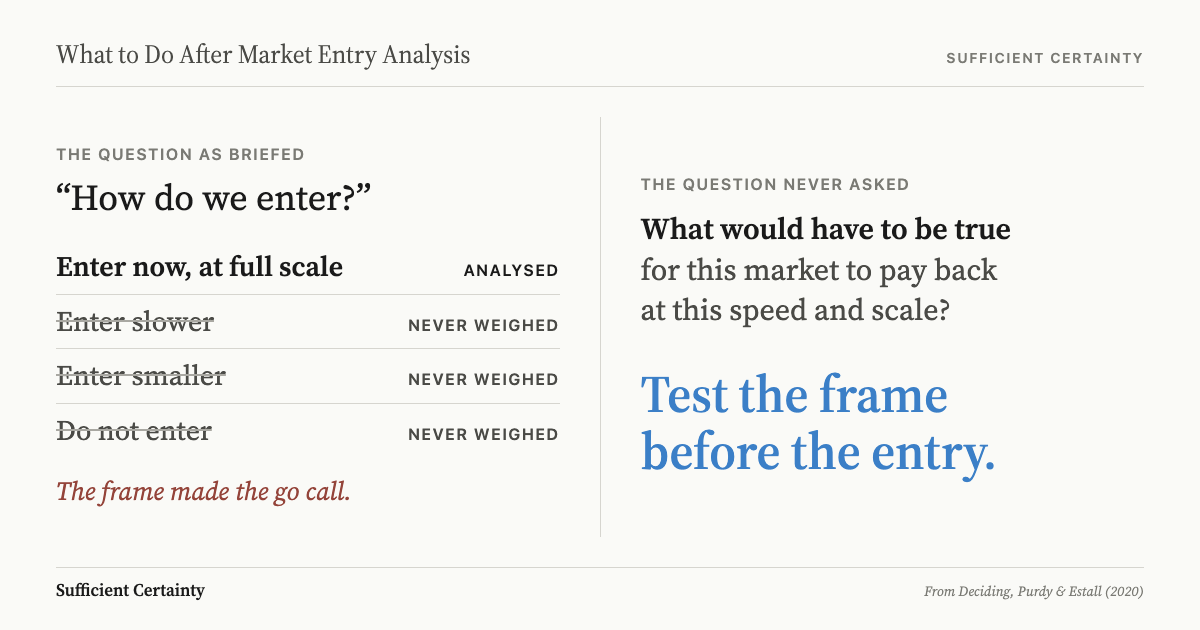
Every entry analysis opens with a question, often on the first slide of the brief. "How should we enter Market X?" "Which entry mode offers the best return?" "How quickly can we reach national coverage?" Each one looks neutral. Each one has already made a decision. The first assumes the organisation will enter. The second assumes one of the listed modes is right. The third assumes speed is the goal and only its limits are in doubt.
The analysis then does exactly what it was asked. It compares the options inside the frame. Options outside the frame never appear: enter more slowly, enter smaller, enter one region first, or stay out. None of them is rejected. They are simply never costed.
The pattern is well documented. Kahneman and Lovallo (1993) found that decision makers treat each problem as unique, isolate it from future opportunities and anchor forecasts on the plan in front of them. An entry brief invites exactly that. The work of problem framing is to ask a different first question: what would have to be true for this market to pay back at the committed speed and scale? That question lets "not yet" and "not like this" onto the option list.
Target Canada's Zellers deal set the speed before the stores could test it
On 13 January 2011, Target agreed to pay C$1.825 billion for the leasehold interests in up to 220 Zellers sites, its first retail expansion outside the United States. The announcement said it expected to open 100 to 150 stores in 2013 and 2014, invest more than C$1 billion in renovations, and see earnings accretion in the first full year of store operations.
The announcement framed entry as a property conversion with a timetable. Once the leases were bought, the open questions were which sites to keep and how fast they could be converted. In 2013 Target opened 124 Canadian stores, which its Form 10-K for fiscal 2013 called "the biggest single-year store opening cycle in the Company's history". The Canadian segment reported sales of US$1,317 million and a loss before interest and tax of US$941 million.
The same filing put the segment's gross margin rate at 14.9 per cent, reflecting "efforts to clear excess inventory following lower than anticipated sales and supply chain start-up challenges". The distribution and data problems behind those empty shelves are covered in the comparison of SWOT or PESTEL for market entry. The schedule meant those problems were met across more than a hundred stores in the first year.
On 15 January 2015, with 133 stores and about 17,600 employees, Target Canada applied for protection under the Companies' Creditors Arrangement Act in the Ontario Superior Court of Justice. In Target's announcement, Chairman and CEO Brian Cornell said Target had been "unable to find a realistic scenario that would get Target Canada to profitability until at least 2021." The 2011 announcement had described one path: convert the leases and open 100 to 150 stores within two years. The pace came with the deal.
Rewriting the entry question before the board sees the schedule
The artefact to check is the entry case's stated decision question and the option list that follows it. Find the sentence the analysis was built to answer. If it reads "how do we enter", "which mode" or "how fast can we roll out", the go or no-go has already been decided by the wording.
Rewrite it before the entry mode and rollout schedule go to the board: what would have to be true for this market to pay back at the committed speed and scale? Then list what that question adds. A pilot region. Fewer sites in the first year. A partner carrying the operating risk. No entry at all. Each needs a cost and a payback date alongside the preferred plan.
Where a deal fixes the pace, as a block of leases or a licence deadline can, price the speed separately. Ask what the plan loses if the rollout takes twice as long, and what it risks if it does not. Reframing the problem at this point costs a meeting. After the schedule is signed, it costs stores.
Framing is the first step of the Universal Decision-Making Method for this reason: every later judgement inherits it. An entry case is only as sound as the question on its first page.
Target Canada had a finished entry analysis and 124 stores open in its first year. What it never had was an entry question that allowed the answer to be slower.
Work through your decisionNo sign-up. Just pick your decision and start.
Grant Purdy is the co-author, with Roger Estall, of Deciding (2020), and the architect of the Universal Decision-Making Method.