
Representativeness bias turns a pattern match into a probability claim without checking whether the conditions that made the pattern work still hold. Resemblance is not evidence, but it feels like it, and that feeling does more damage than a wrong number because nobody thinks to challenge a good fit.
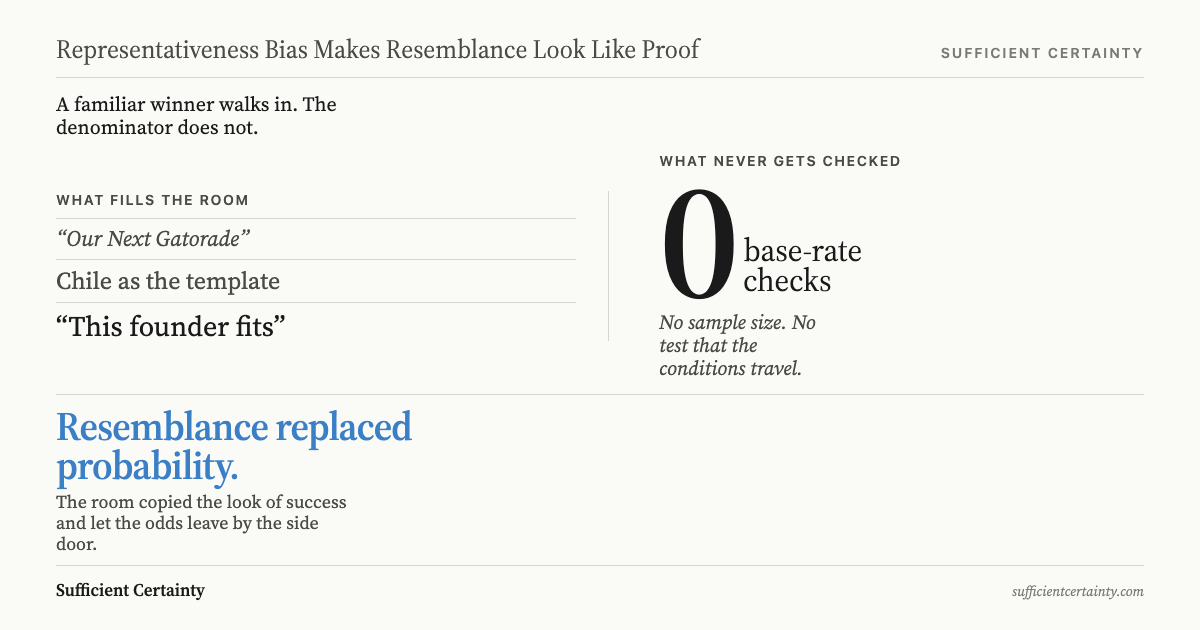
I once read an acquisition paper built around a 22-page deck and a slide titled "Our Next Gatorade". The target had younger buyers and a bit of momentum, so the resemblance was doing all the heavy lifting. Lower margins and weaker retailer loyalty were pushed aside as if they were clerical details. The category itself rewarded novelty more than habit, which should have made the comparison wobble. The room wanted the costume, not the denominator. That is representativeness bias.
The real error is probabilistic. A case looks typical, so people stop asking what usually happens or which local conditions would have to hold for the comparison to mean anything at all. Sample size goes missing soon after. Nobody in the room asks how often the lookalike cases actually paid off.
Roger Estall and I wrote Deciding after watching boards do this with a straight face. A neat analogy saves time and spares the sponsor harder questions. In my experience, that is why the room likes it so much.
Representativeness bias is the habit of treating a past success as proof that the same approach will work again, without checking whether the conditions that made it work still hold.
How representativeness bias turns resemblance into probability
Daniel Kahneman and Amos Tversky named the mechanism in 1972. They showed that people judge likelihood by resemblance, then underweight base rates and sample size. Scientists did it too, which spoils the cosy story that this mistake belongs to amateurs. Expertise often just gives the pattern-match a nicer tie.
Among the usual types of cognitive bias, this one is especially dangerous because it sounds practical when spoken aloud. "It looks like the last one" passes for wisdom in many boardrooms. I hear guesswork wearing the badge of precedent.
When that line appears, I go back to the Universal Decision-Making Method and force the carry-over claim onto the page. What exactly is supposed to travel, and what local fact would make the comparison ridiculous? Once those questions are written down, the great precedent often shrinks into an anecdote that arrived overdressed.
Representativeness bias made Chile look exportable
Chile's pension reform gave ministers and advisers a very saleable story: here was a modern reform with a success halo, ready for export. In Kurt Weyland's account of Latin American pension reform, Chile became the model that dominated the agenda in the 1990s. Bolivia and Peru leaned heavily on Chilean advice, and one participant said about 90 per cent of one reform was taken directly from Chile.
That suited the people selling the model. A portable success story gives politicians instant legitimacy and gives advisers a franchise they can keep exporting. It is tidy nonsense that travels well. The citizens who have to live inside the copied system do not get the same convenience. Weyland notes that Peru's support for reform rested partly on promised macroeconomic benefits without firm empirical backing. I have seen the same move in corporate papers for years. A local win is relabelled as a general rule because the simplified version is easier to approve.
Representativeness bias hides inside the word fit
When investors say fit, they often mean the founder matches a picture already sitting in their heads. Dana Kanze and her co-authors looked at 392 ventures and then ran an experiment with 130 investors. Female-led ventures in male-dominated sectors were treated as worse fits than similar ventures in female-dominated sectors, while male-led ventures escaped that penalty.
Call it one of the psychological biases if you like. I care more about the move itself. The investor is not judging the venture cleanly; the investor is checking whether the founder matches a prototype already trusted. Then the word fit performs its usual little trick and turns a private picture into professional judgement.
That is why I refuse to reduce representativeness bias to stereotyping. Stereotypes are one outlet for it, nothing more. The deeper mistake is letting resemblance sneak past probability and dress itself up as discernment.
Test the familiar case steering your decision and name the conditions that made it rare. Start the Walk →
Experience does not rescue the room from it
Experience often makes this bias harder to challenge, because it gives the comparison rank. Sjoerd Stolwijk and Barbara Vis tested elected Dutch local politicians and found conjunction errors in two of three scenarios, plus scope neglect in another. The main sample covered 211 elected officials from larger municipalities, some responsible for budgets around EUR600 million.
These were not undergraduates amusing a lab. They were elected adults making consequential judgements, and experience did not save them. In my experience, senior rooms can be worse. One vivid prior case strolls in, the veteran says "we've seen this before", half the table relaxes, and the denominator quietly leaves by the side door.
This is one reason I get impatient when people treat experience as a substitute for frequency or actual evidence. Memory is not a base rate. It is a highlight reel, and highlight reels are wonderful tools for selling things that do not travel.
What I ask when a case looks comfortingly familiar
A board chair once introduced me as the man who asks what is different before he asks what is similar. My first question is representative of what, exactly. My next question is what base rate or local fact would make this comparison look foolish.
Under the Universal Decision-Making Method, that sends us straight into Recognise assumptions and Sufficient certainty. If the decision depends on one case behaving like another, the transfer conditions need to be written down in plain English. The room then has to decide what evidence justifies treating this case as comparable, rather than merely comforting.
If the room still wants to proceed, Design monitoring should name the first signs that the supposed precedent was never a precedent at all. This mistake appears across the wider cognitive biases in decision making guide, but this bias has a particular smell. A case looks familiar, the room gets comfortable, and nobody checks whether the odds live here too. I do not trust the comfort. I trust the denominator.
How to correct for representativeness bias before you commit
Knowing the bias exists does not fix it. I have watched people nod along to a presentation on representativeness bias and then, forty minutes later, approve a hire because the candidate "reminded us of Sarah". Sarah had been good. The candidate had Sarah's confidence and Sarah's MBA. Nobody asked how often that profile delivers in this role, in this market, with this team. The resemblance was doing all the work and the room had just finished agreeing that resemblance should not do the work.
The correction is not willpower. It is a short discipline forced into the conversation before judgement hardens. I use three steps, and I insist on them in writing because spoken promises to be objective evaporate the moment the pattern match feels warm.
First, name the assumption the resemblance is carrying. Write it down in one sentence. "We believe this candidate will perform like Sarah because both have consulting backgrounds and a direct communication style." That sentence looks thin on paper. It should. The whole point is to see how little is actually holding the comparison together. Most rooms skip this because the resemblance feels too obvious to spell out, which is exactly when it needs spelling out. Surfacing assumptions is the structural fix because untested resemblance is just an assumption wearing a costume.
Second, find the base rate. Ask the question the room does not want to hear: how often does this profile actually succeed in this specific position? Not in general. Not at the previous company. Here, with these conditions. In one investment committee I sat with, the founder matched the profile of two earlier wins so closely that the partners were ready to write the cheque over lunch. I asked them to pull their own data on founders with that background in that sector. The success rate was around one in five. The two wins were vivid. The three quiet failures had been forgotten, which is what failure does when it leaves without a scene.
Third, decide whether the resemblance is evidence or pattern-matching. If the base rate is strong and the local conditions are genuinely comparable, the resemblance may be useful information. If the base rate is weak or the conditions differ in ways that matter, the resemblance is a comfort blanket and the room needs to put it down. In my experience, this third step is where the real argument starts, and that is exactly where it should start. The argument belongs here, not after the money has moved.
I once ran this exercise with a regional manager who wanted to replicate a distribution model that had worked in Perth. The model looked exportable. Same product, similar demographics, comparable retail density. When we wrote the assumption down, it turned out the Perth success depended on a single warehouse relationship that did not exist in the new market and could not be built in the timeframe the board had approved. The resemblance was real at the surface and hollow underneath. Without the written assumption, the room would have approved the rollout on pattern alone.
Under the method Roger Estall and I set out in Deciding, this discipline sits inside Recognise assumptions and Sufficient certainty. The question is not whether the pattern exists. Patterns always exist if you squint hard enough. The question is whether the conditions that made the pattern succeed are present in this case, and whether the evidence for that is good enough to commit resources. If the answer requires the room to borrow confidence from a different case in a different context, the answer is not ready.
Base rates do not make decisions popular. They make decisions honest. And honest decisions are the only ones worth monitoring, because at least the room knows what it was betting on when the first signs of trouble arrive.
You could chase your next Gatorade and miss the conditions that made it rare.
Work through your decisionNo sign-up. Just pick your decision and start.
Grant Purdy is the co-author, with Roger Estall, of Deciding (2020), and the architect of the Universal Decision-Making Method.