
Types of cognitive bias fill textbooks and training slides and almost none of them tell you where in the decision the distortion actually entered. Sort them by the process checkpoint they broke and you get something useful. Sort them by psychological mechanism and you get a vocabulary lesson the room forgets by Thursday.
I once watched a management team spend two hours in a bias workshop while a live software question sat untouched on the table. The wall carried coloured cards. The board paper ran 46 pages. Everyone agreed the assurance report settled the issue. Nobody could tell me what they were assuming about the software itself, or what fact would make them reopen that assumption. That is what is wrong with most lists of types of cognitive bias.
Tversky and Kahneman sorted the field one way in 1974, and later researchers regrouped it again into broader dimensions, as Ceschi and colleagues did. Useful enough if you publish papers or sell training days. If the vocabulary is new to you, start with what psychological biases actually do to a live decision. Roger Estall and I wrote Deciding because we kept walking into rooms where I was expected to admire the taxonomy instead of fix the decision. I want to know which checkpoint failed, who let the assumption through, and who now has to answer for it.
Types of cognitive bias are patterns of flawed thinking that hide inside a decision at predictable checkpoints, which means each one can be caught with a specific test rather than general awareness.
Why most types of cognitive bias are useless in the room
Most types of cognitive bias are useless in a live decision because they describe how the mind misfires and say almost nothing about where the paper on the table went wrong.
McKinsey's article on behavioral strategy reported a survey of 2,207 executives and a review of 1,048 major decisions. It found process quality mattered six times more than analysis, and that top-quartile processes beat bottom-quartile ones by about 6.9 percentage points in returns. Sensible result. It also points to the broader problem with cognitive biases in decision making: knowing the label is not the same as stopping the mistake.
I have seen plenty of organisations with the full apparatus, registers, matrices, and a room full of solemn nodding. All very respectable, and all curiously useful to the insurers and regulators demanding the machinery, and to the academics and consultants selling it back to you. The favourite answer still glides through untouched, only now it has paperwork strapped to it like ceremonial armour.
Sort your live decision through the five steps and locate whether confirmation, certainty, or monitoring failure is doing the damage. Start the Walk →
The only useful types of cognitive bias are process types
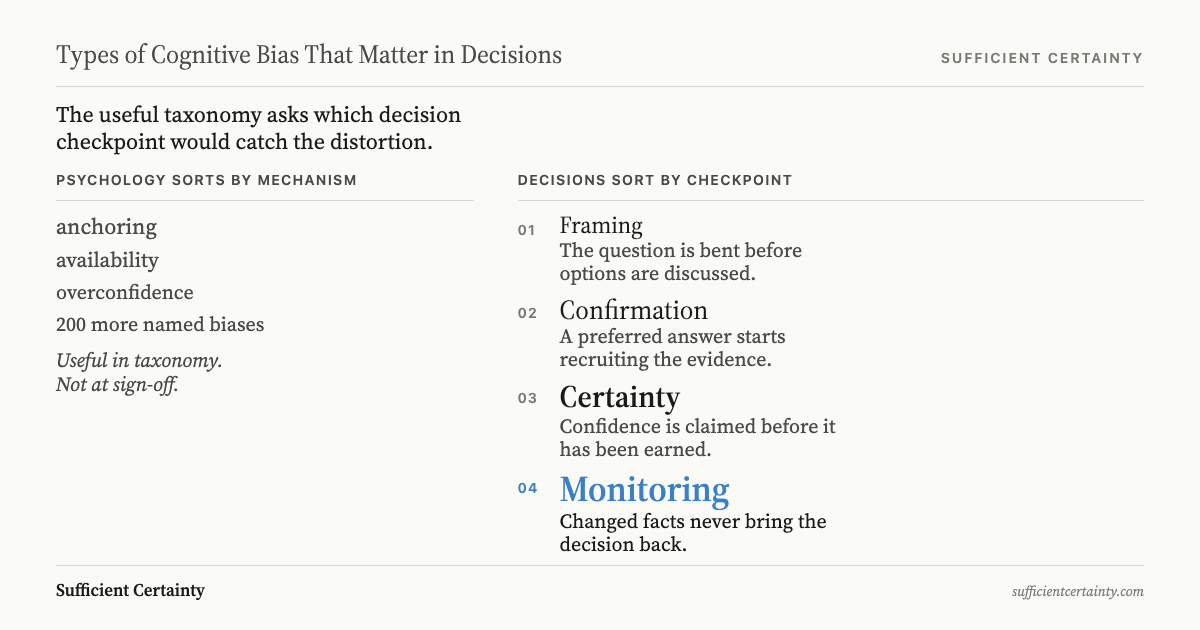
| Process type | What went wrong | Method step |
|---|---|---|
| Framing | The question was bent before options were discussed. | Frame the decision |
| Confirmation | A preferred answer was defended as tested. | Develop options, Recognise assumptions |
| Certainty | The room claimed it knew enough. | Sufficient certainty |
| Monitoring | Warning signs appeared but nobody reopened the call. | Design monitoring |
I learned the first category the hard way. I once chaired a public safety organisation that was spending roughly 0.03% of revenue on its legislated prime function, while about 0.5% went to activity that looked industrious and impressed the right people. The failure sat in the framing of the decision. People thought they were deciding how to handle operational demands. They should have been deciding how to meet the organisation's Purpose. Once we reframed the decision around Purpose, deaths fell by about 60%. No taxonomy was going to do that.
The dangerous types of cognitive bias are confirmation and certainty failures
The most destructive categories are the ones that make a preferred answer feel tested when it has only been defended. The Post Office Horizon scandal is a brutal example. The Inquiry's first volume found that Horizon bugs, errors, and defects were known well before the Post Office kept treating the system as reliable enough to prosecute sub-postmasters. Once "the system is accurate" became institutional property, contrary evidence was handled as user failure. A tidy arrangement if you happen to be the institution.
You see the same defect in milder form when the first number on the page or the freshest anecdote gets treated as evidence. That is how availability bias usually arrives, dressed as common sense. If the room cannot say what it is assuming, it cannot test it.
Silicon Valley Bank shows the next failure, certainty claimed before it was earned. The Federal Reserve's 2023 review said the bank's board and management failed to manage basic interest-rate and liquidity risk while assuming a concentrated, uninsured deposit base was more stable than it was. On March 9, 2023, depositors withdrew $40 billion. The bank expected about $100 billion more the next day, around 85% of deposits. Roger and I built the Universal Decision-Making Method around a colder question: which fact on the table earns this confidence, and which fact kills it?
Monitoring is the bias nobody names at the start
This is the bias nobody names at the start because once the paper is signed the senior people drift away, implementation inherits the mess, and each anomaly becomes someone else's administrative problem. Very few organisations like that sentence because it points to ownership, not culture, and ownership bites back.
General Motors paid for that habit over more than a decade. Anton Valukas's investigation report found an 11-year failure to recognise and escalate a defective ignition switch. GM later disclosed in its 2015 filing that 2,190,934 U.S. vehicles were recalled and that it had agreed to a $900 million deferred-prosecution resolution. The first decision may have been poor. The larger failure was that each new signal was absorbed as background noise because nobody with authority had to reopen the call.
The same ownership failure runs through other cognitive bias examples as well. Bias lasts longest where nobody is explicitly responsible for saying, "Stop, the evidence has turned, bring this back."
In practice I stop the room and ask what assumption is carrying the decision, whether the evidence really earns the confidence on display, and what signal brings the decision back later; in my experience, that is where respectable governance turns evasive, because the machinery works best when nobody has to name the bet.
I do not need another laminated wheel of human error, and nobody running operations needs another binder to prove diligence. We need a process built for overcoming cognitive biases, one that drags the hidden bet onto the table before anyone signs off. That is the only bias classification I have found worth keeping.
You could finish another bias workshop and still miss the checkpoint that mattered.
Work through your decisionNo sign-up. Just pick your decision and start.
Grant Purdy is the co-author, with Roger Estall, of Deciding (2020), and the architect of the Universal Decision-Making Method.