
Strategic thinking examples built around trait lists teach nothing actionable. Four decisions on paper show what the lists leave out: the assumption that carried the choice, the moment somebody named it, and whether the outcome turned on that naming or on something the team never tested.
An operations manager at a plastics business sent me her mid-year review. Four pages. Under strengths it said she ran the tightest plant in the group, had taken eleven days out of the changeover cycle and had not missed a customer commitment in three years. Under development it said one line: needs to be more strategic.
She asked me what she was meant to do with that. I asked her to send me the last significant decision she had made. She sent a spreadsheet comparing two conveyor systems and a note saying which one they bought.
Nothing in it recorded what she had been trying to achieve, what she had assumed about the following four years, or what would tell her later that she had chosen the wrong one. Her thinking may have been excellent. There was no way for anyone to check. That is the trouble with every list of strategic thinking examples I have read: it describes people rather than decisions.
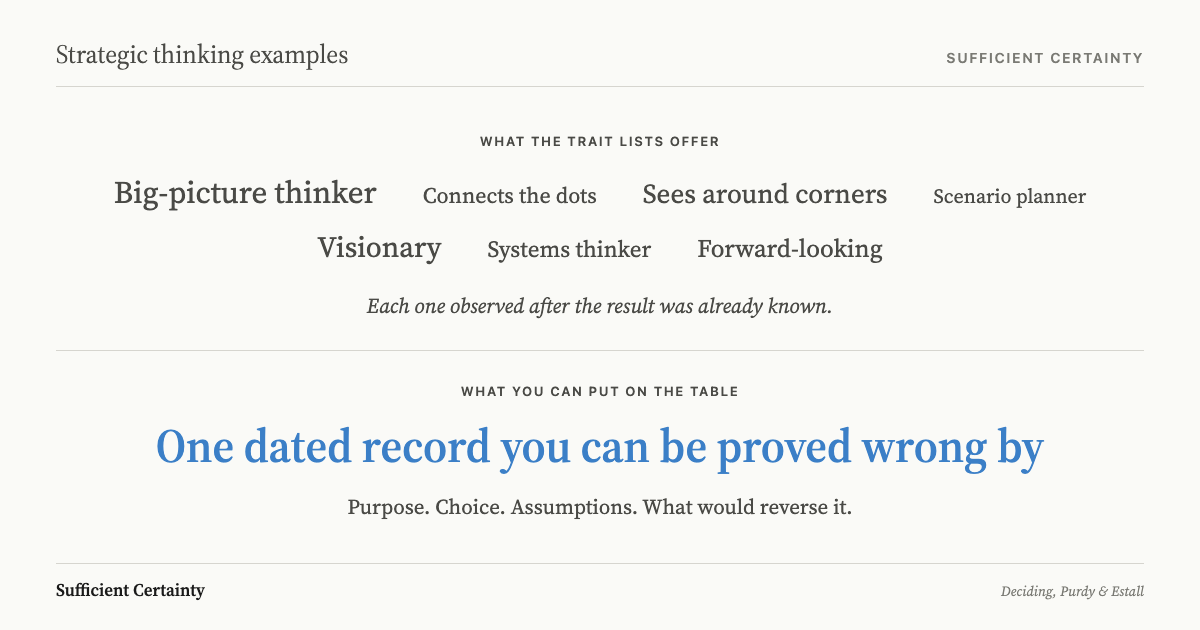
The lists are long and they are all the same, running through scenario planning and connecting the dots. Every item is a behaviour someone else claims to have observed in you, written up after the result was already known, which is why the feedback feels impossible to answer.
Nobody has ever been told they lack a trait and then disproved it by Thursday. What she needed was not another behaviour to perform in a meeting. She needed one page she could put on the table.
Strategic thinking examples are written records of single decisions, showing what each was meant to achieve, what it assumed about conditions ahead, and what would reverse it.
What strategic thinking examples actually are
A behaviour described after the outcome is known is not an example, because by then the thinking and the luck can no longer be separated. That is the wider trouble with how most organisations talk about strategic thinking, which is that almost none of it ever reaches a decision.
Every usable example shares one property: someone can be proved wrong by it later. If a description of your thinking cannot fail, it is not evidence of thinking, it is a character reference.
Four lines make a decision checkable. Two of them are easy and most managers already have them somewhere: what you were trying to achieve, and what you chose from the options in front of you.
The other two are where the strategic content lives, and in my experience they are almost always the ones missing. What did you assume about conditions you do not control, and what would tell you the assumption had stopped holding?
They go missing for a reason. An unwritten assumption cannot be held against you afterwards, and everybody in the room knows it. A decision without those two lines cannot be monitored and cannot be defended, because by the time the result arrives nobody can reconstruct what was believed on the day.
Those four lines are not a template I invented for review season. They fall out of the way careful people already decide, which is what the Universal Decision-Making Method sets out step by step. The point of writing them down is not tidiness. A written assumption can be argued with by somebody who knows more than you do. An unwritten one stays where it is safe, which is inside your head.
Four strategic thinking examples worth copying
None of these came out of an offsite. Each one is a public document in which an organisation committed to something before it knew how the conditions would turn out, and said so in writing. Read them against the five steps of the method and the same skeleton shows through all four.
1. The Bureau of Reclamation decided the drought response before the drought
Faced with declining flows on the Colorado River, Reclamation did not try to forecast one water future and plan for it. It wrote the responses into reservoir elevations in advance.
The 2007 Record of Decision set shortage tiers and balancing bands: if Lake Mead is projected below 1,025 feet on 1 January, Lake Powell releases 8.23 million acre-feet, and the balancing tiers permit annual releases anywhere between 7.0 and 9.5 million acre-feet depending on measured storage. The guidelines ran to 31 December 2025.
Read that as a record rather than a policy and the structure is unmistakable. The Purpose is stated, the trigger conditions are named, and the monitoring that fires the trigger is specified before anyone needs it. The post-2026 environmental impact statement goes further and stress-tests operations against 8,433 modelled inflow traces instead of leaning on a single hydrology. The strategic content is not the forecast. It is the refusal to depend on one.
I have sat in a great many commercial planning meetings and I have almost never seen a number written down the way 1,025 feet is written down. The reason is not technical. A published trigger takes away the sentence that gets people through the inquiry afterwards, which is the one about how nobody could reasonably have foreseen it.
Leave the trigger unwritten and the surprise stays unforeseeable by definition, which suits everyone in the room except the organisation paying for the mistake. A plan states an intention. 1,025 feet is a condition, and a condition is the only thing anyone can hold you to.
2. Maersk changed the question before it changed the fleet
In September 2016 Maersk stopped treating the vessel as the strategic unit of its business. The 2017 annual report describes what followed: Energy separated from Transport and Logistics, the company redefined around the customer's whole supply chain, and management targeted roughly $0.6 billion in savings from combining the two businesses by 2019.
Ocean was still 68% of revenue that year and associated services 17%. The core was intact. What had changed was the question being asked of it.
That savings figure is the least interesting line in the report, and I say that having watched boards spend an entire morning on a number like it.
By February 2025 the group reported 2024 earnings before interest and tax of $6.5 billion with growth across every segment, which belongs in the same column. The example is the moment somebody stopped asking how to run ships better and started asking what problem in the customer's chain was being solved.
3. Microsoft reframed while the old frame was still paying
Microsoft's 2015 annual report describes a company that had stopped putting Windows at the centre of its worldview. Azure was live in 140 countries across more than twenty data centre regions, Office 365 consumer subscriptions had reached 15 million, and Azure revenue grew over 100% in the fourth quarter.
Internally the technology stance shifted from Windows-first to platform-agnostic, which is a costly thing to say out loud when the Windows business is still funding the building.
That is the part worth copying. The assumption being replaced, that the desktop operating system was the thing customers organised their computing around, was still producing revenue on the day it was abandoned. Nine years later the company reported $245.1 billion of revenue with Intelligent Cloud at $105.4 billion. Anyone can change a frame after it breaks; changing it while the old one still looks healthy is the harder move.
I would not pretend that move is easy to reproduce, because nothing rewards it at the time. There is no applause for walking away from a good year and no line in anybody's review for it, and had the old frame held another decade the whole thing would have been written up as vandalism.
The people who manage it are, in my experience, the people who wrote down why they were doing it while they still could.
4. Adobe changed the scorecard before the scorecard flattered it
Adobe moved from selling boxed software to selling subscriptions, and the interesting evidence is in which numbers it chose to be judged by.
The fiscal 2013 annual filing reports 1.4 million paid Creative Cloud subscriptions against 0.3 million a year earlier, Creative annualised recurring revenue of $768.0 million and Digital Media recurring revenue of about $911.0 million, up 347%. Under the old transactional view, that year looked like a company giving away revenue it used to collect up front.
Choosing the measure is the decision. A company electing to be judged by numbers that make it look worse for a year or two is doing the one thing the investor-relations profession exists to prevent, and I do not think it is a small thing to have published.
It forced every subsequent argument inside the company onto the new terms. Digital Media recurring revenue reached $17.33 billion in 2024. The record of what they decided to count, written a decade before, is the example.
The fact on decision day that was always an assumption
Every one of those decisions committed resources now for conditions later, and that gap is where strategic thinking either happens or does not. Roger Estall and I gave the problem its plainest form in Deciding: a fact on the day of the decision becomes an assumption over the life of the decision, and nobody notices the change, because nobody wrote the fact down as a fact while it still was one.
The question that catches this is unglamorous and takes about forty seconds. What are the assumptions we are making here? Ask it in the room and write the answers next to the decision. One that is stable for a decade needs no attention. One that could turn inside a quarter needs somebody watching it by name. Asking the question until it becomes automatic is most of what developing strategic thinking amounts to.
The manager with the conveyor spreadsheet had assumed her main customer's volumes would hold for four years. She knew it. She had thought about it. It was simply not written anywhere, so it could not be challenged by her boss and could not be noticed by anyone when the customer's own market started shifting.
On the day she signed, that volume was a fact. Across the working life of a conveyor, it was always going to be an assumption.
What to put in front of the person who says you are not strategic
Take one decision, not thirty-five traits. Choose something real you decided in the last quarter, write the four lines, add the condition that would make you reverse it, and send it to the person who wrote your review. You are handing them something they can attack, which is the only way the conversation stops being about your personality.
None of this is reserved for the top of the structure. It belongs to whoever writes decisions down, which is practice rather than rank, and an organisation gets more of it by making the record ordinary rather than by staging strategic thinking as a leadership event.
Write one this week. The next time somebody tells you that you are not strategic, they will have to say what is wrong with it.
You could leave your next review told you are not strategic, with nothing to point at.
Work through your decisionNo sign-up. Just pick your decision and start.
Grant Purdy is the co-author, with Roger Estall, of Deciding (2020), and the architect of the Universal Decision-Making Method.