
Strategic thinking vs strategic planning is the difference between judgement and the document that records it. Most organisations have the document without the judgement. The plan persists because nobody revisits the assumptions underneath it, and that is how faith gets dressed as analysis.
A strategy director sent me a finished deck after a two-day offsite. Forty-three slides and 18 initiatives, all polished enough to survive three rounds of executive editing. The board paper was tidy. The problem was more basic: nobody could tell me which decision the deck had actually changed. That is the real difference in strategic thinking vs strategic planning: one changes a decision, the other can merely dress it.
The usual comparison says thinking is creative and planning is practical. That is a harmless classroom distinction, which is where harmless distinctions belong. I am not interested in whether the room calls it thinking or planning. I am interested in whether anyone had the courage to say what must be true before money and reputation are put behind the bet.
Strategic thinking vs strategic planning is the difference between the judgement that chooses a direction under uncertainty and the document that records the choice afterwards.
Strategic thinking vs strategic planning is the wrong fight
If strategic planning is the answer, what was the question? I ask this early because it ruins a surprising number of meetings. If the room cannot answer, the process has already started by protecting its preferred output. A plan can assign owners and carry a beautiful appendix while leaving the real commitment untouched. That is how paperwork earns the status of strategy.
The HBR numbers are useful because they are embarrassing. Michael Mankins and Richard Steele reported in Harvard Business Review that traditional calendar-driven planning produced an average of 2.5 major strategic decisions a year. Continuous issue-focused planning produced 6.1. Only 11% of executives strongly believed planning was worth the effort. The old process failed in public, then senior people kept feeding it after admitting it was not doing much.
I do not think that habit is irrational. The plan has institutional advantages. It can be scheduled and approved. A decision is less comfortable because it exposes uncertainty and accountability. The plan gives the room a respectable way to avoid naming the bet. That is also why strategic thinking in leadership is not a personality trait; it is the discipline of refusing to reward the safest document.
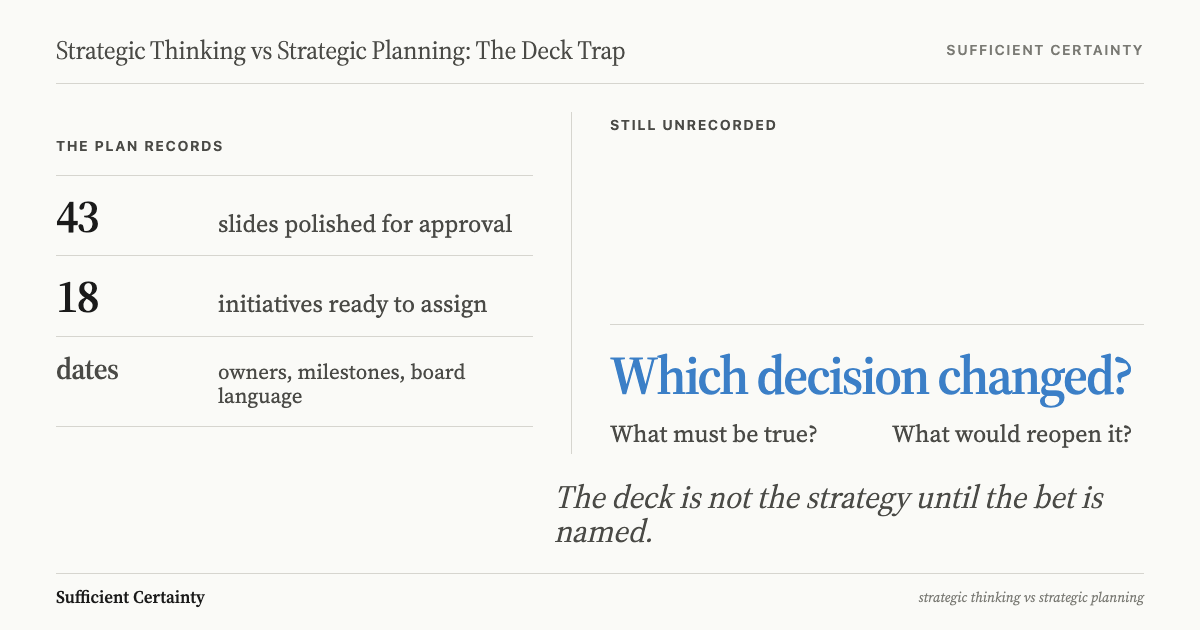
This is why I have little patience for the standard table that says thinking is about the why and planning is about the how. That table would not have helped the director with the 43-slide deck. She needed to ask why the room had paid for a roadmap before anyone named the bet. A template that reaches the answer before the question turns planning into a hiding place.
Here is the table I would put in its place. It compares the two by what each one leaves undone, and by the question that exposes the gap.
| Strategic thinking | Strategic planning | Failure mode | Useful test |
|---|---|---|---|
| Names the bet | Records the bet | Nobody can say which decision changed | What did this deck decide? |
| Tests what must be true | Assumes somebody tested it | Assumptions travel as facts | What must be true for this to work? |
| Sets what would reopen the decision | Sets milestones and owners | Progress is tracked, the premise is not | What would make us stop? |
Strategic planning becomes a belief system when the deck is treated as evidence
A belief system starts with the answer and then recruits activity to protect it. In this setting, the answer is strategic planning. The question it was meant to answer is usually forgotten. Once the annual cycle begins, the offsite and board pack become evidence that strategy is occurring. It keeps consultants and PMO guardians busy. A machine can be useless and still be well fed.
The BBC's Digital Media Initiative is useful because the furniture was all there: governance language and program machinery, enough to look serious from a safe distance. The National Audit Office's report on the BBC's Digital Media Initiative recorded a GBP98.4 million write-off after the program was stopped. The NAO criticised governance and the BBC's understanding of what had actually been delivered. The people protected by that furniture were the sponsors and governance owners who could point at process while the delivered thing remained unclear.
When a plan takes on that kind of authority, people stop asking whether the assumed benefit is still real. The program exists, therefore the purpose must still be sound. The governance process exists, therefore somebody must be checking the right thing. That is a comfortable superstition, especially for people paid to maintain the process.
That is where the Universal Decision-Making Method is useful. I use it here for one reason: it drags the missing decision back into the room. It keeps the Decider focused on the decision and on the assumptions that make Sufficient certainty and Design monitoring honest rather than decorative. In Deciding, Roger Estall and I made the same point in less fashionable language: a decision needs enough certainty to proceed and a way to notice when that certainty has gone. That is why strategic thinking vs strategic planning is a poor question until the decision itself is visible.
Check whether your planning deck records a judgement or just paperwork, then write the bet it expects to hold. Start the Walk →
The useful comparison is decisions versus paperwork
Has the room agreed what it is deciding? The same room has to name the assumptions carrying the preferred option and the evidence that would make the decision embarrassing enough to reopen. That test is awkward, which is one reason it is often replaced by a workshop agenda. The agenda feels productive. The test may cost somebody their favourite initiative.
I would rather have a two-page decision record than a 70-page plan that cannot survive contact with its own assumptions. Four organisations chose the record, and their reasoning is still legible a decade later. The broader guide to strategic thinking makes the same point, but this article should stay with the deck: the plan earns its place only after the bet has been named.
The assumption that matters is usually disguised as a fact. A customer segment will keep growing. A labour market will behave as it did last year. At the moment of approval, each may be supported by evidence. Over the life of the decision, each becomes a claim about the future, and the future has an irritating habit of not respecting the minutes.
The strategic thinking skill worth having at the offsite is the nerve to write the sentence that could still damage the favoured option while there is time to change it. A team unable to write that sentence is still presenting, with thinking left undone.
I ask planning teams to mark which assumptions can move fastest and hurt most. I ask the same after a Wardley map, component by component, after a growth strategy review, initiative by initiative, and after strategic visioning, premise by premise. That is ordinary judgement, not a trick. It stops the plan from pretending all assumptions deserve the same confidence. It also gives monitoring a job: watch the claims that carry the decision, not every metric that can be pasted into a dashboard.
Strategic thinking vs strategic planning should end in monitoring
The comparison is incomplete until the plan says what would reopen the decision. Many organisations treat execution as obedience to a plan. That is comforting, and often dangerous. Donald Sull, Rebecca Homkes, and Charles Sull challenged that view in Harvard Business Review. They found that only 55% of middle managers could name even one of their company's top five priorities, and eight in 10 said their companies failed to kill declining initiatives quickly enough. Call it an execution mystery if you like. I call it what happens when a plan becomes a loyalty test.
The organisation keeps executing because changing course looks like admitting failure. In reality, refusing to revisit a decision after its assumptions have shifted is the failure. A plan that makes review look disloyal is protecting its authors and committee guardians, not the decision.
The final step, Design monitoring, is where many strategic plans show their weakness. The measures are there, but not the facts that would prove the bet wrong. Activity gets counted and the reason for it escapes inspection, so the board hears that the initiative is on track and never hears whether the track still leads anywhere worth going. That is why I do not separate planning from developing strategic thinking on live decisions. The thinking matures only when reality is allowed to answer back.
Before you carry the deck into the executive room, write one sentence on the front: this plan records the decision to do X because we believe Y. If nobody will sign that sentence, the deck is paperwork with ambition, however glossy the cover.
You could approve the plan in the room and never learn which bet you just made.
Work through your decisionNo sign-up. Just pick your decision and start.
Grant Purdy is the co-author, with Roger Estall, of Deciding (2020), and the architect of the Universal Decision-Making Method.