
Independent challenge in decision making needs two conditions most organisations lack: a protected route for doubt to reach the decision, and a trigger that reopens the commitment when the basis shifts. Without both, challenge is a performance that changes nothing before the consequences arrive.
At BP's Texas City refinery on 23 March 2005, 15 people were killed and 180 were injured. The company had board committees, oversight routines, and all the respectable language leaders like to keep on hand for moments like this. The missing control was independent challenge: people who spotted the danger could not get it to the decision before the commitment hardened. Then nobody had to reopen the basis for the decision when the warning signs accumulated.
In forty years of this work, every serious failure I have examined came down to the same pair of missing parts. Nobody who spotted the danger could get a challenge to the decision before it hardened. And nobody was assigned to watch the assumption that carried the decision after everyone went back to work. Fix those two conditions and the fashionable catalogues of strategic thinking skills that leadership programs sell become decoration.
Independent challenge in decision making is a protected route for evidence or objection to reach the person making the call before commitment, followed by a defined trigger for reopening it if the basis changes.
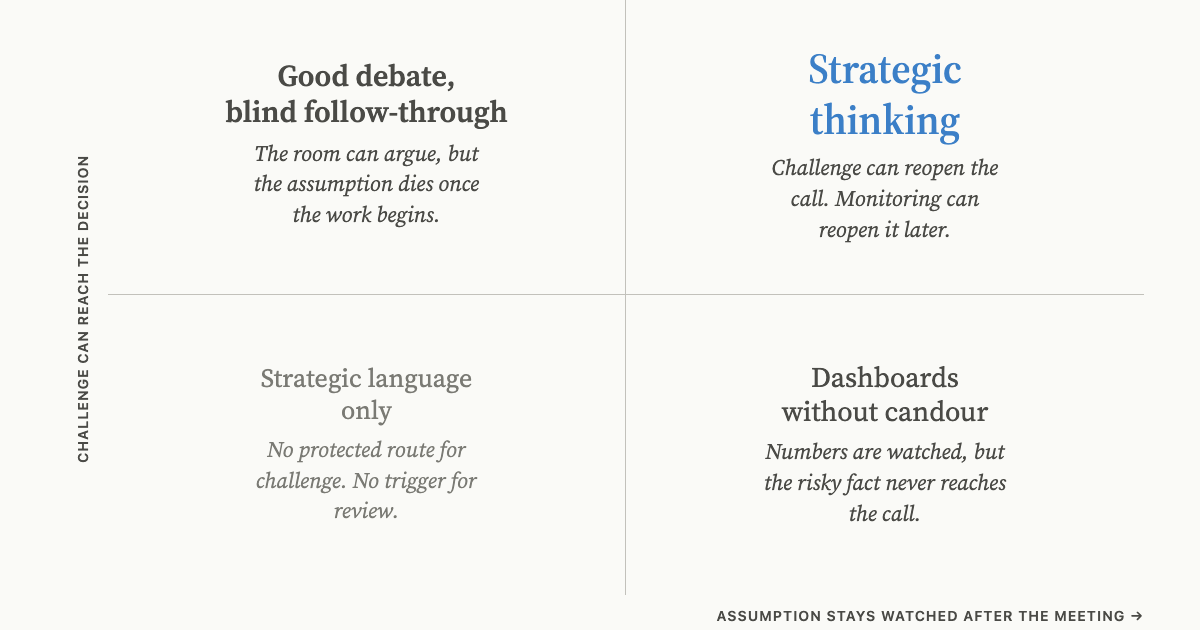
Independent Challenge Needs a Route to Authority
When this sort of thing blows up, people begin grading the chief executive's intellect. Wrong target. In my experience, the useful question is much plainer: who could challenge the call before it hardened, and who had to keep watching the assumption that carried it after everyone went back to work? If those answers are foggy, the organisation is already in trouble, no matter how clever the leadership biographies sound.
I once watched an executive team spend forty minutes debating whether the risk register should use traffic lights or numbered scores. The actual decision underneath it all was whether to commit $40 million on an assumption nobody had tested, and that was not on the agenda. Nobody in the room could tell me who would stop the spend if the assumption moved. That is where the defect always sits: in the wiring, not the wattage.
This starts with a plain answer to who decides. The SEC's investigation into WorldCom described a board detached from operations, unable to hear concerns directly from employees, and willing to approve loans and guarantees that grew past $400 million for Bernard Ebbers. Smart directors were present, which helped not at all once management controlled the paper and the board could not reach past it. The strategic signal died on the way up.
A board should know when it is the Decider, management should know when it is not, and everyone should know who can reopen the call if the assumption moves. I use those plain questions because the foggy alternatives are too useful to too many people. If nobody can say where a challenge goes, the challenge goes nowhere, which is a splendid arrangement for anyone who wants the recommendation waved through without the nuisance of scrutiny.
This is why the fashionable talk about empowerment leaves me cold. Unless the route for challenge reaches the actual decision, empowerment is decor. People are consulted and thanked for their candour, then sent back to their desks while the call stays sealed above them. The chart looks modern. The machinery behaves exactly as it did before.
I have also sat through meetings where the answer had been chosen before the agenda was circulated. The deck arrived later, dressed as analysis. Nobody wanted to name the assumption because naming it would make it examinable, and some governance arrangements are built to prevent exactly that inconvenience. A board that can hear only what management curates is attending a private performance and calling it oversight.
Bring one leadership call through the five steps and design the challenge and monitoring that keep strategy alive after the meeting. Start the Walk →
Protected Challenge Must Reach the Live Decision
The best warning in an organisation is often held by somebody with no impressive title at all. Virginia Mason changed that by letting staff stop the line, and in the case study professional liability claims fell 74 per cent over the following decade. That is leadership in operating form. The awkward fact has somewhere safe to land before it turns into harm, and the senior team cannot pretend not to have heard it.
I see the opposite more often. The invitation to candour is ceremonial, useful for the minutes and harmless to the sponsor. People hear 'speak freely', look for the ceiling, and edit themselves to fit it. If you are carrying a plant decision or a site closure, that is the moment the real information disappears. Independent challenge fails because the risky fact has nowhere safe to land. I wrote more about exposing those weak points in assumptions in decision making.
The Second Condition Is a Trigger to Reopen the Call
Challenge is only half the design. The second condition decides whether a well-tested call stays defensible once conditions move. After Texas City, the U.S. Chemical Safety Board pushed for board-level process-safety expertise and indicators senior executives had to watch. The March 2025 report from the Committee on Standards in Public Life found the same disease elsewhere: warnings discounted and records too thin to force a reopening. Vague monitoring survives because it does not interrupt the people already committed to the call.
In my experience, the monitoring question is always embarrassingly practical. What would show us the assumption has shifted? Who sees that signal first? Who can reopen the decision before the damage compounds? If nobody can answer that before implementation begins, the decision is travelling on hope in a sober suit. That is close to what I mean by effective decision making in leadership, though the leadership trade usually loses interest once the workshop photos are taken.
Set the Challenge and Stopping Rule Before Commitment
So what does this look like on Tuesday morning? One person closes the decision, but the recommendation the room has already fallen for must still be killable. In Deciding, Roger Estall and I put it more bluntly: leaders need to state the decision clearly and name the fact that would bring it back if the key assumption shifts. That is why I still use the Universal Decision-Making Method. It leaves less room for posture and more room for reality.
Most advice on strategic thinking treats leadership as temperament, because temperament photographs well and structure has the bad habit of being checkable on Tuesday morning. I have more use for questions that survive contact with work. Who can challenge this call, and what fact will bring it back? If a leader cannot answer those, independent challenge is just a polite ritual, which is a costly thing to discover after the numbers or casualties arrive.
You could close this tab and carry that decision into another week.
Work through your decisionNo sign-up. Just pick your decision and start.
Grant Purdy is the co-author, with Roger Estall, of Deciding (2020), and the architect of the Universal Decision-Making Method.