
How to develop strategic thinking is answered wrongly by almost every workshop, reading list, and offsite programme. The test is not whether the team can think broadly. The test is whether anything from the exercise changes a live decision before lunch on Monday morning.
I have seen executives come back from a strategy offsite with 68 slides and a consultant's 24-page summary. Monday morning still arrives with a capital request due before lunch. If you want to know how to develop strategic thinking, use that as the test. If none of the offsite changes the call, it was theatre, however expensive the hotel bill was.
Most advice on this topic treats strategic thinking as something you cultivate away from the decision itself, through reading and horizon-scanning, usually in a room full of butcher's paper. I do not buy that. In my experience, it grows inside a live commitment, when money is at stake and the uncertainty is real.
The people I have seen develop it fastest were not the ones with the biggest reading lists. They were the ones who kept getting consequences back from the same domain. A plant manager who faces the same budget committee after each capital decision learns faster than a consultant who moves to the next client before the results arrive. The consequences do the teaching. Strategy courses can give you the language, but until you have signed something with your name on it, the language has nothing to attach to.
Developing strategic thinking means getting better at live decisions by testing assumptions and reaching sufficient certainty to commit.
How to develop strategic thinking starts with a live decision
Lisa Dragoni and her colleagues in The Leadership Quarterly studied 703 executives and found that accumulated work experience predicted strategic-thinking competence even after controlling for ability and personality. The useful detail is that the experience kept bringing consequences back to the same person and the same domain. Gail M. Sullivan Goldman and her colleagues in the Journal of Healthcare Management found much the same thing: strategic judgement was developed by live assignments and ongoing review under pressure. Judgement grows when the call has an owner and the outcome comes back to that owner.
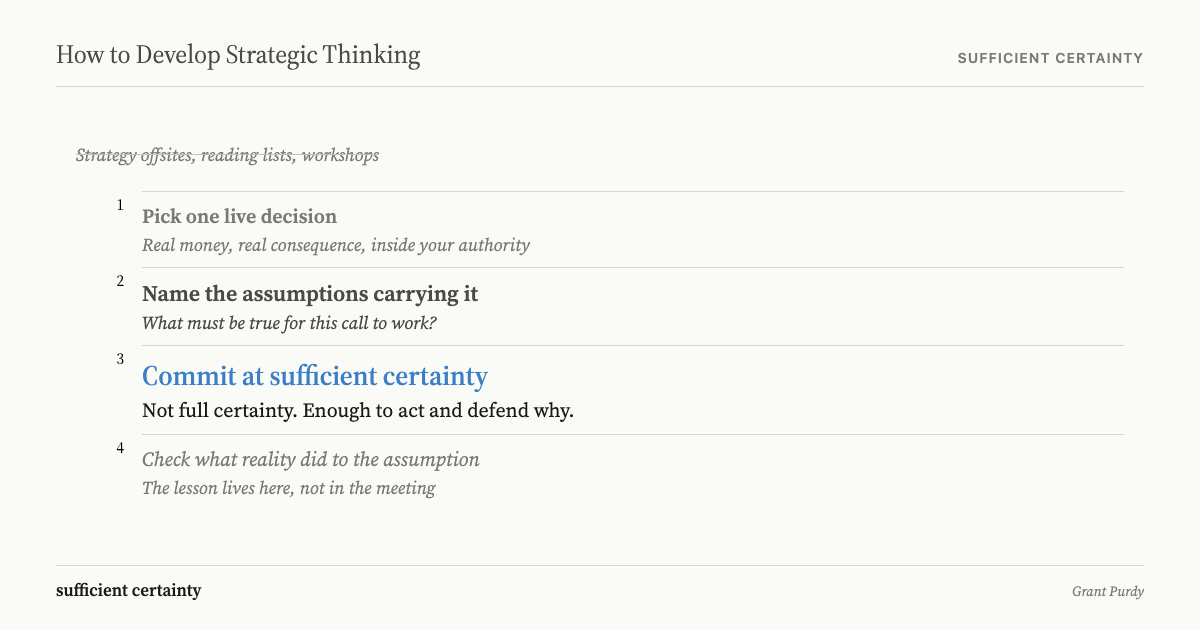
So pick one decision that matters and sits inside your authority. A budget choice or a supplier change is enough, so long as it will still matter next quarter. The Universal Decision-Making Method starts with blunt questions: what are you trying to achieve, and by when? Who carries the consequence if the call is wrong? If the exercise never reaches a real commitment, you are only learning the accent of strategy. Plenty of people become fluent in that accent.
Make the decision real enough that the consequences return to you and your team. A live decision teaches because it resists fantasy. Once money or reputation is on the line, the airy language starts to thin out.
How to develop strategic thinking means naming assumptions
Strategic thinking becomes visible when the room says what it is assuming. Four organisations that said it in writing left records anyone can still check. Until then, what usually passes for strategy is preference with better typography. One person wants growth and another wants caution, but nobody is forced to say what must be true for the favoured option to work. The vagueness survives because it pays people. Workshop sellers do well out of it, and offsite facilitators do too. Internal planning teams rarely beg for less fog.
McKinsey's 2025 work on more than 400 companies found that the small minority who actually shifted resources were 1.7 times as likely to do it at the right speed and about 30% more likely to document assumptions well enough to test them within six months. That is the useful bit. The organisations that look strategic are usually the ones prepared to move money and expose the reasoning behind the move. Once an assumption is visible, the decision can improve. While it stays buried, the meeting becomes a defence of taste.
Hazel Challenger's account of the new UK self-assessment tax system makes the same point in ordinary language. The team spotted that weak early marketing would swamp the call centres and shifted budget before launch. That is strategic thinking doing some actual work. Roger Estall and I kept returning to one question in Deciding: what are we assuming here? I unpack that discipline further in assumptions in decision-making, because this is the point at which an expensive mistake is still cheap enough to stop.
Use a live decision to practise strategic thinking and mark the assumption you keep treating as homework. Start the Walk →
Commit when certainty is sufficient, not complete
Strategic thinking does not mature until it crosses the line into commitment. Plenty of people can narrate uncertainty. Far fewer will put money behind a call before certainty is complete. That reluctance is understandable. Nobody enjoys signing their name under a decision that could go wrong in public. If you are serious about how to develop strategic thinking, though, this is the uncomfortable stretch: judging when you have sufficient certainty and when you are only stalling in better language.
The U.S. Office of Personnel Management foresight guide describes the Chief Financial Officers Council working on a live workforce problem and revisiting it every month as the evidence changed. The capability grew because the council kept working the same decision until the future stopped being a talking point and started forcing trade-offs. That is how judgement toughens up. People often file this under strategic thinking skills, which is fair enough, but the skill only counts once resources are actually committed.
I have watched plenty of teams wait for full certainty and call the delay prudence. Usually it is career management in a smarter suit. The market moves or the window closes while another deck is commissioned. Sufficient certainty is demanding because it makes you say what you know and why the remaining uncertainty is still tolerable.
In practice, that means writing down what the decision assumes before the room empties. Most teams skip that step. They approve the proposal and rely on the next quarterly review to surface problems. By then nobody can remember what was assumed and nobody wants to reopen a call that already has momentum and a budget code. The assumption stays buried and the organisation files the outcome under bad luck instead of bad process. That is not strategic thinking. It is paperwork pretending to be judgement.
Monitoring is where the lesson becomes a habit
The organisation learns only when someone checks what reality did to the assumptions behind the decision. Without that, the lesson dissolves into anecdote. People remember the confidence of the meeting, not the evidence that turned up three months later. That is why so many firms keep congratulating themselves on process while repeating the same blunders.
Design the monitoring before the decision is announced. Name the condition that would make you reopen the call. Otherwise monitoring turns into a recital of activity, which flatters the author and teaches the next Decider nothing.
This is why the annual strategy ritual is so feeble. It separates the grand talk from the feedback, then waits long enough for the assumption to be forgotten and the author to be promoted. By the time the room returns to the subject, memory has improved the old decision and the awkward facts have gone missing. That is a broader problem in strategic thinking: the calendar is doing the thinking, not the people.
Leaders do not need grander decks. They need awkward facts to reach the decision before the money goes out, and a named moment when the team must reopen the call. A plan can carry all of that and still record a decision nobody actually made. That is the leadership job in strategic thinking in leadership. Leave it vague and the system serves the presenter and the planner, because both are safer when the assumption stays buried. Broken machinery always has admirers when it protects the wrong people.
That is how to develop strategic thinking. Work one live decision properly, then revisit it when reality answers back. Do that often enough and judgement hardens into habit. Keep the subject abstract and the offsite trade will love it, because posture is easier to sell than commitment.
You could attend another strategy offsite and still leave the next assumption untested.
Work through your decisionNo sign-up. Just pick your decision and start.
Grant Purdy is the co-author, with Roger Estall, of Deciding (2020), and the architect of the Universal Decision-Making Method.