
Strategic thinking skills are treated as a development goal and measured on a competency grid. The defect is earlier. If nobody in the room has named the bet the plan depends on, no amount of skill will convert analysis into a decision that can be defended or reopened.
A managing director handed me a forecast and a glossy market map from a strategy firm six weeks before a board meeting. He said his executive team wanted stronger strategic thinking skills. I asked what the preferred option was leaning on. Silence. There was no shortage of material, but nobody had named the bet.
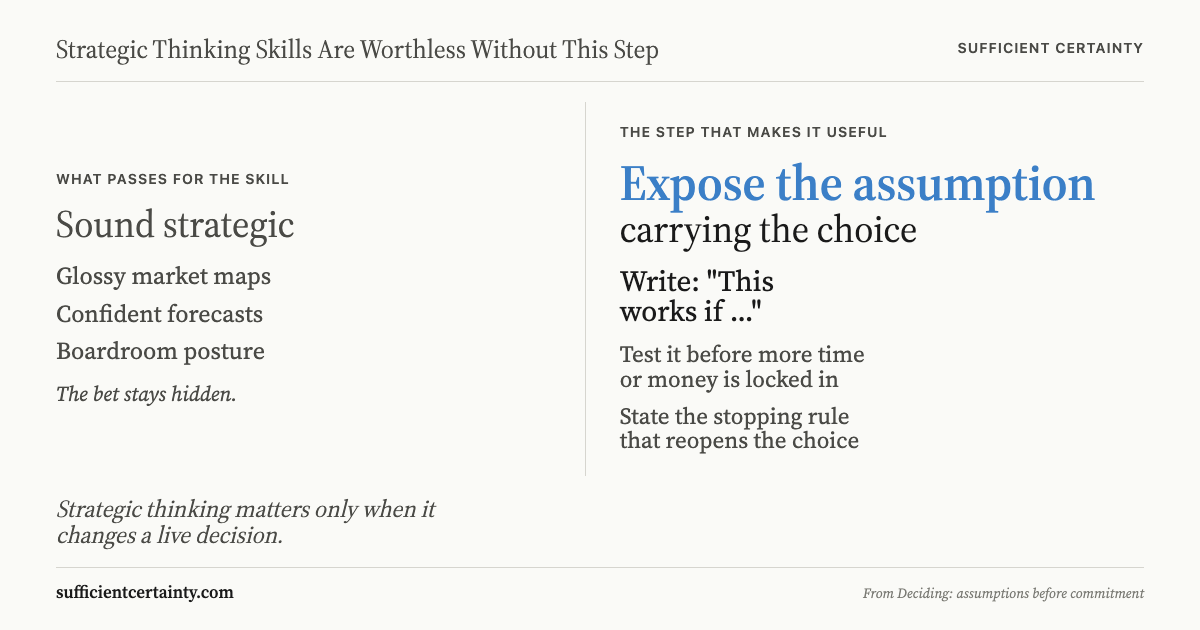
That is the defect in most advice on strategic thinking skills. Workshop sellers and strategy consultants profit from it, as do the people paid to run offsites, because strategy can stay at the level of posture and personal uplift. Fine for selling another session, useless for telling a Decider whether the case on the table deserves commitment. The skill that pays is not broader thinking. It is narrower testing. In my experience, the useful skill is exposing the assumption carrying the choice and testing it before sunk effort and status make the answer hard to touch.
Strategic thinking skills are the practical abilities used to set direction and test whether the assumptions behind it are strong enough to justify commitment.
Strategic thinking skills matter only when they change a live decision
The cleanest evidence I have seen comes from Camuffo, Gambardella, and Spina. In a field experiment with 250 nascent entrepreneurs, tracked through 18 data points over 14 months, one group was taught a more disciplined way to form and test hypotheses before committing harder. Those founders were more willing to shut weak ventures or pivot, and more likely to show stronger revenue when the venture continued. That is not mindset theatre. It is decision discipline with consequences.
Nobody became useful because they could sound more visionary in a workshop. They became useful when the premise was made testable. I have watched the same shift in boardrooms for years. The conversation improves only when somebody has to write the sentence that would justify more money being spent, or specify what would disprove the favourite answer. There are four public records of organisations doing exactly that, and not one of them reads like a trait list. That is why I keep returning to assumptions in decision making. Until the assumption is visible, strategy is still a performance.
The useful skill is naming the bet before commitment
A strategy becomes real when you can finish the sentence, "this works if ...". Netflix gave a useful public case in 2023. In its first-quarter shareholder letter, it said more than 100 million households were sharing accounts and delayed the paid-sharing rollout because the member experience was not ready. In the second-quarter letter, after launching across more than 100 countries representing over 80 per cent of revenue, it reported 5.9 million paid net subscriber additions, against a loss of 1.0 million in the same quarter a year earlier.
The staged bet forced the team to name what had to be true at each gate: would the enforcement mechanism land without triggering mass cancellation? That is a testable sentence. They ran it in markets representing less than five per cent of revenue first, watched churn settle, then widened. The discipline was not in the spreadsheet. It was in the willingness to let a partial answer override the launch date.
The interesting part is not the timeline. Most leaders prefer the grand launch because staged bets expose uncertainty, and ego hates that. A staged rollout admits the team might still be wrong, which is exactly why it is useful. Netflix kept one assumption in view: people would accept the change if the experience was right. That is what Roger Estall and I built the method to force. In Deciding, we were trying to stop teams from dressing up a hunch as strategy and make them state what the commitment is leaning on before pride locks the door. The Universal Decision-Making Method exists to make that sentence explicit.
Take the bet inside your plan and write the stopping rule that turns strategic thinking into a finished decision. Start the Walk →
Strategic thinking skills fail when the user assumption stays hidden
The Sonos app rollout shows the opposite case. On 7 August 2024, Sonos said in its third-quarter results that rollout problems had forced it to cut fiscal 2024 guidance. Revenue for the quarter was $397.1 million; nine-month revenue fell to $1.263 billion from $1.350 billion a year earlier. People in corporate life like to file cases like that under execution, as though the strategy itself had already been vindicated. I do not accept that description. A decision had gone public before one crucial assumption had earned the right to carry it.
The assumption was simple enough to state in one line: customers would accept the new app as the platform for the next product cycle. That is the sentence that needed punishing before the wide launch, not excusing afterwards. A limited beta with real users, a churn metric with a threshold, a date by which the old app could be retired without support calls doubling. Any of those would have been a stopping rule. None appeared in the public record until the damage was already in the quarterly numbers.
This is where organisations usually get caught. People can talk fluently about category shifts and product roadmaps, yet almost nobody wants to write the sentence that could still kill the proposal. If you want the leadership version of the same defect, I laid it out in strategic thinking in leadership. The wiring often rewards advocacy and treats scrutiny as disloyalty.
Strategic thinking skills need a stopping rule to finish the job
Long-range strategy has the same weakness. The USPS Office of Inspector General reviewed the assumptions and metrics behind the Postal Service's Delivering for America plan. The OIG flagged 47 assumptions underpinning the 10-year plan and noted that several lacked measurable targets or owned review dates. Without those targets, no one inside the organisation can say with authority that the plan is still on its original basis or that the basis has shifted enough to warrant a course change.
A plan that large, with that many moving parts, will rot unless somebody writes a sentence that says when the original basis no longer holds. The live question was who wrote the tripwire and who was allowed to act when the assumption started to fail. That is the part most strategy work ducks. Someone has to say what will be watched and what signal counts as trouble. If nobody owns that sentence, the monitoring pack becomes an alibi.
I have spent much of my working life watching plans presented as if writing them had solved the decision. The plan is never the decision, however carefully it is written. It never does. The real work starts after approval, when context moves and the original basis begins to rot.
Most monitoring systems are built to report activity, not to reopen a decision before more damage is done. A dashboard full of green indicators means nothing if nobody specified which indicator turning amber would force the room back together. If the room has not decided what fact would reopen the choice, the so-called strategy is only a hope with formatting. That is why I treat monitoring as part of the decision rather than a report for later, and why the broader case for strategic thinking keeps coming back to decisions rather than documents.
So when somebody asks me about developing strategic thinking, I do not reach for a competency model. I ask what the plan is resting on. Then I ask what evidence would force the room to reopen the choice, and who has the authority to call it. If the answer is nobody, the strategy is not yet a decision. It is a document waiting for permission to fail quietly. The useful skill is keeping the bet honest before and after commitment. The rest is furniture.
You could train the team in strategy and still leave the next assumption untested.
Work through your decisionNo sign-up. Just pick your decision and start.
Grant Purdy is the co-author, with Roger Estall, of Deciding (2020), and the architect of the Universal Decision-Making Method.