
Critical thinking vs strategic thinking is treated as a hierarchy, with strategy on top. It is not. One sets direction, the other tests claims. Get the order wrong and sharp analysis hardens the wrong call. Get it right and each discipline does work the other cannot.
A director I worked with walked into a quarterly review carrying a 41-slide pack and a sponsor who wanted an answer before the capital window closed. The numbers were sound. The logic was tidy. Six minutes in, the sponsor stopped him and said, "You are solving the wrong problem." If you want a plain-English version of critical thinking vs strategic thinking, that is it.
Most organisations speak as if strategic thinking is the senior form of intelligence and critical thinking is the technical one. I have never found that useful. Strategic thinking sets the direction of the decision. Critical thinking tests whether the case for that direction can survive contact with awkward facts. Mix the jobs up and smart people spend their energy proving something that was badly aimed from the start.
Strategic thinking vs critical thinking is a sequence question, not a ranking. Strategic thinking sets direction by choosing where to commit resources under uncertainty. Critical thinking tests whether the reasoning and evidence behind that direction survive challenge. One is forward-looking and resource-allocating; the other is backward-looking and truth-testing. Both are needed; confusing their order is common and costly.
Critical thinking vs strategic thinking is the difference between testing whether an argument holds up and deciding which direction an organisation should commit to.
Critical thinking vs strategic thinking is a sequence problem
Strategic thinking comes first because somebody has to decide what the decision is for. Before the models and challenge questions arrive, somebody has to frame the issue against purpose and consequence over time. In the Universal Decision-Making Method, that work sits in Frame the decision and Develop options. It is the discipline of choosing what future you are even trying to create.
Critical thinking is different. It does not set direction. It asks whether the reasoning underneath that direction is any good. It pushes on the evidence and the assumptions, especially the hidden leap between them. In the same method, it bites hardest when you Recognise assumptions. That is where the room finds out whether conviction was earned or merely performed.
This matters because "think more strategically" is one of the laziest criticisms in organisational life. It usually means the person did competent analytical work inside a frame nobody bothered to test. The manager feels the gap but cannot name it, so the employee gets vague advice instead of a better decision process. People talk about traits when they should be talking about jobs inside a decision.
This is why critical thinking vs strategic thinking is not an IQ ranking. I have seen brilliant analysts miss the point because nobody framed the choice properly, and I have seen bold leaders drive into a wall because nobody challenged the story they liked. The damage comes from using them in the wrong order.
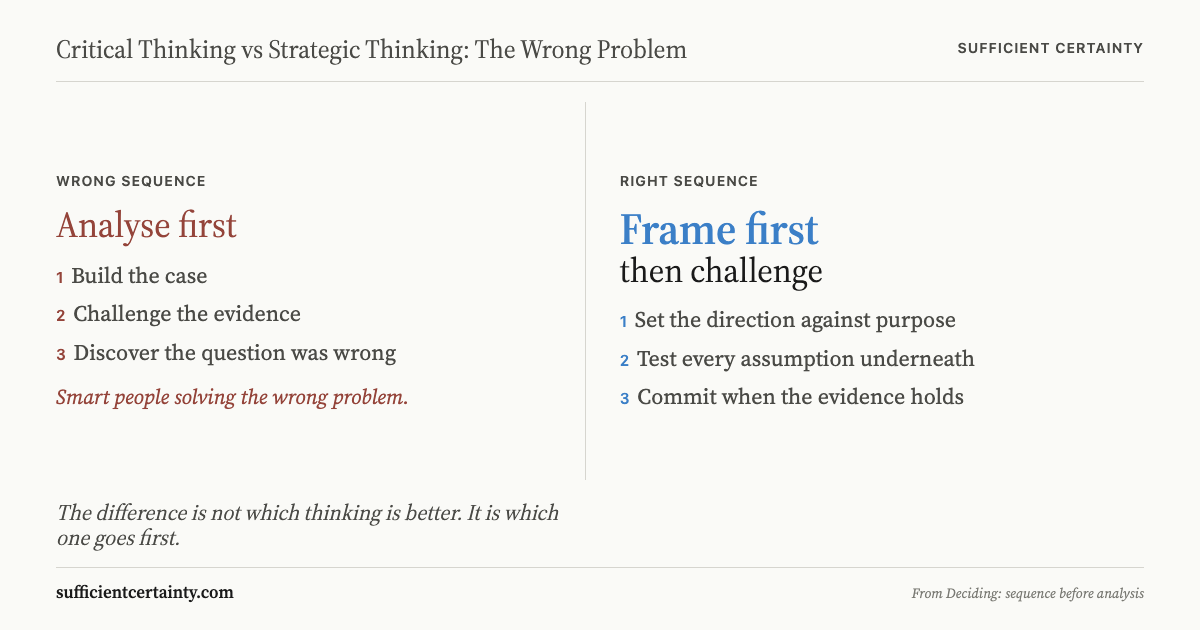
When critical thinking outruns strategic thinking, teams solve the wrong problem
This failure mode is common because critical thinking leaves a paper trail. A good challenge session produces sharper slides and the pleasant feeling that the room has been serious. What it does not necessarily produce is the right frame. Once the starting question is wrong, better analysis simply hardens the mistake.
The FDA's 2022 evaluation of its response to the Abbott infant formula crisis laid this out. Four infant cases triggered a production shutdown. The agency could analyse contamination risk, but it had no serious framework for deciding what the shutdown would do to supply for infants who had nowhere else to go. Its own review concluded that it lacked the authority and capacity to manage shortages of critical food products. Critical thinking tested the contamination issue. Strategic thinking should have forced a larger question much earlier: what happens to the system if the safe answer also breaks the supply?
I have seen the same thing in boardrooms. A team starts with an answer that sounds respectable, perhaps compliance, perhaps efficiency, then uses critical challenge to defend it. In Deciding, Roger Estall and I called that habit a belief system because it starts with the answer and then hunts around for supporting logic. Once that happens, critical thinking becomes advocacy with spreadsheets. The trap is the same one I unpack in assumptions in decision-making: the assumption nobody named is usually the one steering the whole meeting.
Put your current recommendation in order and check whether strategy sets the direction before analysis sharpens the wrong problem. Start the Walk →
When strategic thinking outruns critical thinking, the story gets ahead of the evidence
The opposite error is no better. The room has a destination and a sense of historic opportunity. People call that strategic. Sometimes it is. Sometimes it is only unchallenged ambition wearing strategic language.
WeWork's 2019 S-1 filing had strategic ambition in abundance. It spoke about scale and platform economics. It also disclosed a $3.3 billion revenue run rate and a $1.9 billion net loss for 2018, while noting that only 30% of open locations were mature. On 30 September 2019, the company withdrew the IPO filing. The company had a direction. The assumptions underneath it, especially the promise that maturity would fix the economics, were not being cut hard enough. Strategic thinking had supplied the destination. Critical thinking had not earned the route.
That is why I noticed Intel's 2024 foundry restructuring. I am not judging the outcome. What matters is that management exposed the foundry economics instead of hiding them behind strategy language. They tied the bet to more than $15 billion in expected lifetime deal value and gave the evidence recurring permission to interrupt the narrative.
I have watched smaller organisations make the same mistake without the headlines. A strategy acquires moral prestige, criticism starts to look like disloyalty, and soon the room is rewarding confidence instead of challenge. Brave language is cheap. The costly part is giving somebody explicit permission to say that the assumption does not survive the numbers. Organisations that cannot do that do not have strategic capability. They have a taste for theatre.
Building that capability into a team means building strategic thinking skills that force the assumptions into the open, not skills that reward sounding visionary.
The point of critical thinking vs strategic thinking is to use both in one decision
The useful answer to critical thinking vs strategic thinking is to stop treating them as rival badges on a leadership framework. Roger Estall and I separated the jobs because organisations blur them at their cost. Strategic thinking frames the commitment and shapes the options. Critical thinking tests the assumptions until the room reaches Sufficient certainty. Then both have to stay alive while the decision is being monitored.
That is the logic of the method. You Frame the decision before the analysis turns ceremonial. You Develop options before the room acts as if the first proposal was inevitable. You Recognise assumptions before confidence hardens into status. Then you judge Sufficient certainty and Design monitoring so reality gets a vote after commitment. I lay out the wider argument in strategic thinking and how it shapes commitments.
The positive example in this set is Thames Estuary 2100 and its ten-year monitoring review. The plan is meant to protect 1.42 million people and 586,000 homes, yet it was never treated as a static strategy document. The Environment Agency reviews high-level indicators every five years and can change pathways or deadlines when the evidence moves. Most strategy documents are written as if the future owes them obedience. This one at least built in a way to find out when the assumptions stop holding.
The discipline dies whenever the two jobs get separated by organisational habit. Strategic thinking moves to an off-site. Critical thinking moves to a review committee. The actual commitment gets made in a corridor, then both are invited in afterwards to approve what somebody already decided.
The fix is not grander ambition or sharper analysis. It is keeping both jobs inside the same commitment from the first conversation to the last monitoring report. That is what developing strategic thinking actually requires. Until both jobs are present, the whole debate is wallpaper for polite disappointment in quarterly reviews.
You could sharpen the analysis and still solve the wrong problem.
Work through your decisionNo sign-up. Just pick your decision and start.
Grant Purdy is the co-author, with Roger Estall, of Deciding (2020), and the architect of the Universal Decision-Making Method.