
Sunk cost fallacy examples from Concorde to Enron share one feature. In every case, the people involved could name the fallacy. Knowing the label did not help because the process had no mechanism to separate what had been spent from what lay ahead. The trap is structural, not cognitive.
When the Infected Blood Inquiry set out that around 1,250 people with bleeding disorders had been infected with HIV, with thousands more infected with hepatitis C, nobody needed another toy story about a cinema ticket. Those are the cases worth studying, because they show how yesterday's spending acquires a fraudulent moral authority.
The sunk cost fallacy covers the pattern; these cases show how it survives inside boards and public systems because someone still benefits from not reopening the decision.
Sunk cost fallacy examples are cases where dead spend is allowed to vote on a live decision about what to do next.
Why the popular examples teach the wrong lesson
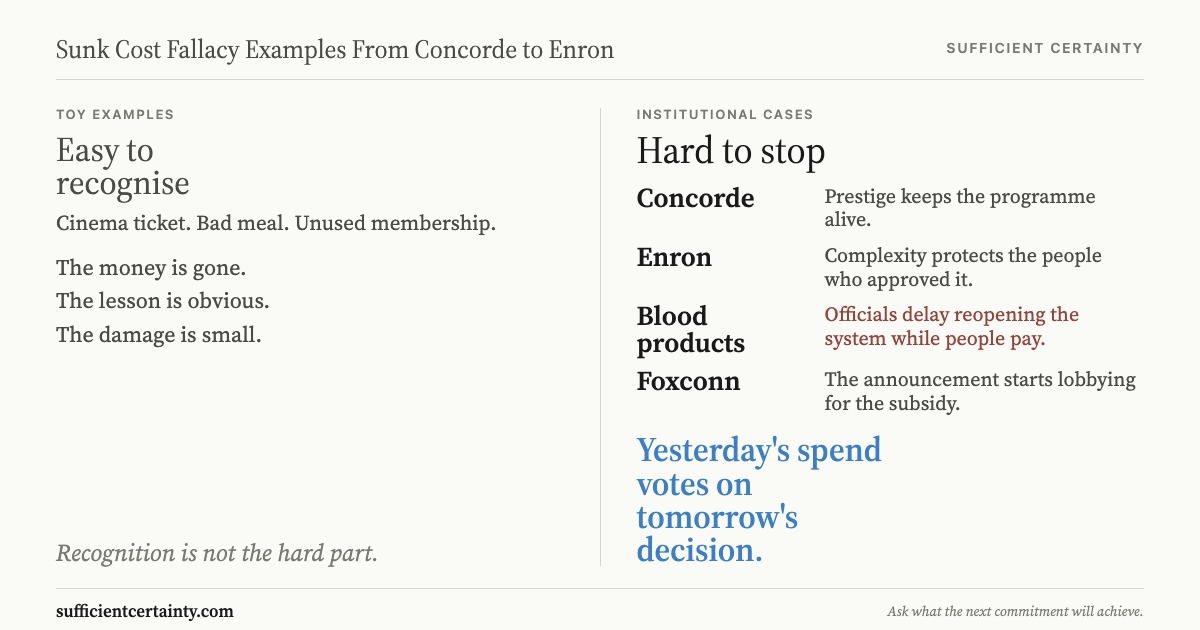
Most examples teach recognition when the real problem is deciding the next move. Anybody can say the money is gone. The hard part is deciding whether the next budget round should go in. That is where committees go soft. Sponsors protect their biography, while everyone paid by the program protects the thing that keeps them important. That is why the best examples are not consumer stories, but committee papers with beneficiaries attached.
In the Universal Decision-Making Method, I Frame the decision around Purpose, then Recognise assumptions by making continuation speak plain English about the future. "We have come too far to stop" usually means the redesign will work, or that the minister cannot bear the write-off. Once the claim is written down, the room either has a future case or it has vanity dressed as stewardship.
Awareness rarely saves a room once the paper is written to flatter the sponsor. The psychology behind sunk cost bias matters, but the damage is done when a board secretariat turns embarrassment into process and makes another approval look respectable.
Concorde is the sunk cost example everybody remembers
Concorde kept flying through politics long after the numbers had turned. By March 1969 the British Government was already saying a substantial part of the research and development cost would never be recovered, and by 1971 the joint spend was being put in Parliament at about GBP 1 billion against an original development estimate of GBP 150 million. Yet the program carried on. Hansard and the 1971 Commons debate show ministers protecting prestige while the aerospace industry protected its contracts, with the write-off left for somebody else to own.
Concorde should have lived or died on one forward claim: premium supersonic travel, or the prestige attached to it, would justify the next round of development and support. Instead, the engineering bill was made to do work it could not do.
I have seen weaker versions of the same trick in ordinary organisations. Once an expensive design exists, people begin talking as if the design has earned immunity from doubt. It has not.
Enron and the credit boom show the corporate version
At Enron, the board kept approving machinery that made executives look indispensable and made retreat harder each quarter. When the company finally unwound the LJM structures, its own special-investigation report described a USD 544 million after-tax charge and a USD 1.2 billion reduction in shareholder equity. The Senate report showed a board repeatedly approving the machinery without properly challenging it. By then the complexity was doing political work inside the company, not just accounting work.
The 2007 credit boom was the same vice at system scale. The Financial Crisis Inquiry Commission linked the collapse to more than 8 million job losses and almost USD 11 trillion in household wealth destroyed. Its full report said the system leaned on finely honed models and techniques that were divorced from reality. People like to describe that as model error. I call it a continuation racket. Banks and ratings firms had built routines around the apparatus, and the regulators around them had grown used to it, so very few wanted to say the whole thing should stop.
I unpack the boardroom version in sunk cost and decision making: when the case for continuation cannot point to a better future, it is only reputational self-defence with a budget attached.
Reframe the project you keep defending around future costs and see whether yesterday's spend still deserves a vote. Start the Walk →
The nastiest cases sit inside public systems
The blood-products scandal in the UK is uglier because the sunk-cost problem sat inside a supply setup that nobody in authority wanted to reopen. A government chronology shows a self-sufficiency policy launched in 1975 with an initial GBP 0.5 million allocation and an expectation that factor VIII self-sufficiency would arrive quickly. It did not. Imported product remained central, and the Infected Blood Inquiry later recorded around 1,250 people with bleeding disorders infected with HIV and thousands more with hepatitis C. Officials had backed the policy, and blood services and suppliers were already billing through the arrangement. Changing it would have embarrassed one group and disrupted the income of the other.
Foxconn in Wisconsin is less tragic and more familiar. Politicians sold a USD 10 billion flagship plant and 13,000 jobs, then reality kept shrinking the promise. By 2021 the deal had been reset far downward, and the 2025 WEDC update was talking about a path to 2,616 jobs and USD 1.2 billion in capital investment instead. That is not simply a bad forecast. It is what happens when a government becomes more committed to preserving the announcement than to reopening the decision. Once the press conference is done and the subsidy architecture is in place, yesterday's spectacle begins lobbying for tomorrow's budget.
These public cases matter because they expose who benefits from staying the course. Suppliers keep billing while officials avoid humiliation. Advisers then get hired to resize or rescue the program they should have pronounced dead. Nobody in that arrangement is the patient or the taxpayer.
When a sunk cost example is really a future-cost case
Some cases that people call sunk cost are really about the price of walking away now, which I cover in the sunk cost fallacy is not always a fallacy. Once stopping creates a fresh penalty or strips out a capability you still need, you are pricing a new future, not worshipping the old spend.
Roger Estall and I made the same distinction in Deciding, because rooms kept trying to smuggle comfort into the evidence column. One chair snapped, "Grant, you are making this harder than it needs to be." What he meant was that I was making him own the next decision. That is where these cases end, with somebody choosing whether to protect the organisation's Purpose or protect the people who authorised the last mistake.
How to decide whether to keep funding or pull the plug
The textbook says "ignore sunk costs." That advice is useless in any room where people have careers attached to the spend. Nobody ignores what they have spent because a lecture slide tells them to. They ignore it when someone reframes the question so sharply that the old spend stops mattering.
The reframe is simple. Stop asking "should we keep going?" and ask instead: "If this project came to us today, for the first time, at the remaining cost, with everything we now know, would we approve it?" That question strips the biography out of the room. It does not matter who championed the original case or what the minister said at the press conference. The only thing that matters is whether the next tranche buys something worth having.
I have used that question in boardrooms where the sponsor was sitting three seats away, and it changes the air immediately. Once the room is judging a fresh proposal rather than defending an old one, the politics do not vanish, but they lose their leverage. The sponsor can no longer say "we have come too far." He has to say "the remaining work will deliver this result." If he cannot say it plainly, the room has its answer.
In the Universal Decision-Making Method, this maps to two steps. First, Frame the question around the organisation's Purpose, not around the program's history. Second, surface the assumptions behind continued funding and test each one for sufficient certainty. When I do this in practice, I write each assumption on a single line: the supplier will deliver by Q3, the regulation will not change before launch, the redesign will fix the failure mode. Then the room votes on whether it has enough evidence for each one. Not opinion. Evidence.
The hard part is not the method. The hard part is what happens when the evidence says stop. Stopping a program means somebody has to own the write-off. The sponsor does not want that line on his record. The consultants do not want to lose the engagement. The middle managers who acquired headcount through the program do not want to go back to their old jobs. So the room finds reasons to defer the decision by one more quarter, which is how a live question becomes a continuation racket.
In my experience, the only thing that breaks that cycle is naming the owner. Someone in the room has to be accountable for the decision to continue, not just for the decision to start. If stopping is treated as failure, nobody will stop. If stopping is treated as a decision that someone owns and can defend, the politics shift. I once watched a chair kill a seven-figure program in twenty minutes once the question was reframed and the accountability was clear. He did not enjoy it. But he could explain it to the board the following week, because the case for continuation had been tested and had failed on its own terms.
The practical sequence is short. Reframe the question as a new approval. Write down what has to be true for the next tranche to succeed. Test whether you have sufficient certainty on each assumption. If not, name what has changed since the original approval and assign one person to own the recommendation. Then set monitoring on whatever you decide, because even a sound decision to continue can rot if the assumptions shift next quarter and nobody is watching.
None of this requires courage or character. It requires a question that makes the room answer about the future instead of defending the past.
You could defend yesterday's spend and trap tomorrow's decision in the same wreckage.
Work through your decisionNo sign-up. Just pick your decision and start.
Grant Purdy is the co-author, with Roger Estall, of Deciding (2020), and the architect of the Universal Decision-Making Method.