
The sunk cost fallacy is not a fallacy if switching costs are real and the process cannot measure them. Calling it irrational skips the harder question: does the organisation have a forward-looking test that separates dead money from live commitment? Without that test, continuing is not irrational. It is the only option the process allows.
I sat with an executive team that had spent two years moving core systems into one cloud provider. Their architects knew the interfaces, and nobody wanted to pay to unpick them. Someone tried to end the discussion with the usual slogan about sunk costs. I stopped him, because the sunk cost fallacy is not a fallacy when the past has changed what it costs to leave now.
Sufficient certainty is the point at which a Decider knows enough about the future to act. Past investment matters only when it has altered that future.
Most advice about the sunk cost fallacy gets lazy at exactly that point. Sunk cost theory names why people persist, then stops. Dead money stays dead, but it can leave behind a live constraint or an advantage the team still owns. I use the Universal Decision-Making Method here because it forces that claim into the open instead of letting people wave old invoices around like holy relics.
The sunk cost fallacy is not a fallacy when walking away carries its own price.
Why the sunk cost fallacy is not a fallacy in every case
I will put the blunt point first. Dead money does not come back. Live switching cost is not sentiment. Ryan Doody makes the point cleanly in this paper, and McAfee, Mialon and Mialon make the same point from another angle: a sunk cost stays sunk, but the future condition created by it may still matter.
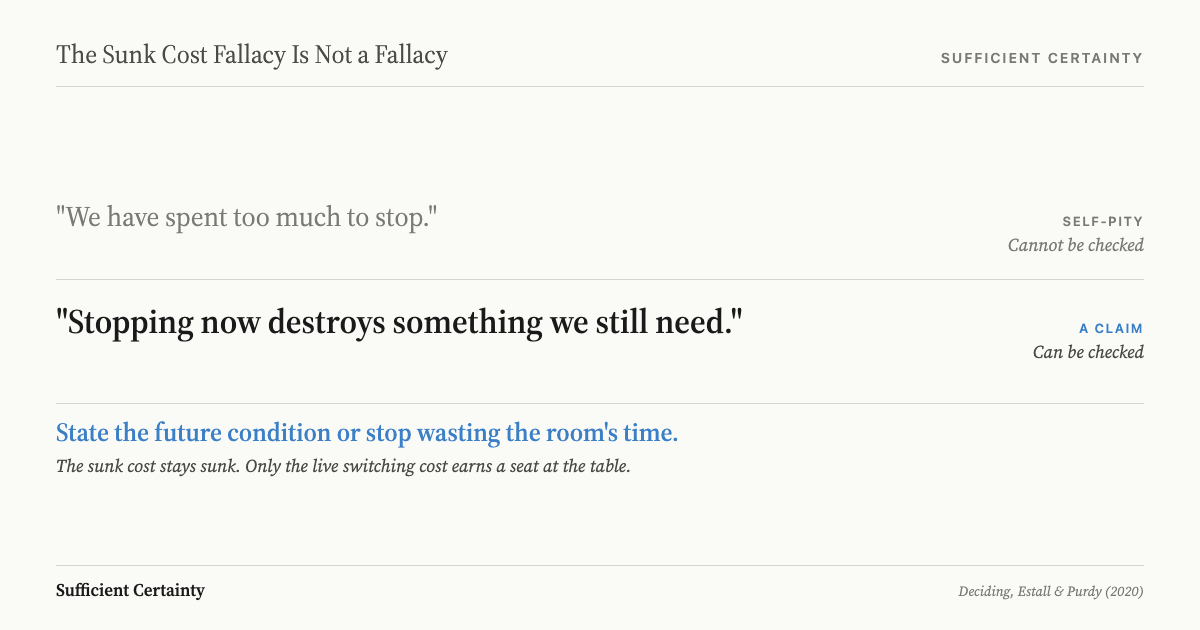
That is the whole dispute. "We have already spent too much to stop" is self-pity. "Stopping now destroys something we still need" is a claim. A claim can be checked. Self-pity cannot. That is also where sunk cost bias starts, when pain dresses itself up as evidence.
Most rooms never get that far because somebody tries to win with a slogan. Slogans are cheap. They save people from asking the only question that matters here: what did the old spending change from this point forward?
People who earn their living from sticky systems have every reason to blur that distinction. The fairy tale that exit is frictionless suits the incumbent cloud vendor and the migration partner who sold the move. Inside the firm, the platform baron with a small empire to defend is rarely offended by it either.
Work the exit you are resisting through the five steps and separate sunk history from future costs and odds. Start the Walk →
Cloud switching costs are future costs, not sentimental ones
The UK Competition and Markets Authority put numbers on this in its 2025 cloud services market decision. UK customers spent GBP10.5 billion on cloud services in 2024, yet fewer than 1 percent switched provider each year. That is not because executives became sentimental about old architecture. Leaving means paying exit charges and redesigning the workload around a new provider.
Cloud lock-in is usually built by sensible choices made one at a time. A team optimises for today's delivery pressure and plugs deeper into one provider, then calls the growing dependency efficiency. Later somebody discovers that the bill for freedom was merely deferred.
In cases like that, the sunk cost fallacy is not a fallacy because the pain still lies ahead. The implementation spend is sunk; the exit bill is live. That live exit number is exactly what a vendor renewal negotiation should test before the meeting, not inherit from an old contract line. Boards get into trouble when they blur the two and then call the mess discipline. The vendor keeps the revenue, and the implementation partner gets another round of fees selling the supposed escape.
I have watched chairs hear "ignore sunk cost" and imagine a clean break. Then somebody discovers that the data model and the reporting routines were shaped around the old platform, so the break is not clean at all. The serious question is the bill from today, not yesterday's invoice or a manager's wounded pride.
Knowledge and relationships can change the odds
I have seen teams stay with an awkward platform because, after years in it, they spot failure modes faster than any newcomer could. That can be a real future advantage if it still improves results. Cohen and Levinthal gave the academic label in their absorptive capacity paper, but the plain-English point is simple: prior knowledge can change what the team is able to do next. Treat that as a claim about future performance, not as a bedtime story about effort already spent.
This is where managers fool themselves. They say they spent years building the capability, as though the calendar were evidence. Years are not the point. The point is whether the learning still sits in the team and still lifts the odds now. If the staff have gone or the market has moved, the old spend has bought a memory and nothing more.
The same goes for suppliers. Sometimes the relationship is worth money because both sides have learned how to get work done without the usual procurement liturgy. Dyer and Singh put an academic frame around it in their paper; I just call it two firms knowing each other's moves. If that knowledge still changes future performance, it belongs in proper decision analysis under uncertainty. If it does not, sentiment has borrowed a necktie and come into the meeting.
I do not romanticise supplier relationships. Some are just cosy failures with better lunches. But some reduce delay and rework because each side already knows where the other side will stumble. That belongs in the decision if it is real. It does not belong there just because the relationship has lasted a long time.
How I tell when the sunk cost fallacy is not a fallacy
I restate the live decision without mentioning spend to date. That clears out the self-pity and the status panic. Then I ask a harder question: what future condition exists now because of the money already spent? If nobody can answer that plainly, I stop the discussion there. Roger Estall and I wrote Deciding around exactly that test.
When there is an answer, I make them say it in ordinary English. Leaving this cloud will cost us more over the next eighteen months than staying put. This team knows the supplier's machinery well enough to avoid delays a rival would suffer. In that sort of case, the sunk cost fallacy is not a fallacy because the future has been changed in a measurable way.
Then I ask what would prove the claim wrong. If the argument is about exit cost, I want a number and a date. If it is about operating capability, I want evidence that the capability still sits in the team. That is the real work in sunk cost and decision making: turn the plea into a concrete future claim, and watch whether it holds.
A chair once complained that I was slowing the room down. He was wrong. The room was wasting its own time by arguing about honouring old spend instead of pricing the future honestly. Either somebody can state the future condition and price it without romance, or the appeal to sunk cost is just an excuse.
You could call it sunk cost and trap yourself in the next expensive exit.
Work through your decisionNo sign-up. Just pick your decision and start.
Grant Purdy is the co-author, with Roger Estall, of Deciding (2020), and the architect of the Universal Decision-Making Method.