
Sunk cost fallacy investing puts the buy price in charge of the exit. The number on the screen becomes a moral claim: sell below it and the loss becomes real. A forward-looking test asks a different question. Would you buy this position today, at this price, knowing what you know now?
I once sat with a private investor whose two screens were full of red and whose legal pad held eleven buy prices ringed in blue ink. One stock was down 46 percent, another had cut guidance twice, yet every sentence came back to the same number: "If it just gets back to 70, I am out." That is sunk cost fallacy investing in its natural habitat.
Most market advice files this under investor psychology and moves on. Fine, loss aversion is real. In my experience the deeper problem is governance, because the old buy price is allowed to sit there dressed up as judgment. I see the same machinery in the wider sunk cost fallacy: brokers and advisers get what they want, and the investor gets one more month of pretending the holding is merely "early" rather than broken.
Sunk cost fallacy investing is holding or adding to an investment because of the price already paid, rather than the return still likely from here.
Why sunk cost fallacy investing survives experience
When people tell me experience cures this, I hand them Terrance Odean's study of 10,000 brokerage accounts. Investors realised gains at a 14.8 percent rate and losses at 9.8 percent. Outside December the gap widened to 15.2 percent against 9.4 percent. Worse, the winners they sold later beat the losers they kept by 3.4 percentage points over the following year. Experience did not clean up the habit, it charged them for it.
The newer data says the habit survived the age of apps and cheerful dashboards. In a large NBER study of 2,840,093 retail accounts covering about USD273 billion of assets, Patrick Luo and his co-authors still found investors realising losses at 15.2 percent and gains at 19.5 percent. That matters because sunk cost fallacy investing did not disappear when trading got faster and prettier. The reference point simply moved onto brighter screens. That is also why sunk cost bias survives awareness. People can name the trap and still hand it the steering wheel.
Why sunk cost fallacy investing gets built into the screen
Most brokerage software puts the wrong number in the middle. Cary Frydman and Antonio Rangel ran a trading experiment and found the disposition effect was 25 percent smaller when the purchase price was not displayed. That ought to embarrass every platform that makes cost basis the headline, but it will not, because cost basis keeps the user watching the scoreboard instead of judging the holding, and that kind of attachment is good for business (detachment is harder to monetise).
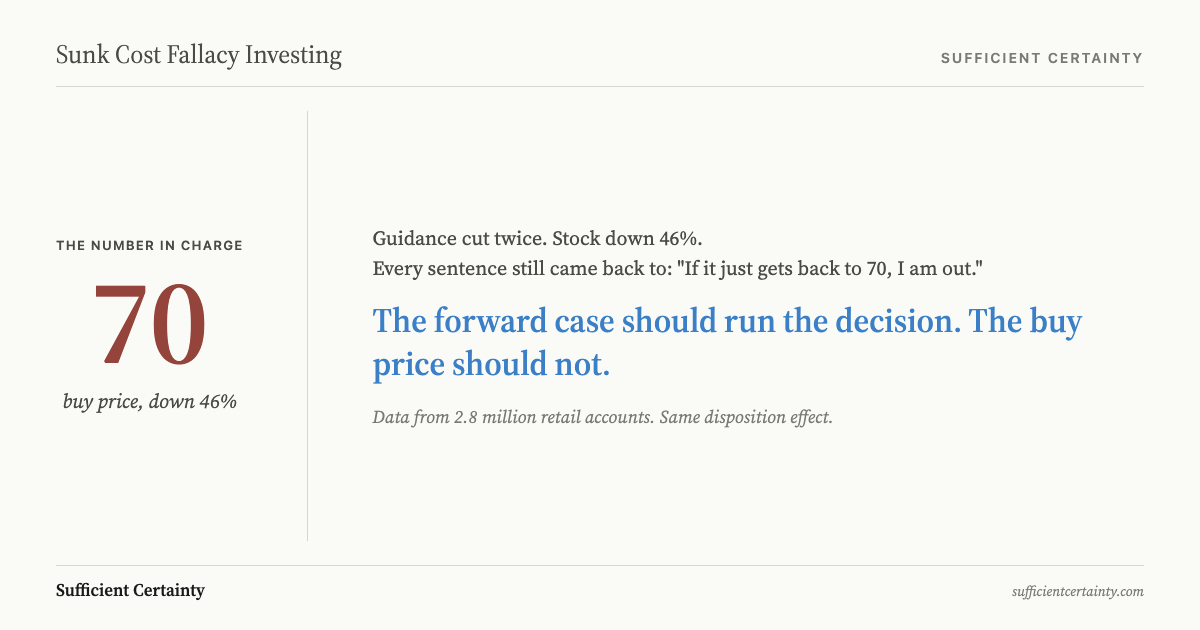
I see this constantly. A portfolio app paints one line green, another red, then plants the entry price in the middle like a gravestone with push notifications. In sunk cost fallacy investing, 70 stops being history and starts acting like the company's destiny. In sunk cost and decision making I make the same move I use here: rewrite "I paid 70" as a forecast, then ask what would have to be true for that forecast to deserve another dollar.
If the answer is vague, the position is already being run by memory. I do not let people stop at "it is a good company", because that protects pride, while a dated claim such as "margins recover when inventory clears in the second half" can actually be checked.
Put the position you keep defending through the forward-looking test and see whether the buy price is still in charge. Start the Walk →
Woodford showed what portfolio denial looks like
Professional investors do this in better tailoring and with other people's money. The FCA's 2025 decision notice on Woodford Investment Management is a miserable example. The LF Woodford Equity Income Fund peaked at just over GBP10.1 billion in May 2017 and had fallen to about GBP3.6 billion when it was suspended on 2019-06-03. Securities that could be liquidated within seven days fell from 18 percent in July 2018 to 8 percent at suspension. During the same period the fund sold about GBP2.2 billion of shares and bought about GBP0.9 billion, which made the liquidity mix worse, not better. The FCA fined WIM GBP40 million.
Read those numbers slowly and the failure is obvious. This was a regulated fund with enough process to protect the manager's reputation, and not enough honesty to protect the redeeming investor. The live question should have been dull and fatal: do the liquidity and redemption assumptions still hold from here? Instead the old reason for staying got professional ceremony, while advisers billed through the fog and investors were asked for patience as the exit door narrowed.
What I want written before a position gets another dollar
Before a position gets another dollar, I want a written answer to one boring question: what job is this holding doing in the portfolio now? When I use the Universal Decision-Making Method, I start with Purpose inside Frame the decision. An income position and a hedge do different jobs. A stock that no longer does its job does not earn another quarter simply because selling it would make the first mistake visible.
Then I move to Recognise assumptions. "It will come back" is shorthand for an untested forecast about revenue or refinancing. I want the sentence rewritten in plain English, with a date if the date matters. Revenue recovers after the next product cycle. Refinancing lands before the cash squeeze bites. That is the level at which Sufficient certainty becomes possible, because now we can judge a live claim instead of admiring our own stamina.
Berkshire made the point in May 2024 when it exited Paramount at a loss after building a stake worth roughly USD2.6 billion in 2022. In this CNBC interview clip, Warren Buffett said Berkshire had lost quite a bit of money. The loss was real, but sunk money gets no vote: it told Berkshire nothing about whether Paramount deserved another dollar.
Sometimes selling does create a real future cost, perhaps tax leakage or the loss of a hedge you cannot replace cheaply. Price that honestly. I made that broader point in the sunk cost fallacy is not always a fallacy. What I will not do, and what I do not think any investor should do, is let the old buy price stand in for current judgment.
Roger Estall and I used a plain rule: write the reason for staying, then name the fact that would kill it before the next meeting. In my experience, once that is on paper, sunk cost fallacy investing loses most of its swagger. What gets sold as temperament is usually clerical cowardice with a ticker symbol.
You could check the old buy price again and keep letting it drive your next trade.
Work through your decisionNo sign-up. Just pick your decision and start.
Grant Purdy is the co-author, with Roger Estall, of Deciding (2020), and the architect of the Universal Decision-Making Method.